Contents: Removal ↳ Installation ↳
Note: Read the entire procedure, especially the instructions regarding lifting equipment. Depending on your means, you may want to remove the powerhead first, then use a workbench to separate the engine from the transmission (Chapter 2).
Removal
1. Disconnect the negative battery cable (chapter 5 paragraph 1). For better access, the battery can be removed.
2. If necessary, remove the hood to improve access and install a lifting device (Chapter 11).
3. Raise the radiator and secure it in the raised position by inserting cotter pins into the holes in the upper support pins. This is necessary to hold the radiator when removing the subframe.
4. Remove the air flow meter and intake air duct (chapter 4).
5. Remove the air cleaner assembly (chapter 4).
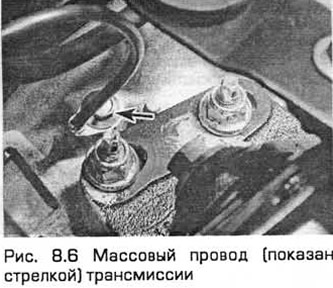
6. Disconnect the ground wire from the transmission (see Fig. 8.6).
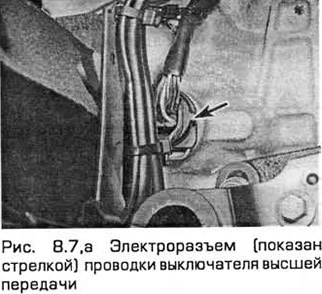
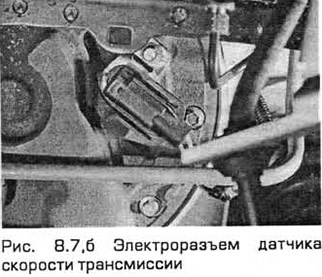
7. Disconnect the electrical connectors of the high gear switch, control unit and transmission speed sensor wiring (see Fig. 8.7,a,b).
8. Disconnect the selector cable end from the lever on the transmission. Unscrew the bolt and remove the bracket.
9. Apply the parking brake, lift the front end and place it on supports. Remove the front wheels.
10. Remove the wheel arch liner from the right side of the vehicle (Chapter 11).
11. Remove the accessory drive cover (chapter 1).
12. Disconnect the anti-roll bar connecting link from the suspension strut. To do this, working alternately on each side of the car, unscrew the nut of each even. Note that the brake hose bracket is attached to the connecting link stud.
13. Remove the cotter pins and then the nuts securing the end of each tie rod to the steering knuckle. Release the ball joints from the steering knuckle arms using a ball joint puller.
14. Working alternately from each side of the car and taking into account which side the front lower arm ball joint clamp bolt is inserted, unscrew the bolt. Remove it from the knuckle. Press the ball joint away from the steering knuckle. If this is difficult to do, press the joint apart with a power screwdriver or a crowbar. Do not damage the ball joint seal.
15. Remove the front lower cover from the bottom of the radiator. To do this, release it from the clips and unscrew the mounting bolts.
16. Drain the cooling system (chapter 1).
17. Disconnect the oxygen sensor wiring harness electrical connector. Then unclip the wiring harness from the rear engine mount.
18. Disconnect the vacuum hose from the fuel afterburning system filter.
19. Remove the entire exhaust system (chapter 4).
20. On models with air conditioning, remove the bolts securing the evaporator to the subframe and tie the evaporator down.
21. Remove the steering gear mounting bolts from the subframe. It is difficult to reach them with a regular wrench. It is advisable to use a Ford elbow adapter (Chapter 10).
22. Remove the bolts of the rear support of the power unit from the subframe.
23. Remove the central bolt from the front engine mount. Disconnect the fuel afterburning filter from the bracket located on the mount.
24. Remove the radiator bracket bolts from the subframe.
25. With the help of an assistant, support the subframe and remove the bolts securing the hydraulic steering system radiator pipes to the subframe. Then remove the subframe bolts and lower it to the ground.
26. Remove the center bolt from the rear powertrain mount. Then remove the mount bolts from the transmission.
27. Loosen the transmission cooler line fastening nut on its left side. Unfasten the line and move it to the side. Plug the end of the line to prevent dirt or dust from getting in.
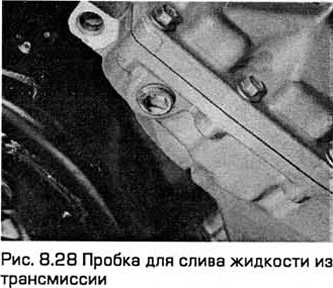
28. Place a container under the transmission. Then unscrew the drain plug (see Fig. 8.28). Finally, install and tighten the plug.
29. Insert a pry bar between the left drive shaft inner joint and the transmission housing (using a thin piece of wood between the housing and the pry bar). Then pry the joint away from the differential. If necessary, tap the pry bar with the palm of your hand. Be careful not to damage adjacent components, and be prepared to clean up any oil leaks.
30. Support the left drive shaft so that the inner joint does not rotate more than 18° (otherwise it may be damaged).
31. Remove the bolts securing the right input shaft center bearing to the cylinder block. Remove the heat-insulating casing. Then pull the right strut so that the intermediate shaft comes out of the transmission differential. Be prepared to eliminate oil leaks.
32. Support the right drive shaft so that the inner joint does not rotate more than 18° (otherwise it may be damaged).
33. Loosen the transmission cooler line nut at the front of the transmission cooler. Disconnect the line and plug the end to prevent dirt or dust from getting in.
34. Remove the bolts and cover from the bottom of the transmission to access the torque converter mounting bolts (see Fig. 8.34).
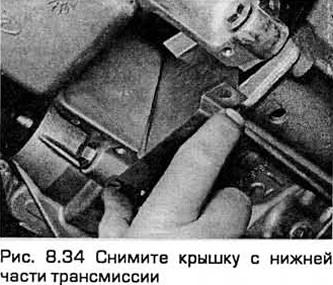
35. Remove the torque converter mounting bolts. To gain access to the bolts one at a time, rotate the engine by the crankshaft pulley bolt.
36. If necessary, the vehicle can be lowered to the ground at this point to attach the hoist to the engine. If the engine is supported on a rod resting on the engine compartment, the vehicle can remain in the raised position.
37. Attach the hoist by securing the clamp to the diagonally located engine lifting eyes and lift the power unit out.
38. Disconnect the electrical wiring connectors on the thermostat housing.
39. Disconnect the radiator hoses from the thermostat housing.
40. Unscrew the bolts and remove the thermostat housing.
41. Remove the upper transmission-to-engine mounting bolts.
42. Unscrew the nuts of the right engine support bracket. Note that if this support is hydraulic (chapter 2A paragraph 22), then it should not deviate from the vertical by more than 5°.
43. Loosen the nuts and remove the left support of the power unit from the transmission.
44. On models with air conditioning, lower the engine until the compressor is below the right crossmember.
45. On models without air conditioning, lower the transmission until it is against the opening located on the left side of the engine compartment.
46. Support the transmission with a jack. Secure it to the jack with chains or a suitable support.
47. Remove the starter bolts.
48. Remove the lower transmission-to-engine mounting bolts.
49. With the help of an assistant, separate the transmission from the engine, being careful not to tilt it and so that the clutch friction disc does not bear the weight of the transmission. After removing the transmission, remove the lower cover installed between the transmission and the engine (see Fig. 8.49).
50. Lower the transmission to the ground.
Installation
51. Clean the mating surfaces of the faceplate and torque converter.
52. The torque converter must fit completely into the transmission. Check this with a ruler installed on the transmission flange. The distance from the transmission flange to the end of the torque converter shaft must be at least 10 mm (see Fig. 8.52).
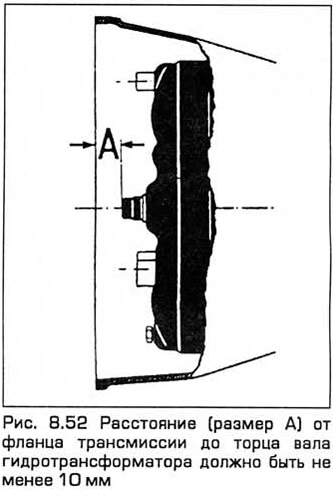
Caution: This is necessary to mechanically connect the torque converter to the pump. Incorrect connection will cause serious damage!
53. Raise the transmission, secured to the jack, to the operating position, and then carefully mate it with the rear of the faceplate. The torque converter must maintain its position.
54. Insert the transmission-to-engine mounting bolts and tighten them.
55. Insert and tighten the starter bolts.
56. Remove the jack.
57. Install the left and right power unit supports and lightly tighten their nuts.
58. Install the thermostat housing and tighten its bolts.
59. Connect the radiator hoses to the thermostat housing.
60. Connect the two wiring connectors on the thermostat housing.
61. Insert all torque converter bolts and tighten them to the specified torque while turning the engine.
62. Install the cover onto the lower part of the transmission and tighten its bolts.
63. Install the transmission cooler pipe to the front of the transmission and tighten the fitting nut.
64. Install the right drive shaft and intermediate shaft together with the heat-insulating casing (Chapter 8).
65. Install the left drive shaft (Chapter 8).
66. Install the transmission cooler pipe on the left side of the transmission and tighten the union nut. Secure the pipe with clamps.
67. Install the rear power unit support onto the transmission without tightening the center bolt.
68. Install and adjust the subframe (chapter 2B paragraph 4). Tighten the bolts to the specified torque.
69. Install the power steering radiator pipes to the subframe and tighten the bolts.
70. Install the radiator bracket onto the subframe and tighten the bolts.
71. Install the center bolt into the front engine mount, hand tightening it.
72. Install the fuel afterburning system filter.
73. Install the rear support of the power unit on the subframe and tighten the bolts.
74. Disconnect the lifting mechanism from the engine.
75. Install the engine mount bolts and tighten them (chapter 2A, paragraph 22).
76. Install the steering gear on the subframe and tighten the bolts.
77. On models with air conditioning, install the evaporator onto the subframe and tighten the bolts.
78. Install the exhaust system (chapter 4).
79. Connect the vacuum hose to the fuel afterburning system filter.
80. Connect the oxygen sensor wiring and secure it to the rear engine mount.
81. Install the bottom cover under the radiator.
82. Install the ball joint of each front lower control arm to the steering knuckle and tighten the clamp bolt (Chapter 10).
83. Install each tie rod end to the steering knuckle (Chapter 10).
84. Install the anti-roll bar connecting links to the suspension struts and tighten the nuts.
85. Install the accessory drive cover and the right wheel arch poker.
86. Install the front wheels and lower the car to the ground. Tighten the wheel nuts.
87. Install the cable and selector bracket and tighten the bolts.
88. Connect the high gear switch electrical connector.
89. Connect the ground wire to the transmission and tighten the bolt.
90. Install the air cleaner assembly.
91. Install the air flow meter and intake air duct (chapter 4).
92. Remove the cotter pins securing the radiator.
93. Install the hood if it was removed.
94. Install the battery if it was removed and connect its cables.
95. Adjust the selector cable (paragraph 3).
96. Adjust the selector lever position sensor (paragraph 6).
97. Fill the transmission and check the fluid level (chapter 1).
98. Fill the cooling system (chapter 1).
99. After the engine has run for a while, check the fluid level again and top up the transmission if necessary (chapter 1).
100. Test the vehicle on a road trip, monitoring the operation of the transmission.
Information for this article was taken from the website: FORDBOOK