General information
1. The engine electrical systems include all ignition, battery charging and engine starting components. Since their operation is related to engine operation, these components are presented separately in this chapter. And such electrical devices of the body equipment as lighting devices, control devices, etc. are presented in Chapter 12.
Precautionary measures
2. When working on an electrical system, always observe the following precautions:
- a) Be extremely careful when servicing the electrical components of the engine. They can be easily damaged if not properly controlled, connected or handled.
- b) Never leave the ignition on for a long time if the engine is not turning.
- c) Do not disconnect the battery cables while the engine is running.
- d) Observe the polarity when connecting the cable from the battery of another vehicle in case of jump starting (see "Starting from auxiliary source").
- d) Always disconnect the negative wire first and connect it last. Otherwise, the battery can be short-circuited by the tool when releasing the wire clamps (see Fig. 1.2). Before starting work, it makes sense to read the information "Safety First".
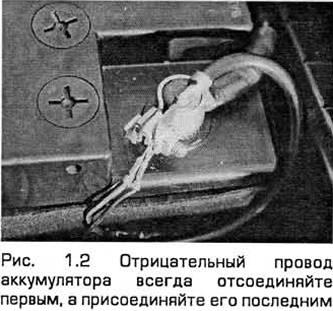
Disconnecting the battery
3. Some vehicle systems require a constant power supply due to continuous operation (such as a clock) or to store electronic memory parameters (such as the ECU engine management system), which are erased if the battery is disconnected. Therefore, whenever you need to disconnect the battery, first of all, consider the following instructions:
- a) On vehicles with a central locking system, you should always remove the key from the ignition and carry it with you so that it does not remain in the vehicle locked by this system in the event that the system is accidentally activated while connecting the battery!
- b) The ECU loses the information stored in its memory when the battery is disconnected. This applies to idle speed and other operating parameters, as well as to detected fault codes. If fault codes appear indicating a system malfunction, the car should be taken to dealers for fault finding on special diagnostic equipment (Chapter 6). In any case, when the battery is disconnected, the parameters related to idle speed control, as well as other operating parameters, must be re-entered into the electronic memory of the control unit. The ECU enters such parameters automatically, but until they are entered, the engine may starve, intermittently or run erratically at idle, or not reach its programmed characteristics. To enter these parameters into the ECU in the learning mode, start the engine and bring it to an operating mode with a speed that is minimally different from idle speed. Keep it in this mode until it warms up to normal operating temperature, and then let it run at 1200 rpm for about two minutes. After that, you should drive the distance you require. When you have driven about eight kilometers using the different driving modes, the learning process is complete.
- c) If the battery is disconnected while the hazard warning system is on or activated, the hazard warning system will remain in the same mode it had when the battery was disconnected. The same applies to the engine immobilizer (if any).
- d) If there is an on-board computer, all information stored in the memory will be lost.
- d) If the vehicle is equipped with an audio unit with a special code, then if the unit and/or battery are disconnected, the unit will cease to function after it is reconnected until the appropriate code is entered. Detailed information on this, depending on the unit and year of manufacture, is provided in the Ford Audio Systems Manual, which is supplied with the new vehicle, and the code itself is recorded in the radio registration document and/or code label. Before disconnecting the battery, make sure that you have the necessary code. For safety reasons, this procedure is not described in this manual. If you do not have the code or the procedure, but you can prove your ownership and have a legitimate reason for obtaining this information, contact your dealers who can help you.
4. To eliminate the above-described problems, devices with the "memory saving" (or "code saving") function are used. They have some differences. But usually, such a device is inserted into the cigarette lighter socket and connected with its wires to a spare battery. After that, the car battery can be disconnected from the electrical system. In this case, the "memory saving" device supplies power to the audio unit (for saving the code) and the ECU memory, as well as constant power supply circuits, such as those used in watches. In this case, the battery (spare) is protected from the influence of a possible short circuit during work.
Warning: Some of these devices allow a mode in which many of the vehicle's systems will remain powered and operational after the battery has been disconnected. If you use a "memory saver" device, make sure that the circuit you are servicing is actually de-energized!