Contents: Characteristics of the telematics… ↳ Microphone ↳ Antenna ↳ Telematics system control module ↳ Operating principle ↳
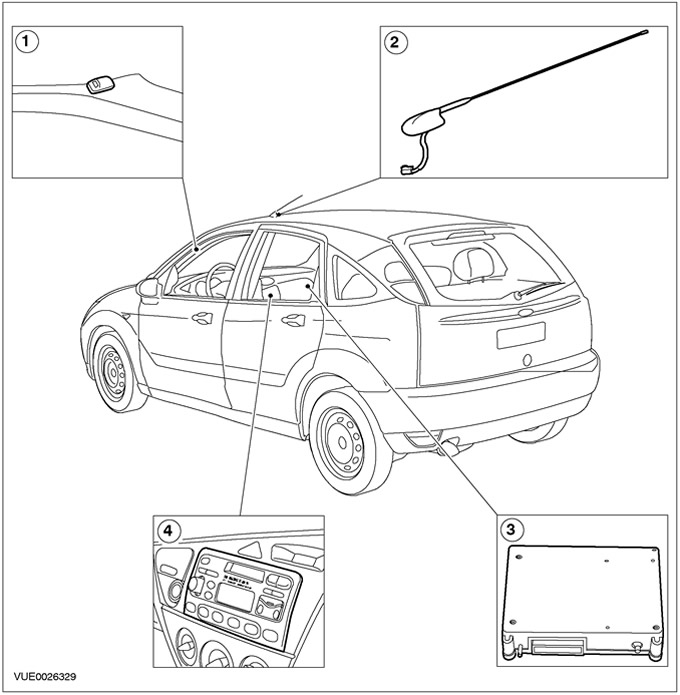
| Pos. | Spare Part No | Name |
| 1 | - | Microphone |
| 2 | - | Antenna |
| 3 | - | Telematics system control module |
| 4 | - | Audio unit compatible with telematics system |
Characteristics of the telematics system
The telematics system allows the user to select the following functions:
- Emergency calls
- Emergency Roadside Assistance Service
- Vehicle location using GPS system
- Voice communication
- Route information
- Road information
- Booking services (hotel reservations, theatre tickets, repair shops, car rentals, car parking, airline tickets, restaurant reservations, test drives of new Ford cars, florist services and train tickets).
For more information, please refer to the "Operating Manual".
The audio unit, compatible with the telematics system, is available in two versions:
- 5000 Radio/cassette player with Radio Data System (RDS)
- 6000 radio/CD player with RDS
Microphone
The microphone is located on the driver's side A-pillar trim panel. The microphone is held in place on the trim panel by a clip that must be positioned correctly.
Antenna
The antenna also consists of AM/FM, GPS and Global System for Mobile Communications (GSM) antennas. The GPS and GSM antennas are connected to the telematics control module via ultra-thin wires that can be replaced individually.
Telematics system control module
The telematics control module is located behind the glove compartment and is secured with two screws that also support the glove compartment locking plate.
The control module of the telematics system consists of the following elements:
- Subscriber Identity Module (SIM) card
- GSM module
- GPS receiver
- Telematics processor
Operating principle
Global Positioning System (GPS) Antenna
NOTE: When the vehicle battery is disconnected, the GPS satellite information stored in the telematics control module will be lost. The telematics control module must relearn this information before it can accurately determine the vehicle's location. This operation can be accomplished by leaving the audio unit on for at least 20 minutes.
NOTE: When entering the Self-Diagnostic Mode, do not press button 2 on the audio unit, as this will connect the system to the emergency operator.
To determine the exact location of the vehicle, the GPS antenna must be able to receive information from at least three GPS satellites. If the GPS antenna receives more than three GPS satellite signals, only the three strongest signals will be used to calculate the location of the vehicle.
If the GPS antenna only receives signals from one or two GPS satellites, it will not be able to accurately determine the vehicle's location. If this happens, make sure the vehicle is outside the workshop and there are no large buildings/structures or metal objects in the immediate vicinity.
You can view the current number of received GPS satellites by entering Self-Diagnosis Mode. The number of received GPS satellites is displayed when SYS OK.