The rear towing eye is located on the left side under the rear bumper.
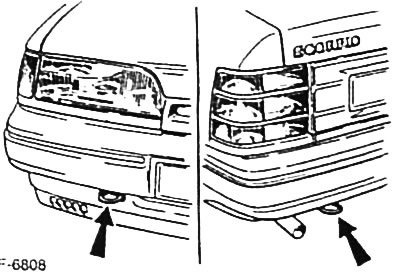
Towing rules
Turn on the ignition to unlock the steering wheel and to enable the turn signal lights, brake light, horn and windscreen wipers to function.
Shift the gearbox to neutral, and in a vehicle with an automatic transmission, move the mode selection lever to position N.
Turn on the hazard warning lights of the towing and towed vehicles.
Since the brake booster only works when the engine is running, on cars with the engine not running, the brake pedal must be pressed harder!
On cars with hydraulic power steering, when the engine is not running, more effort is also required to turn the steering wheel, since the power steering does not work.
Tow the vehicle forward only (in the direction of travel).
The towing rope or towing bar must be installed so that the towing eyes are not loaded by lateral forces.
The towing rope must be elastic, so as to have a gentle effect on both the towing and towed vehicles. Use only a rope made of synthetic material or with an elastic intermediate link. It is safer to use a towing rod.
Features of towing a car with an automatic transmission
Maximum towing speed: 50 km/h!
Maximum towing distance: 50 km!
For longer towing distances, the rear wheels of the vehicle must be raised.
If there is no oil in the gearbox, the vehicle can only be towed with the drive wheels raised.
When using a towing vehicle, the vehicle must be towed only in reverse (with the rear wheels raised). If the vehicle is raised only at the front, the rear wheels must be mounted on a wheel dolly.
For all-wheel drive vehicles, when towing over longer distances, it is recommended to transport them using special tow trucks.
The text of the article was copied from the website: FORDBOOK