


Rise
Using a portable jack, for which there are two installation points on each side of the vehicle.
Using a garage mobile jack. The jack installation points are shown in Fig. 1.2.
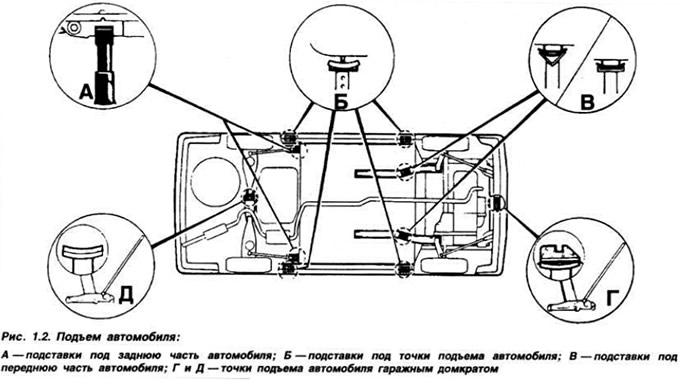
When lifting a car with a mobile garage jack, install the jack at the points provided for it, as perpendicular to the car body as possible.
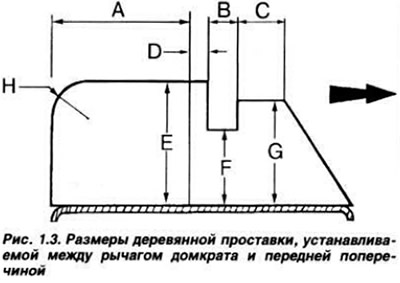
In case of using side points to lift the vehicle, in order to avoid damage to the paint and body, it is necessary to use stands with square heads having soft pads, or additionally install wooden pads, the shape and dimensions of which are given in Fig. 1.3. It is recommended to use "tripod" type stands, installing them so that one of the legs is directed towards the side.
When installing stands at the rear of the vehicle at a point in front of the rear suspension arm, eliminate the possibility of the stand coming into contact with the arm.
Start installing the car on stands from the rear. When using a garage lift, install its daddies in the designated points of the car body, using wooden spacers to avoid damaging the paint or the body itself.
Towing
The front and rear parts of the vehicle are equipped with one towing unit (eye) (Fig. 1.4), which allows the vehicle to be towed for short distances using a flexible coupling. A chain, steel cable or rope can be used as a flexible coupling. Towing a vehicle on a flexible coupling is permitted for a distance of no more than 100 km at a speed of no more than 50 km/h on roads with a hard surface.
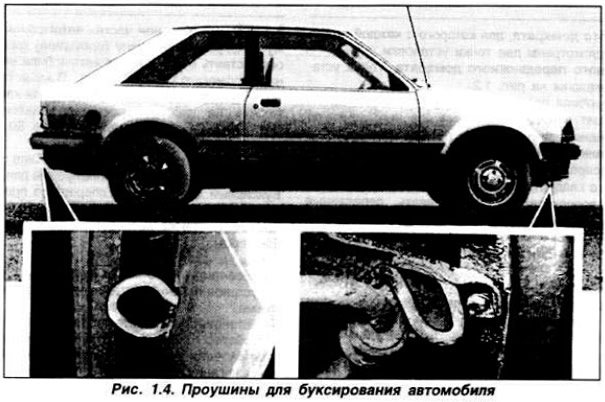
Moving a faulty vehicle over long distances should be done on a platform for transporting cars. The towing cable is attached at the front to the eye located in the lower right part of the body under the bumper, and at the rear - to the eye, also located in the lower right part under the bumper.
Before towing:
- check the steering and brakes for proper operation;
- set the gear shift lever to neutral;
- set the ignition key to position II (the anti-theft device is deactivated, the steering, horn, brake light and direction indicators work, the ignition indicator light is on).
WARNING: When the engine is stopped, the brake booster does not operate, so more force is required on the service brake pedal and a longer braking distance is required to stop the vehicle.
While driving, it is necessary to monitor the tension of the flexible coupling and keep it taut, slightly braking the car when necessary.
When operating a vehicle with a trailer, do not exceed the maximum permitted towing weight and do not subject the rear axle and towing hitch to excessive loads (see Table 1.2).
(Content was created using data from this website fordbook)