Diesel engines (since 1992) of the car Ford Escort 5

Fuel pump adjustment
Checking the idle speed and fast idle speed With the engine warmed up to normal operating temperature, check that the thermal probe cable on the fuel pump side has a gap...
Checking the idle speed and fast idle speed With the engine warmed up to normal operating temperature, check that the thermal probe cable on the fuel pump side has a gap...

Adjusting the idle speed
Install a 4 mm thick plate between the acceleration lever on the fuel pump and the minimum portion adjustment bolt (arrow in Fig. 2E.44). Turn the "STOP" lever clockwise...
Install a 4 mm thick plate between the acceleration lever on the fuel pump and the minimum portion adjustment bolt (arrow in Fig. 2E.44). Turn the "STOP" lever clockwise...

Fuel pump
Removal Disconnect the ground cable from the battery and protect the battery from being flooded with fuel. Remove the alternator drive belt. Remove the air conditioning...
Removal Disconnect the ground cable from the battery and protect the battery from being flooded with fuel. Remove the alternator drive belt. Remove the air conditioning...

Turbocharger
Removal Disconnect the ground cable from the battery. Raise the vehicle and remove the three nuts securing the exhaust manifold to the turbocharger flange. Disconnect...
Removal Disconnect the ground cable from the battery. Raise the vehicle and remove the three nuts securing the exhaust manifold to the turbocharger flange. Disconnect...

FORD EDC Electronic Engine Control Unit
Electronic control device An electronic control unit located in the engine compartment above the right front wheel (near the coolant expansion tank) controls the exhaust...
Electronic control device An electronic control unit located in the engine compartment above the right front wheel (near the coolant expansion tank) controls the exhaust...

Exhaust system
The exhaust system of some versions of Escort vehicles equipped with diesel engines uses an exhaust gas catalytic converter. The exhaust systems of these versions are...
The exhaust system of some versions of Escort vehicles equipped with diesel engines uses an exhaust gas catalytic converter. The exhaust systems of these versions are...

Fuel heater
Removal Disconnect the ground cable from the battery. Disconnect the fuel heater electrical connector. Disconnect the fuel supply and return lines. Unscrew the two bolts...
Removal Disconnect the ground cable from the battery. Disconnect the fuel heater electrical connector. Disconnect the fuel supply and return lines. Unscrew the two bolts...
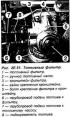
Fuel filter
Removal Disconnect the ground cable from the battery. Place a container under the filter to collect any leaking fuel. Hold the fuel filter and unscrew the bolt (5. Fig....
Removal Disconnect the ground cable from the battery. Place a container under the filter to collect any leaking fuel. Hold the fuel filter and unscrew the bolt (5. Fig....
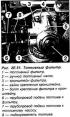
Removing air from the fuel system
Air should always be removed from the fuel system after operations related to its opening (disconnecting fuel lines, unscrewing the fuel filter, etc.), as well as in the...
Air should always be removed from the fuel system after operations related to its opening (disconnecting fuel lines, unscrewing the fuel filter, etc.), as well as in the...
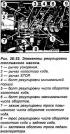
Adjusting the fuel pump cable
Adjusting the accelerator lever cable Press the accelerator pedal all the way down and check whether the acceleration lever (1, Fig. 2E.52) of the fuel pump is in the...
Adjusting the accelerator lever cable Press the accelerator pedal all the way down and check whether the acceleration lever (1, Fig. 2E.52) of the fuel pump is in the...
Design and operation of electronic engine control FORD EDC
Ford's Electronic Engine Control (EDC) regulates the engine's injection advance angle under different operating conditions and also controls exhaust gas recirculation to...
Ford's Electronic Engine Control (EDC) regulates the engine's injection advance angle under different operating conditions and also controls exhaust gas recirculation to...

Electrical power supply of electronic engine control FORD EDC
The main power supply to the electronic control circuit is protected by a fuse (fuse #27 - 15 A up to model 1994, fuse #16 - 20 A from model 1995) located in the fuse...
The main power supply to the electronic control circuit is protected by a fuse (fuse #27 - 15 A up to model 1994, fuse #16 - 20 A from model 1995) located in the fuse...
Sensors
In the engine control circuit, there are two types of sensors, active and passive, which differ in their operating principle. Active sensors do not require external...
In the engine control circuit, there are two types of sensors, active and passive, which differ in their operating principle. Active sensors do not require external...
Executive devices
Electromagnetic vacuum valve Opening this valve, controlled by an electronic control unit, allows the vacuum servomotor to connect to the vacuum pump. The diaphragm...
Electromagnetic vacuum valve Opening this valve, controlled by an electronic control unit, allows the vacuum servomotor to connect to the vacuum pump. The diaphragm...
Turbocharger — removal and installation
Removal Disconnect the ground cable from the battery. Disconnect the air supply line between the air cleaner and the turbocharger. Remove the fuel filter bracket...
Removal Disconnect the ground cable from the battery. Disconnect the air supply line between the air cleaner and the turbocharger. Remove the fuel filter bracket...
Air radiator
Removal Disconnect the ground cable from the battery. Unscrew the clamp and remove the air duct between the intake manifold and the air radiator. Unscrew the clamps and...
Removal Disconnect the ground cable from the battery. Unscrew the clamp and remove the air duct between the intake manifold and the air radiator. Unscrew the clamps and...
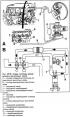
Exhaust gas recirculation system
The exhaust gas recirculation system reduces the emission of very toxic nitrogen oxides. The supply of part of the exhaust gases together with air into the engine...
The exhaust gas recirculation system reduces the emission of very toxic nitrogen oxides. The supply of part of the exhaust gases together with air into the engine...
Exhaust gas recirculation valve
Removal Disconnect the ground cable from the battery. Disconnect the vacuum line from the EGR valve. Remove the bolts securing the exhaust gas recirculation valve to the...
Removal Disconnect the ground cable from the battery. Disconnect the vacuum line from the EGR valve. Remove the bolts securing the exhaust gas recirculation valve to the...
Bosch fuel pump vacuum control valve for 1.8 D engine
Removal Disconnect the ground cable from the battery. Disconnect the two vacuum lines from the vacuum control valve and mark which one is the inlet line (engine side)...
Removal Disconnect the ground cable from the battery. Disconnect the two vacuum lines from the vacuum control valve and mark which one is the inlet line (engine side)...
This section is available on russian, bulgarian, belarusian, ukrainian, serbian, croatian, romanian, polish, slovak, hungarian
See other similar sections for Ford cars:
• Power unit: Fuel injection (diesel) Ford Focus Turnier 1 (1998-2004)
• Power unit: Fuel injection (diesel) Ford Mondeo 1 (1993-1996)
• Power unit: Diesel engines Ford Scorpio 1 (1985-1994)
• Power unit: Fuel injection (diesel) Ford Focus Turnier 1 (1998-2004)
• Power unit: Fuel injection (diesel) Ford Mondeo 1 (1993-1996)
• Power unit: Diesel engines Ford Scorpio 1 (1985-1994)
Escort 5
Escort 4
Escort 3
- General information
- User manual
- Maintenance
- Engine
- HCS and Endura-E engines
- CVH and PTE engines
- Zetec and Zetec-E engines
- Gasoline engines
- Diesel engines
- Diesel engines (since 1992)
- Cooling and heating
- Carburetors
- CFI fuel injection
- EFI fuel injection
- SEFI fuel injection
- Exhaust system
- Charging and starting system
- Ignition system
- Transmission
- Clutch
- Mechanical gearbox
- Automatic gearbox
- Drive shafts
- Chassis
- Brake system
- Car suspension
- Steering
- Body
- Electrical equipment
- Light and appliances
- Schematic diagrams
Escort 4
- General information
- User manual
- Maintenance
- Gasoline engines
- OHV engine repair
- CVH engine repair
- Fuel system
- Weber 2V carburetor
- KE-Jetronic injection system
- CFI injection system
- Ignition system
- Diesel engines
- Engine repair
- Fuel system
- High pressure pump
- Cooling and lubrication system
- Transmission
- Clutch
- Mechanical gearbox
- Automatic gearbox
- Drive shafts
- Chassis
- Suspension and wheels
- Steering
- Brake system
- Body
- Body elements
- Doors, locks and windows
- Electrical equipment
- Equipment and devices
- Lighting system
- Electrical circuits
Escort 3
- General information
- Maintenance
- Characteristics
- Engine
- Disassembly and assembly
- Cooling system
- Lubrication system
- Supply system
- Fuel injection «K-Jetronic»
- Transmission
- Clutch
- Mechanical gearbox
- Hydromechanical box
- Drive shafts
- Chassis
- Front suspension
- Rear suspension
- Steering
- Brake system
- Electrical equipment
- Starting and charging system
- Ignition system
- Ignition «Escort RS 1600»
- Light and appliances
- Schematic diagrams