Vehicle cooling and heating system Ford Escort 5

Technical specifications
Coolant capacity HSC and Endura-E engines with a working volume of 1.3 dm³ - 7.1 dm³ CVH engines with a working volume of 1.4 dm³ - 7.6 dm³ CVH engines with a working...
Coolant capacity HSC and Endura-E engines with a working volume of 1.3 dm³ - 7.1 dm³ CVH engines with a working volume of 1.4 dm³ - 7.6 dm³ CVH engines with a working...
General information
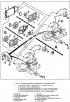
Engine cooling system The sealed cooling system includes a pump, an aluminum radiator, an expansion tank, an electric radiator fan, and a thermostat. When a cold engine...
Engine cooling system The sealed cooling system includes a pump, an aluminum radiator, an expansion tank, an electric radiator fan, and a thermostat. When a cold engine...
Antifreeze
Antifreeze is a mixture of distilled water and ethylene glycol concentrate. Antifreeze protects the cooling system from corrosion and increases the boiling point of the...
Antifreeze is a mixture of distilled water and ethylene glycol concentrate. Antifreeze protects the cooling system from corrosion and increases the boiling point of the...
Cooling system hoses
Check the condition of the cooling system hoses and if a defect is found, replace the hose as follows. Drain the coolant from the cooling system. Remove the hose clamps...
Check the condition of the cooling system hoses and if a defect is found, replace the hose as follows. Drain the coolant from the cooling system. Remove the hose clamps...

Thermostat
Removal Remove the negative terminal from the battery. Drain the coolant from the cooling system. Engines and HCS, Endura-E, CVH and PTE Loosen the clamps and remove the...
Removal Remove the negative terminal from the battery. Drain the coolant from the cooling system. Engines and HCS, Endura-E, CVH and PTE Loosen the clamps and remove the...

Radiator fan
Examination If the radiator fan does not work when the coolant temperature is high, check the condition of the fuses and the operation of the relay. Remove the connector...
Examination If the radiator fan does not work when the coolant temperature is high, check the condition of the fuses and the operation of the relay. Remove the connector...
Electrical sensors of the cooling system
Coolant temperature gauge Examination If the coolant temperature gauge does not work, check the condition of the fuses. If the coolant temperature gauge indicates engine...
Coolant temperature gauge Examination If the coolant temperature gauge does not work, check the condition of the fuses. If the coolant temperature gauge indicates engine...

Radiator and expansion tank
Radiator Removal Remove the negative terminal from the battery. On carburetor engines, remove the air intake manifold. Drain the coolant from the cooling system. Remove...
Radiator Removal Remove the negative terminal from the battery. On carburetor engines, remove the air intake manifold. Drain the coolant from the cooling system. Remove...

Water pump for HCS and Endura-E engines
Removal Remove the negative terminal from the battery. Drain the coolant from the cooling system. Loosen the water pump pulley mounting bolts and remove the auxiliary...
Removal Remove the negative terminal from the battery. Drain the coolant from the cooling system. Loosen the water pump pulley mounting bolts and remove the auxiliary...

Water pump for CVH and RTE engines
Removal Remove the negative terminal from the battery. Drain the coolant from the cooling system. Remove the toothed belt and belt tensioner. Remove the coolant hose...
Removal Remove the negative terminal from the battery. Drain the coolant from the cooling system. Remove the toothed belt and belt tensioner. Remove the coolant hose...

Water pump for Zetec and Zetec-E engines
Removal Remove the negative terminal from the battery. Drain the coolant from the cooling system. Remove the toothed belt and tensioner. Disconnect the lower radiator...
Removal Remove the negative terminal from the battery. Drain the coolant from the cooling system. Remove the toothed belt and tensioner. Disconnect the lower radiator...

Heater fan
Removal Remove the negative terminal from the battery. Remove the air filter housing. Remove the rubber seal from the top of the engine compartment bulkhead. Release the...
Removal Remove the negative terminal from the battery. Remove the air filter housing. Remove the rubber seal from the top of the engine compartment bulkhead. Release the...

Heater control panel
Removal Remove the center air duct. Disconnect the control cables from the heater. The right cable controls the temperature adjustment, and the left cable controls the...
Removal Remove the center air duct. Disconnect the control cables from the heater. The right cable controls the temperature adjustment, and the left cable controls the...

Air conditioning system
The air conditioning system consists of a condenser installed in front of the radiator, an evaporator located near the heater, a compressor installed on the engine and a...
The air conditioning system consists of a condenser installed in front of the radiator, an evaporator located near the heater, a compressor installed on the engine and a...
This section is available on russian, bulgarian, belarusian, ukrainian, serbian, croatian, romanian, polish, slovak, hungarian
See other similar sections for Ford cars:
• Power unit: Cooling system Ford Focus 2 (2004-2010)
• Power unit: Cooling system Ford Mondeo 2 (1997-2000)
• Power unit: Cooling system Ford Fiesta 4 (1996-1999)
• Engine: Cooling system Ford Taurus 1 and 2 (1986-1994)
• Gasoline engines: Cooling and lubrication system Ford Sierra (1982-1993)
• Power unit: Cooling and heating Ford Transit 2 (1986-2000, diesel)
• Power unit: Cooling system Ford Focus 2 (2004-2010)
• Power unit: Cooling system Ford Mondeo 2 (1997-2000)
• Power unit: Cooling system Ford Fiesta 4 (1996-1999)
• Engine: Cooling system Ford Taurus 1 and 2 (1986-1994)
• Gasoline engines: Cooling and lubrication system Ford Sierra (1982-1993)
• Power unit: Cooling and heating Ford Transit 2 (1986-2000, diesel)
Escort 5
Escort 4
Escort 3
- General information
- User manual
- Maintenance
- Engine
- HCS and Endura-E engines
- CVH and PTE engines
- Zetec and Zetec-E engines
- Gasoline engines
- Diesel engines
- Diesel engines (since 1992)
- Cooling and heating
- Carburetors
- CFI fuel injection
- EFI fuel injection
- SEFI fuel injection
- Exhaust system
- Charging and starting system
- Ignition system
- Transmission
- Clutch
- Mechanical gearbox
- Automatic gearbox
- Drive shafts
- Chassis
- Brake system
- Car suspension
- Steering
- Body
- Electrical equipment
- Light and appliances
- Schematic diagrams
Escort 4
- General information
- User manual
- Maintenance
- Gasoline engines
- OHV engine repair
- CVH engine repair
- Fuel system
- Weber 2V carburetor
- KE-Jetronic injection system
- CFI injection system
- Ignition system
- Diesel engines
- Engine repair
- Fuel system
- High pressure pump
- Cooling and lubrication system
- Transmission
- Clutch
- Mechanical gearbox
- Automatic gearbox
- Drive shafts
- Chassis
- Suspension and wheels
- Steering
- Brake system
- Body
- Body elements
- Doors, locks and windows
- Electrical equipment
- Equipment and devices
- Lighting system
- Electrical circuits
Escort 3
- General information
- Maintenance
- Characteristics
- Engine
- Disassembly and assembly
- Cooling system
- Lubrication system
- Supply system
- Fuel injection «K-Jetronic»
- Transmission
- Clutch
- Mechanical gearbox
- Hydromechanical box
- Drive shafts
- Chassis
- Front suspension
- Rear suspension
- Steering
- Brake system
- Electrical equipment
- Starting and charging system
- Ignition system
- Ignition «Escort RS 1600»
- Light and appliances
- Schematic diagrams