Vehicle Exhaust System Ford Escort 5

Technical specifications
Tightening moments EGR pipe to EGR valve sleeve nut 55 Nm EGR pipe to exhaust manifold bushing nut 73 Nm Exhaust manifold to cylinder head — HCS and Endura-E engines 23...
Tightening moments EGR pipe to EGR valve sleeve nut 55 Nm EGR pipe to exhaust manifold bushing nut 73 Nm Exhaust manifold to cylinder head — HCS and Endura-E engines 23...
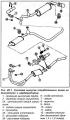
General information
Exhaust system for treated gases The exhaust system includes an exhaust manifold, a front intake manifold, a catalytic converter and 2 mufflers. The exhaust system...
Exhaust system for treated gases The exhaust system includes an exhaust manifold, a front intake manifold, a catalytic converter and 2 mufflers. The exhaust system...

Exhaust system repair
Attention. Repair of the exhaust system should be carried out only after it has completely cooled down, especially the catalytic converter. If the exhaust system...
Attention. Repair of the exhaust system should be carried out only after it has completely cooled down, especially the catalytic converter. If the exhaust system...

Removing the exhaust manifold
Removal All engines except Zetec and Zetec-E Remove the negative terminal from the battery. The exhaust manifold is attached to the cylinder head with studs and nuts....
Removal All engines except Zetec and Zetec-E Remove the negative terminal from the battery. The exhaust manifold is attached to the cylinder head with studs and nuts....
Catalyst
The catalyst is a reliable and simple device that does not require maintenance. However, the following requirements must be met: do not use leaded gasoline; ignition and...
The catalyst is a reliable and simple device that does not require maintenance. However, the following requirements must be met: do not use leaded gasoline; ignition and...

Elements of the crankcase ventilation system
Crankcase ventilation valve (PCV) On Zetec engines the valve is located in the oil separator (see Fig. 4E.19). To access the valve, remove the air pulsation system. Oil...
Crankcase ventilation valve (PCV) On Zetec engines the valve is located in the oil separator (see Fig. 4E.19). To access the valve, remove the air pulsation system. Oil...

Fuel Evaporation Control System
Examination Unstable engine operation in idle mode and decreased engine efficiency can be caused by a non-functioning canister purge solenoid valve, a damaged canister...
Examination Unstable engine operation in idle mode and decreased engine efficiency can be caused by a non-functioning canister purge solenoid valve, a damaged canister...

Exhaust gas re-burning system
Examination EGR valve Start the engine. Disconnect the vacuum hose from the EGR valve and plug it with a plug. Apply vacuum to the EGR valve. The vacuum should be stable...
Examination EGR valve Start the engine. Disconnect the vacuum hose from the EGR valve and plug it with a plug. Apply vacuum to the EGR valve. The vacuum should be stable...

Air pulsation system
Examination An erratic idle, stalling or backfiring can be caused by damage to the air pulsation system. Inspect the vacuum tube for cracks and other defects along its...
Examination An erratic idle, stalling or backfiring can be caused by damage to the air pulsation system. Inspect the vacuum tube for cracks and other defects along its...
This section is available on russian, bulgarian, belarusian, ukrainian, serbian, croatian, romanian, polish, slovak, hungarian
See other similar sections for Ford cars:
• Power unit: Exhaust system Ford Focus 1 (1998-2004)
• Power unit: Exhaust system Ford Mondeo 4 (2007-2014)
• Power unit: Exhaust system Ford Fiesta 4 (1996-1999)
• Power unit: Exhaust and vapor recovery Ford Fusion (2002-2012)
• Power unit: Exhaust system Ford Focus 1 (1998-2004)
• Power unit: Exhaust system Ford Mondeo 4 (2007-2014)
• Power unit: Exhaust system Ford Fiesta 4 (1996-1999)
• Power unit: Exhaust and vapor recovery Ford Fusion (2002-2012)
Escort 5
Escort 4
Escort 3
- General information
- User manual
- Maintenance
- Engine
- HCS and Endura-E engines
- CVH and PTE engines
- Zetec and Zetec-E engines
- Gasoline engines
- Diesel engines
- Diesel engines (since 1992)
- Cooling and heating
- Carburetors
- CFI fuel injection
- EFI fuel injection
- SEFI fuel injection
- Exhaust system
- Charging and starting system
- Ignition system
- Transmission
- Clutch
- Mechanical gearbox
- Automatic gearbox
- Drive shafts
- Chassis
- Brake system
- Car suspension
- Steering
- Body
- Electrical equipment
- Light and appliances
- Schematic diagrams
Escort 4
- General information
- User manual
- Maintenance
- Gasoline engines
- OHV engine repair
- CVH engine repair
- Fuel system
- Weber 2V carburetor
- KE-Jetronic injection system
- CFI injection system
- Ignition system
- Diesel engines
- Engine repair
- Fuel system
- High pressure pump
- Cooling and lubrication system
- Transmission
- Clutch
- Mechanical gearbox
- Automatic gearbox
- Drive shafts
- Chassis
- Suspension and wheels
- Steering
- Brake system
- Body
- Body elements
- Doors, locks and windows
- Electrical equipment
- Equipment and devices
- Lighting system
- Electrical circuits
Escort 3
- General information
- Maintenance
- Characteristics
- Engine
- Disassembly and assembly
- Cooling system
- Lubrication system
- Supply system
- Fuel injection «K-Jetronic»
- Transmission
- Clutch
- Mechanical gearbox
- Hydromechanical box
- Drive shafts
- Chassis
- Front suspension
- Rear suspension
- Steering
- Brake system
- Electrical equipment
- Starting and charging system
- Ignition system
- Ignition «Escort RS 1600»
- Light and appliances
- Schematic diagrams