Contents: Battery ↳ Battery charge indicator light ↳ Generator ↳ V-belt for generator drive ↳ Fuses ↳ Block headlights ↳ Side lights, low beam and high beam ↳ Windscreen wiper and washer ↳ Direction indicators, low/high beam… ↳ Rear fog lights ↳ Instrument cluster lighting ↳ Cigarette lighter ↳ Hazard warning switch ↳ Rear window heating ↳ Rear window wiper and washer… ↳ Interior lighting ↳
The electrical equipment circuit is single-wire, the negative pole of the power sources is connected to ground. The nominal voltage is 12 V.
The batteries installed in the Escort and Opop vehicles are designated 270 A/50 RC (35 Ah); 330 A/65 RC (43 Ah) and 440 A/75 RC (52 Ah).
The vehicles can be equipped with alternating current generators with a built-in rectifier and electronic voltage regulator of the Bosch, Lucas or Motorola brands with a current output of 28 to 45 A, depending on the model. Starters of the Lucas, Bosch or Nippondenso brands with electromagnetic switching and a freewheel clutch have a power of 0.70 to 0.97 kW, depending on the model.
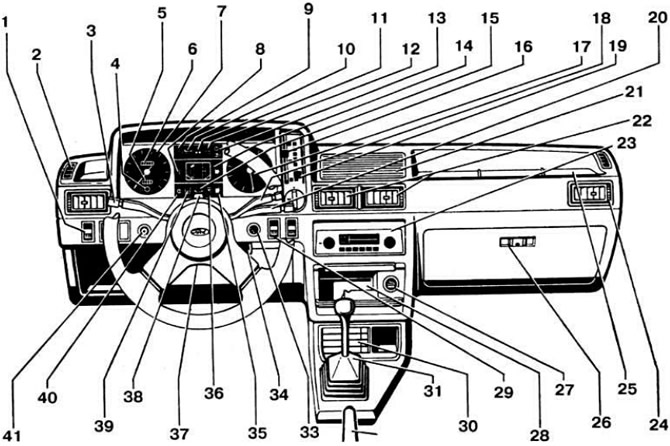 Fig. 11. Controls and instrumentation of the Ford Escort:
1 - Rear fog light switch with indicator lamp; 2, 24 — side ventilation nozzle; 3 - switch for direction indicators, headlights, horn; 4 — trip meter reset button; 5 — daily mileage counter; 6 — trip meter; 7 — speedometer; 8 — coolant temperature warning light; 9 — high beam indicator lamp; 10 - Oil pressure indicator lamp; 11 — direction indicator lamp; 12 — battery charge indicator lamp; 13 — brake fluid level and parking brake indicator light; 14 — fuel level indicator; 15 — oil level indicator; 16 — air distribution control handle; 17 — tachometer (clock)*: 18 — exterior lighting switch; 19 — air intake control handle; 20 — Windshield and headlight wiper and washer switch; 21 - loudspeaker; 22 — central ventilation nozzle; 23 — car radio socket; 25 - shelf for small items; 26 - glove box lock; 27 — cigarette lighter; 28 - ashtray; 29 — Rear window heating switch; 30 — audio cassette socket; 31 — gear shift lever; 32 — parking brake lever; 33 — windshield wiper mode switch; 34 - ignition switch; 35 — Fuel reserve indicator lamp; 36 — coolant emergency level indicator lamp; 37 — hood lock drive lever; 38 - Hazard warning switch; 39 — low windshield washer reservoir indicator light; 40 — Front brake lining wear indicator lamp; 41 — Instrument lighting switch.
Battery
It is recommended to check the electrolyte level in the battery cans as often as possible, especially in the summer, which should be between the "maxi" and "mini" marks. Distilled water should be used for topping up, and if the battery has level marks, then it is necessary to raise the electrolyte level to the "maxi" mark, and if not, then 10 mm above the edge of the plates.
CAUTION: To prevent the battery from freezing in cold weather, distilled water should only be added when the engine is running.
Every 10,000 km of run, the general technical condition of the battery should be checked and recharged if necessary. Clean and lubricate sulfated battery terminals with Vaseline or grease.
When recharging the battery from an external DC source, it is necessary to completely disconnect it from the on-board electrical system by disconnecting the positive and negative wires from the battery terminals.
Battery charge indicator light
The instrument cluster has a battery charge indicator lamp that lights up when the ignition key is turned to position II and goes out when the crankshaft speed begins to slightly exceed the engine speed when idling.
If this lamp lights up while the car is moving, it means that the battery is discharging. In this case, you should first check the condition and tension of the alternator drive belt, make sure that the electrical connections are secure, and if the lamp does not go out, check the condition of the electrical circuits.
Generator
The generator does not require special maintenance, and its technical condition and repairs should be carried out by electrical specialists.
ATTENTION
To prevent damage to the voltage regulator or generator, DO NOT:
- disconnect the wires from the battery terminals while the engine is running;
- connect a charger to the battery without completely disconnecting it from the vehicle's electrical system;
- short-circuit the "EXC" ("excited") wire of the voltage regulator or generator to ground.
V-belt for generator drive
The technical condition and tension of the generator drive V-belt are checked every 10,000 km, but not less than once every two years. The belt tension is adjusted on a warm engine so that when pressing the middle of the longest branch with the thumb, the deflection is 10 mm.
Fuses
In case of failure of any electrical device, the following should be checked first:
- fuse integrity;
- reliability of the connection of detachable contacts.
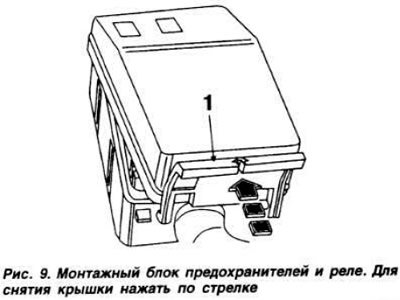
- operation of the relay installed in the corresponding circuit. Removable fuses and relays are installed in a common mounting block, access to which is closed by a folding plastic cover 1 (see Fig. 9).
Block headlights
Every 10,000 km of mileage, the headlights should be checked and, if necessary, adjusted in height and direction.
Side lights, low beam and high beam
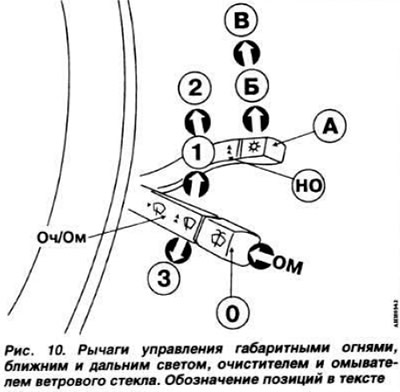
The side lights are switched on by the NO (external lighting) lever of the three-position switch mounted on the steering column on the right side. near the steering wheel. The switch positions (the lever moves upward parallel to the plane of the steering wheel) are as follows (Fig. 10):
- Off (default): The exterior lighting is off;
- "B" (side lights): front and rear side lights are on;
- "B" (headlights): front and rear side lights are on, voltage is supplied to the low/high beam switch located on the steering column on the left side.
The low/high beam switch lever has two positions and moves perpendicular to the steering column (Fig. 10).
To turn off the external lighting, including the headlights, simply move the HO lever all the way down (to the original position).
Windscreen wiper and washer
The windshield wiper and washer are controlled by the windshield wiper/washer lever of the combination switch located on the right side of the steering column. The lever moves parallel to the steering wheel and has the following positions (Fig. 10).
0 — Starting position.
1 - Normal mode.
2 - Accelerated mode.
3 - Intermittent mode
OM - Windshield washer.
The first two positions of the lever are fixed, and in the third it is held by hand for as long as the driver considers necessary, after which it is pressed by the return spring to the (initial) position 0.
The lever is set to the OM position (switching on the windshield washer electric pump) by pressing its end in the axial direction and held in it by hand for as long as the driver considers necessary, after which it is pressed back by the return spring to the (initial) position 0.
The direction of the water jet ejected from the washer nozzle is adjusted using a needle or pin.
NOTES
1. On vehicles equipped with headlight lens wipers/washers, the latter are controlled by the same lever, but operate only when the headlights are on.
2. Some vehicle modifications are equipped with a mechanical pump, controlled by a pedal mounted on the floor.
The windshield washer reservoir is installed in the engine compartment on the left side, the rear window washer reservoir (if any) is installed in the luggage compartment also on the left side. In winter, it is recommended to fill the reservoirs with a special antifreeze mixture.
Direction indicators, low/high beam switch and sound and light alarm (Fig. 12)
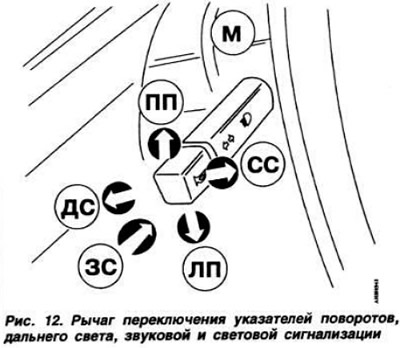
On the left side of the steering column there is a combination switch lever "M", which is used to:
- turning on the right turn signals (by moving the lever up to the "PP" position);
- turning on the left turn signals (by moving the lever down to the "LP" position);
- switching on the high beam headlights (by moving the lever from the initial position forward/down from the steering wheel to the "DS" position), while the high beam indicator lamp lights up in the central part of the instrument cluster;
- switching on the low beam headlights (returning the lever to its original position):
- sound signaling (by pressing the lever towards the steering column to the "ЗС" position);
- flashing light signaling (by pressing the lever towards the steering wheel to the "CC" position), while the high beam indicator lamp lights up in the central part of the instrument cluster.
Rear fog lights
Some vehicles are equipped with rear lights with fog lamps, which are turned on and off using a switch mounted on the left side of the dashboard.
Instrument cluster lighting
On some models of the car, a rheostat is built into the instrument cluster lighting circuit, allowing you to adjust the brightness of the lamps. The rheostat is installed on the instrument panel to the left of the steering column (plastic wheel with transverse knurling).
Cigarette lighter
The cigarette lighter is installed next to the ashtray in the center of the dashboard.
Hazard warning switch
The hazard warning switch is mounted on the steering column and has a built-in repeater - a hazard warning signal indicator lamp. The hazard warning signal does not depend on the presence or position of the key in the ignition switch.
Rear window heating
Voltage is supplied to the rear window heating element from a two-position switch installed in the central part of the instrument panel by the heater control levers. The switch key has a built-in light signaling pump connected in parallel to the heating element.
ATTENTION: The heating element built into the rear window is a powerful current consumer, so it is recommended to use it only with the engine running to avoid deep discharge of the battery. The heating element of the rear window is made of very thin foil, which is not resistant to mechanical impact. The inner surface of the glass should be protected from contact with hard objects and wiped only with a soft, damp chamois. Scratching the glass is strictly prohibited.
Rear window wiper and washer combination switch
If the vehicle is equipped with a rear window wiper and washer, then on the right side of the central part of the instrument panel there is a combination pushbutton switch, when the button is pressed to the first (fixed) position, voltage is supplied to the wiper motor, and to the stop (the second non-fixed position) - to the washer motor.
Interior lighting
The interior light switch can be set to one of the following three positions:
- interior lighting is on;
- interior lighting is off;
- the interior lighting turns on when the doors are opened.
The text of the article was copied from the website: www.fordbook.ru