Warning! Engines of vehicles equipped with a catalytic converter must not be started by towing or pushing. This may cause the converter to overheat and fail. If the battery is discharged, do not attempt to start the engine by towing or pushing the vehicle.
Note: The towing eye has a left-hand thread.
To tow the vehicle, attach the cable to the towing eye supplied with the vehicle, which should be screwed into the bushing welded to the front end of the right side member.
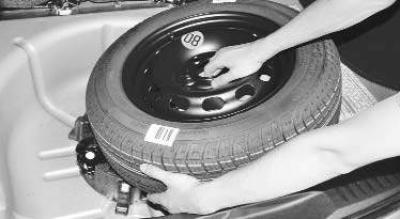
1. Remove the spare tire (see "Using a jack")…
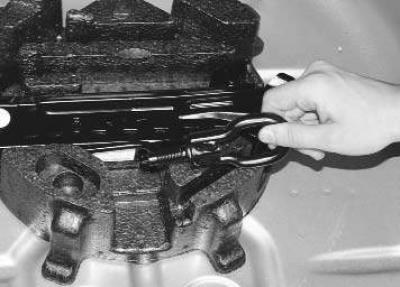
2. …and remove the towing eye from the holder.
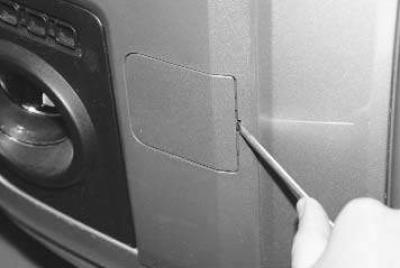
3. To install the towing eye, use a screwdriver to pry…
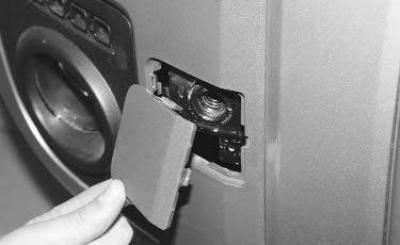
4. …and remove the plug from the bumper on the right side of the car.
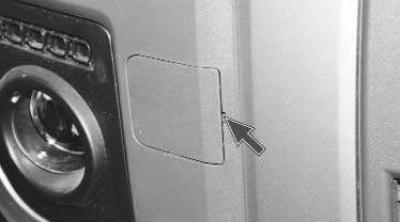
Note: Insert the screwdriver into the hole provided.
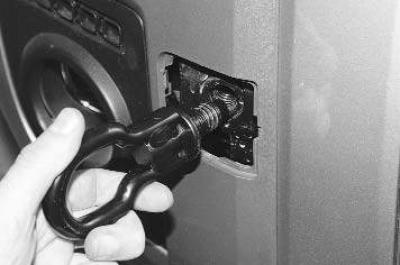
5. Screw in the towing eye by hand, turning it counterclockwise.
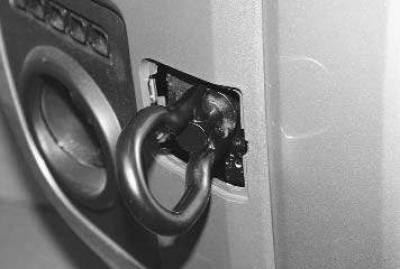
Note: When tightening the towing eye, use the lug wrench as a ratchet.
6. Remove the eye in reverse order.
Before towing your vehicle, set the ignition key to position "0" and turn on the light signaling in accordance with the Road Traffic Regulations. Set the manual transmission control lever (automatic transmission selector lever) to neutral position (position "N").
Attention! A vehicle equipped with an automatic transmission can be towed with the engine off at a speed of no more than 50 km/h for a distance of no more than 30 km. Otherwise, the transmission will fail, since its working fluid pump does not work and the transmission parts are not lubricated. For the same reason, the above conditions should also be observed when towing a vehicle with an automatic transmission with a tow truck with the drive wheels supported on the road.
If possible, tow the vehicle with the engine running to avoid increased steering and brake pedal effort.
Attention! The brake booster and power steering operate only when the engine is running. Therefore, keep in mind that when towing a vehicle with the engine off, the force on the brake pedal and steering wheel increases sharply.
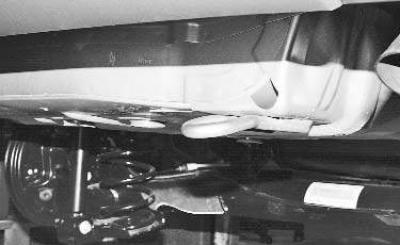
To use the vehicle as a towing vehicle, attach the cable to the designated location at the rear of the vehicle.