Contents: Evaluation of measurements ↳ Checking the battery under load ↳ Checking the density of the… ↳ Checking the battery under load ↳
The battery condition is checked by measuring the voltage between the battery terminals using a voltmeter.
Clean the outside surface of the battery.
Before testing, the battery must not be charged for at least six hours, including by cranking the engine. Otherwise, turn on the main headlight for 30 seconds before testing.
Turn off the headlights and all other electrical consumers and wait for 5 minutes.
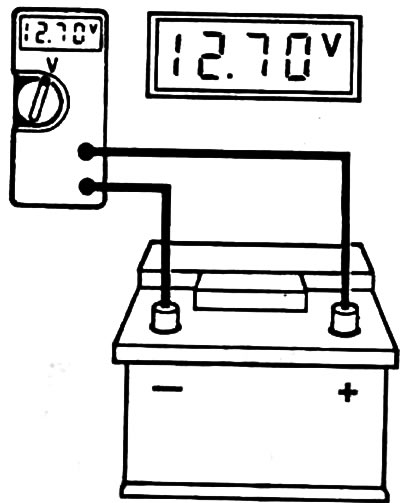
Connect a voltmeter to the battery terminals and measure the voltage.
Evaluation of measurements
12.7V or higher = battery in good condition.
12.6 V = normal.
12.4V or below = battery is in bad condition, charge or replace it.
Checking the battery under load
Connect the voltmeter to the battery terminals.
Start the engine and read the voltmeter readings.
During the starting process, with a fully charged battery, the voltage should not fall below 10 V (at an electrolyte temperature of about +20°C).
If the voltage drops immediately and the cells show different electrolyte densities, the battery is faulty.
Checking the density of the electrolyte
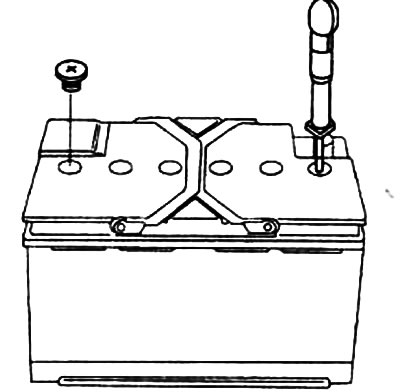
By measuring the battery voltage and electrolyte density, an accurate conclusion can be made about the battery condition. A densimeter is used to check the electrolyte density. The higher the electrolyte density (the concentration of the absorbed acid), the deeper the densimeter float sinks. The scale can be used to determine the electrolyte density in g/ml or degrees Baume (+°Be). The following values are possible:
| State of charge | + Be | g/ml |
| The battery is discharged | 16 | 1,15 |
| The battery is half charged | 24 | 1,22 |
| The battery is well charged | 30 | 1,26 |
Check all battery cells in sequence. They must have the same electrolyte density (without connected current consumers). Otherwise, the battery is faulty.
Checking the battery under load
Connect the voltmeter to the battery terminals.
Note: If the battery voltage (without connected electrical consumers) is less than 12.0 V, the battery is discharged and must be charged.
Start the engine and determine the voltage value.
During start-up with a charged battery, the voltage should not fall below 10 V (at an electrolyte temperature of about +20°C).
If the voltage drops immediately and different concentrations of acid are observed in the cells, then it can be concluded that the battery is faulty.