Knock Sensor: works on the basis of piezoceramics, i.e. a material that has long replaced flint in lighters. Piezoceramics convert mechanical energy, such as tension or pressure, into electrical voltage. The slightest disharmony, such as uncontrolled vibration of the engine block during "detonation combustion", is enough to activate the sensor. It senses the vibrations and reports them to the on-board computer. As a result, the ignition timing of the corresponding cylinder is immediately adjusted (by about -5'). The remaining cylinders continue to work as before until the sensor detects failures in their environment and reports them. Immediately after this, the ignition timing changes based on the nominal ignition timing and during one working stroke until in the direction of retardation until the combustion process is normalized. The maximum offset range is -15°.
If combustion is proper, the ignition timing in the cylinder gradually returns to the advance position after a short time.
Speed sensor: an induction sensor that switches the current to both ignition coils on and off via the control unit. The sensor has a magnet and a coil integrated into it. Control is provided by special pulse jumpers on the engine flywheel: whenever the jumper passes the sensor, the electromagnetic field in the permanent magnets changes - then the coil generates voltage. In order to determine the crankshaft position as an acceptable TDC signal, two pulse jumpers are made on the flywheel for the first and last cylinders before each of their TDCs as a reference mark. The control unit processes these voltage signals as a source of information about the engine speed.
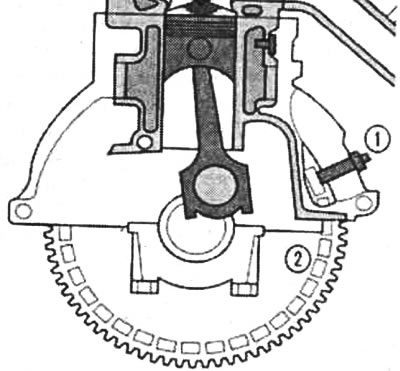
Crankshaft position sensor: 1 - sensor; 2 - sectional fields.
(The article was taken in its entirety from the specified website FordBook)