Note: The drives of the left and right front wheels are of different designs (the drive of the right front wheel is made as one piece with the intermediate shaft), therefore the left and right drives are partially removed using different techniques, described separately for each drive.
You will need: all the tools to disconnect the ball joint from the steering knuckle (see " "Replacing the outer tie rod end"), as well as a socket head and a 13 mm wrench, a lug wrench.
To remove the left front wheel drive perform the following operations.
1. Remove the engine crankcase guard (if present).
2. Drain the oil from the gearbox (see "Gearbox oil change").
3. Remove the decorative cap of the left front wheel (see "Wheel replacement").
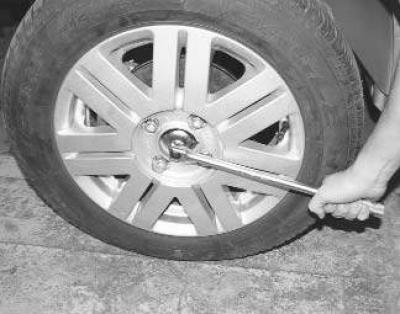
4. Loosen the hub nut and wheel nuts.
Attention! When unscrewing the hub bolt, the car must be on the ground!
Caution! Loosen and tighten the wheel nuts only when the vehicle is on the ground.
5. Apply the parking brake, place chocks under the rear wheels and raise the front of the car using reliable supports.
6. Remove the front wheel (see "Wheel replacement").
Note: If your vehicle has an anti-lock brake system (ABS), disconnect the wire harness connector from the wheel speed sensor.
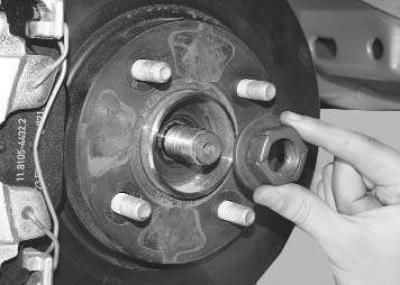
7. Unscrew the hub nuts.
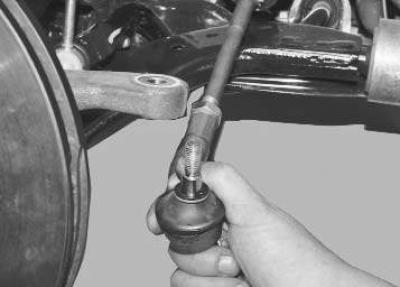
8. Disconnect the left steering rod from the steering arm (see "Replacing the outer tie rod end").
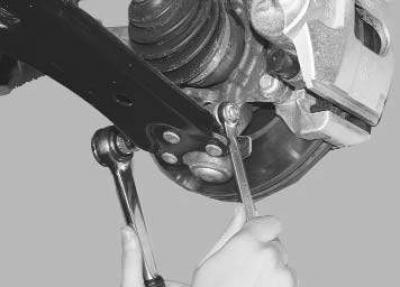
9. Loosen the tightening bolt and remove the bolt from the steering knuckle hole.
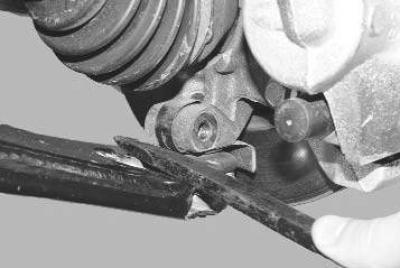
10. Use a mounting blade to pry up the steering knuckle…
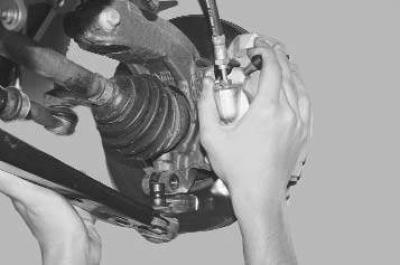
11. …and remove the ball joint from it.
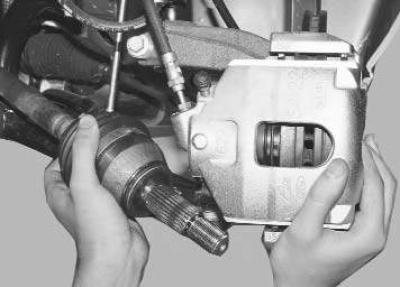
12. Move the shock absorber strut slightly to the side and remove the outer constant velocity joint tailpiece from the hub.
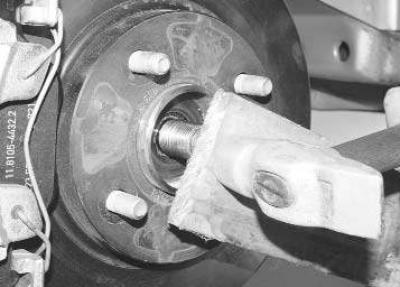
Note: If you cannot remove the joint tail by hand, knock it out of the hub with light hammer blows through a wooden spacer.
Caution: Make sure that the drive shaft does not come out of the inner joint housing, as this may cause damage to the joint.
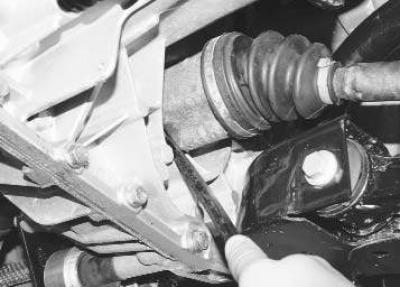
13. Having rested the mounting blade against the gearbox housing…
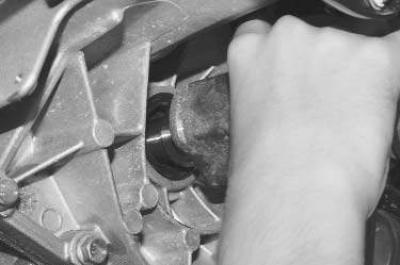
14. …press out the inner drive joint from the axle gear and remove the left front wheel drive assembly.
Note. The gap between the inner joint housing and the gearbox housing is very small, it is impossible to insert the end of the mounting blade completely into it at once. After inserting the pointed part of the mounting blade into the gap, carefully hammer the end along the blade to drive it deep into the gap and use it to push the joint housing away from the housing like a wedge until the joint tailstock retaining ring comes out of the axle shaft gear. Then use the blade to finally push the joint tailstock out of the gear.
Caution! When using a tire iron to press out the inner joint from the gearbox axle shaft gear, do not damage the gearbox housing and joint.
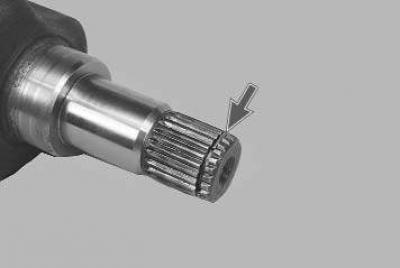
Caution: Replace the inner joint tailstock snap ring with a new one each time the drive is removed from the vehicle.
15. To install the drive, first insert the splined tail of the outer joint housing into the wheel hub, install the thrust washer and tighten the hub nut until it stops with a torque of 45 N·m (4.5 kgf·m).
16. Then insert the splined tailpiece of the inner joint housing into the axle shaft seal and turn the drive shaft slightly so that the splines of the joint tailpiece and the axle shaft gear align.
17. Move the front suspension arm down and, using a sharp movement of the shock absorber strut with the steering knuckle, press the drive into the axle shaft gear until the drive is secured with a retaining ring.
18. Try to pull the inner joint tailpiece out of the axle gear by giving the steering knuckle a sharp tug. If you succeed, repeat the installation of the joint into the gear. If the second attempt does not produce the desired result, replace the inner joint tailpiece retaining ring.
19. After installing all the parts, fill the gearbox with oil (see "Gearbox oil change").
20. Install the wheel and tighten the wheel nuts until they stop, without tightening them completely.
21. Place the vehicle on its wheels, removing it from the supports, and tighten the hub nut.
Caution! Tighten the hub nut finally with the vehicle on the ground, using a torque of 100 N·m (10 kgf·m). It is strictly forbidden to move the vehicle with the hub nut loose, to avoid damaging the hub bearing separator.
22. Tighten the wheel nuts (see "Wheel replacement").
23. Install the decorative wheel cover (see ""Wheel change").
To remove the right front wheel drive perform the following operations.
1. Perform on the right side of the vehicle operations 1–12 that were performed on the left side to remove the left front wheel drive (see above).
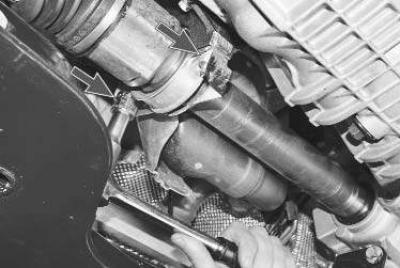
2. Unscrew the two nuts securing the intermediate support bracket…
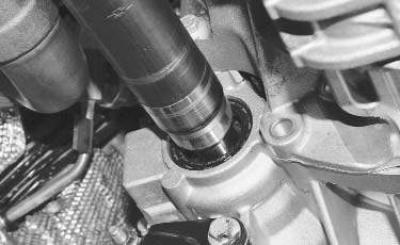
3. …remove the inner joint shank from the axle gear…
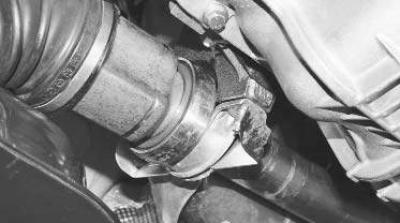
4. …and remove the right front wheel drive, removing it from the intermediate support.
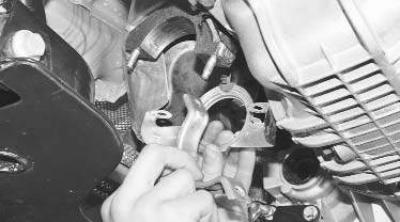
Note: If necessary, remove the intermediate support…
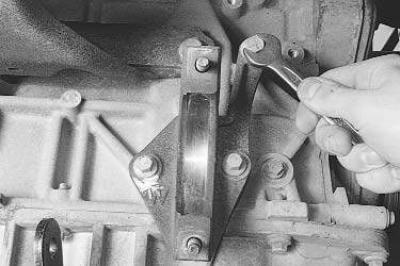
Note: … remove the three bolts securing the intermediate support bracket to the engine cylinder block…
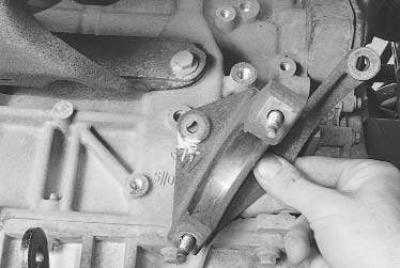
Note: …and remove the bracket.
5. To install the drive, first insert the splined tail of the outer joint housing into the wheel hub and tighten the hub set nut to a torque of 45 N·m (4.5 kgf·m).
6. Then insert the splined tailpiece of the inner joint housing into the axle shaft seal and turn the drive shaft slightly so that the splines of the joint tailpiece and the axle shaft gear match. By moving the shock absorber strut with the steering knuckle, insert the drive into the axle shaft gear until it stops.
7. Install and secure the intermediate support bracket with nuts.
8. After installing all parts, fill the gearbox with oil (see "Gearbox oil change").
9. Install the wheel and tighten the wheel nuts until they stop, without tightening them completely.
10. Place the vehicle on its wheels, removing it from the supports, and tighten the hub nut.
Attention! The hub nut must be finally tightened with the vehicle on the ground. Tighten the nut to a torque of 100 N·m (10 kgf·m). It is strictly forbidden to move the vehicle with the hub nut loose to avoid damaging the hub bearing separator.
11. Tighten the wheel nuts (see "Wheel change").
12. Install the decorative wheel cover (see "Wheel replacement").