Contents: Car interior ↳ At a high level – safety ↳ 50% more reliable than its… ↳ "Bends" from hydroelectric power -… ↳ Provide rapid absorption of roof… ↳ Good for the wallet - easy to repair… ↳ Structural elements of the body -… ↳
The last "European" Ford with rear-wheel drive had its day in 1993. The successor to the Sierra has since been branded as the Mondeo, since the 2001 model year in its second generation: no old wine in new hoses - the latest Mondeo is a thorough new design that is conceptually convincing and in line with the times. This newcomer has managed a flawless lightning start - and not only in Germany. The 2001 edition is available in three body styles and three trim levels: as a 4-door car - a saloon; as a 5-door hatchback and as a 5-door estate under the name Turnier – all together forming a company with "Ambiente", "Trend" or "Ghia". Only the ST200 with its special status still showed off its relevance in the old "sports suit" – at least until the series launch of the ST220 at the beginning of 2002.
The positive features of the new Mondeo include, among other things, the light and stable body structure. In the basic equipment (Ambiente), the "empty" 1.8-liter Mondeo, which has a sedan body, shows on the scales 1374 kilograms - up to 1600 kilograms increases the weight of the station wagon in the "Ghia" equipment with an 85 kW engine with direct injection DuraTorg. From the front to the B-pillar, the unupholstered and unpainted bodies "feed" largely on the same parts.
Car interior
The Mondeo's makers have, to some extent, "sculpted" their ward from the inside out: according to the engineers' world system, the Mondeo offers up to five passengers "a high level of ergonomics, comfort and functionality." Mondeo buyers initially benefit from a 2754-millimeter wheelbase and a majestic roof: virtues that are bestowed upon the Mondeo's crew in all places in the form of ergonomic seats, easy entry and exit, and plenty of knee, shoulder and head room. Without a doubt, in the middle class, the Mondeo trumps its size - its seating positions are more in line with the "upper class.".
And all this in a "tailor-made suit" that looks "airy" even in narrow multi-storey car parks or at rush hour: with a length of 4731 millimetres (estate: 4804 mm), a width of 1931 and a height of 1429 – 1460 millimetres (estate: 1441–1514 mm), the modest Mondeo appears here. It"s a completely different picture on the road – here the Ford shines to a greater extent: even with a full payload (461–589 kg) on board, it quickly takes a turn like a "baby" and copes with potholes, transverse joints or folds in the ground like an "adult".
At a high level – safety
The important structural elements of the unlined and unpainted body are designed by the Mondeo manufacturers for the future – reinforced – taking into account safety and collision requirements. The decisive factor for the high safety standard of the Mondeo is its extremely "rigid" passenger cell: the structural elements of the front, rear and sides of the car absorb the energy generated by a collision "in a team". CAD models and Ramsis modelling made it possible to carry out a more precise analysis of new projects already on the screen. For example, a computer colleague provided a picture of the nature of deformations on a scientific basis – real collision experiments were also used by the engineers as confirmation of the data of the virtual "reality". Only 10 to 15% of all experiments were real collisions in nature, the rest were carried out on a computer using computer modelling.
50% more reliable than its predecessor – front legroom
One of the main requirements for the "bare and bare body structure" is that the front footwells must be more robust than those of its predecessor. This has been achieved - the risk of injury in the new Mondeo is 50% lower than in its predecessor. The reason: the subframe not only carries the drive unit together with the front axle, it also has the function of an auxiliary frame with strictly defined deformation parameters.
"Bends" from hydroelectric power - front shock absorber
The front shock absorber is a steel crossbar, which under the action of strong water pressure (deep hydraulic drawing) can deform from the inside out. At low impact speeds (15 km/h), the "trick" with water basically minimizes the deformation of the rear structures of the car. The wallet is always a cautious argument for insurance and the enthusiast himself: Mondeo confirms this fact with its favorable casco rating and moderate costs for post-accident repairs.
 Deformed under strong water pressure: the front push rod holder before (top) and after the "trouble" (bottom). |
In addition, the Mondeo has a reinforced front wall, front and middle pillars, and body floor components. High-strength steel is used everywhere where deformation energy is absorbed and transferred – a total of 43% of the protruding parts of the body"s metal sheets. To ensure that the steering column has very little chance of entering the passenger compartment in a head-on collision "without cuts", the instrument panel crossbar, screwed between the front pillars, blocks its path in the form of a rigid, closed tubular profile. Together with the lower and upper longitudinal beams, which are designed to absorb energy, all this creates a "humane" deformation process of the front part of the car, creating sufficient space for the survival of passengers.
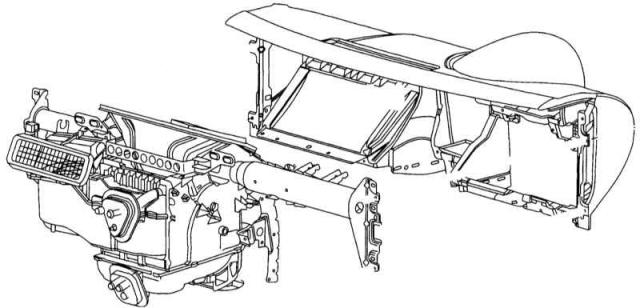 Deflects the steering column: the instrument panel cross member is a rigid closed tubular profile. |
Provide rapid absorption of roof impact forces – B-pillars
Your Mondeo is also effectively protected from lateral "unpleasant encounters": the main share of forces in this case is taken by the B-pillars - however, they are not "spent" here, but quickly "burn out" on the roof. To increase its protective function, the "metal firmament" received its own reinforced roof ribs. In addition, in the Mondeo, of course, you can also find door protectors, as well as, of course, impact-absorbing door trim or seats with compensation for inertial forces that occur during braking, with the appropriate fastening means.
Not only does the Mondeo parry front or side "opponents" with great flexibility and the necessary stability, its rear can also "take on" the energy of a collision without endangering passengers. And if the driver's neighbor gets really "hot", then the emergency switch on the right front pillar shuts off the fuel supply, thereby preventing the formation of large "gasoline puddles" and subsequent fires. To make it easier for rescuers to get inside the cabin, the doors of the 2000s Mondeo can now also be opened with a strong arc handle: it withstands the load of high traction forces and does not capitulate to "clamped" doors.
Good for the wallet - easy to repair body
As a result, the second generation of the Mondeo meets the legal requirements of the ECE and Euro-NCAP standards. In addition, it is also in the green zone of the internal Ford standard. Any standard does not differentiate between men and women: therefore, all safety measures must fully reveal their optimal protective effect both for 5% of women and for 95% of men. Legislative requirements were "known" to only 50% of men so far. And parents fasten children in the Mondeo in child seats at Isofix base points.
The modern Mondeo acquired its relatively repair-friendly body from its ancestors, however: good information for those who like to tinker with their cars themselves, you deserve to know it.
Structural elements of the body - front and rear glass
The following sections will be devoted exclusively to simple bodywork that you can do yourself. The front and rear windows, as well as the glued-in side windows of the station wagon version, of course, should be handled by a professional: for these structural elements of the body, this is a typical case for a workshop.
| HAZARD INSTRUCTIONS | ||||
|
| PRACTICAL ADVICE | |
|
(The original post is on the web portal: FORDBOOK.ru)