During each maintenance and repair, it is necessary to check the condition of the protective covers of the suspension ball joints; there should be no mechanical damage on the covers.
Find out if there are any cracks or traces of contact with road obstacles or the body on the suspension parts, deformation of the levers, the stabilizer bar and its struts, or parts of the front of the body in the places where the suspension units and parts are attached.
Check the condition of the rubber-metal hinges, rubber cushions, suspension ball joints, as well as the condition (settlement) of the upper supports of the telescopic suspension struts.
Rubber-metal hinges and rubber cushions are subject to replacement in case of ruptures and one-sided bulging of the rubber, as well as in case of cutting of their end surfaces.
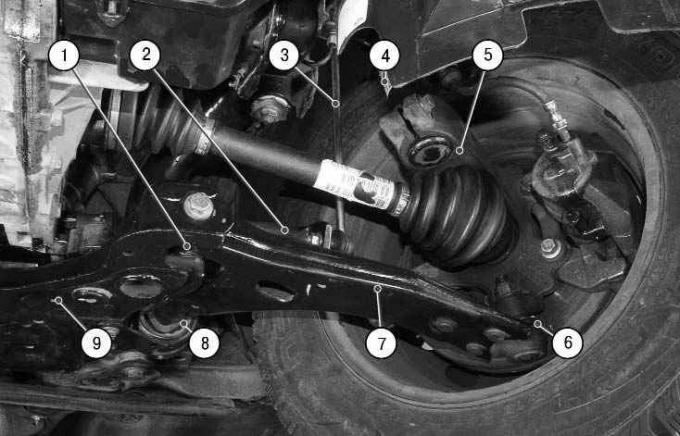
Fig. 4.2. Location of the front suspension elements on the vehicle: 1 – front hinge (silent block) of the front suspension arm; 2 - anti-roll bar; 3 - anti-roll bar; 4 – shock absorber strut; 5 – steering knuckle; 6 – ball joint of the steering knuckle; 7 – front suspension arm; 8 – rear hinge (silent block) of the front suspension arm; 9 – front suspension cross member
The location of the front suspension elements on the vehicle is shown in Fig. 4.2.
The following is not allowed on rubber suspension parts:
- signs of rubber aging;
- mechanical damage.
The following are not permitted on rubber-metal hinges:
- signs of aging, cracks, one-sided bulging of the rubber mass;
– separation of the rubber mass from the reinforcement.
Replace faulty parts.
WARNING: Pay special attention to mechanical damage (deformations, cracks, etc.) of suspension elements, especially levers.
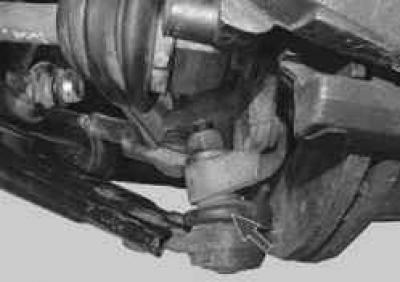
1. Check the condition of the ball joint protective boots. If the boots are damaged, replace the ball joints as a whole.
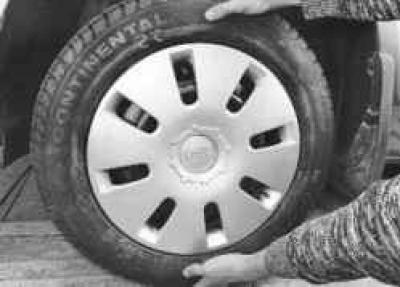
2. By rocking the wheel in a vertical plane, check the ball joints for play. If there is play in the ball pins, replace the supports.
USEFUL TIP: When rocking the raised front wheel, it is difficult to distinguish between play in the hub bearings and in the ball joints. Ask an assistant to press the brake pedal: if you still feel play, then the ball joints are faulty.
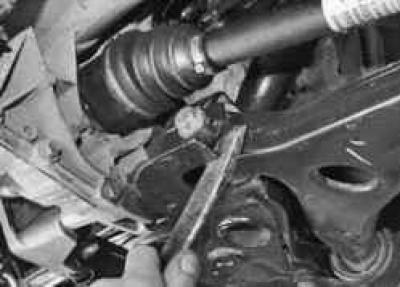
3. Check the front… for play
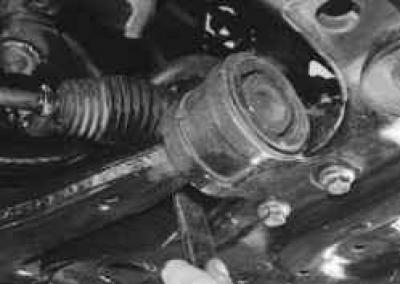
4. …and rear silent blocks in the places where the levers are attached to the suspension cross member.
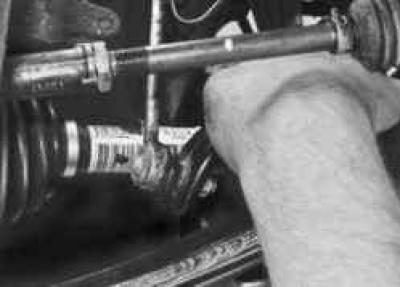
5. Check the condition of the stabilizer bar struts and rubber cushions by shaking the stabilizer bar up and down.
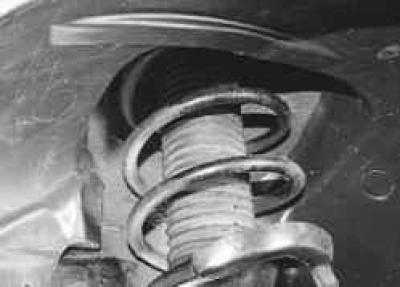
6. Check the condition of the shock absorber strut protective cover.
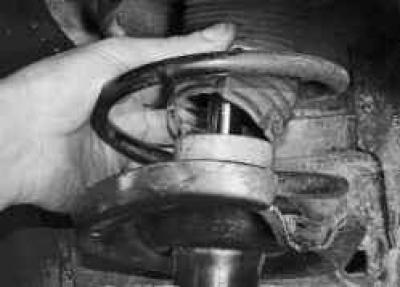
7. Lift the protective cover and check the shock absorber for leaks. No fluid leaks are allowed.
8. Replace any faulty or damaged parts.