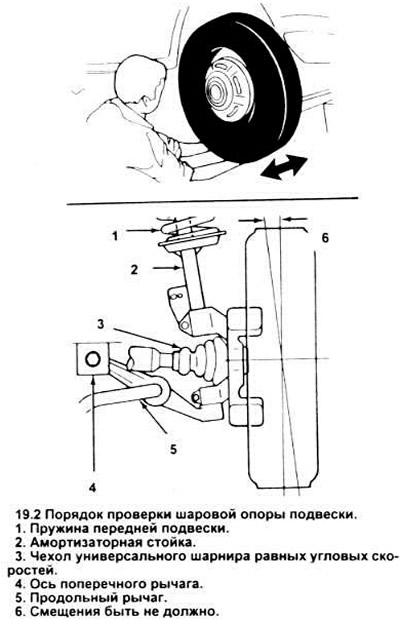
2. Wipe away any dirt from the bottom of the ball joint and control arm. Grasp the bottom of the tire and move the wheel outward (see illustration) to determine if there is any play in the ball joint. If there is, the suspension ball joints should be replaced.
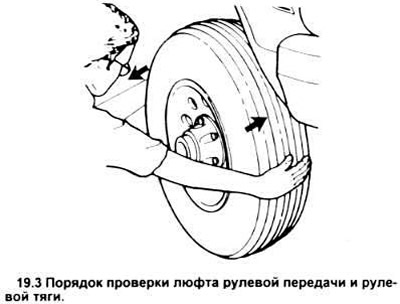
3. Grasp the wheel as shown in Figure 19.3 and move it back and forth. If you find any play, check the suspension mount and the tightness of the ball joints of the steering rods. Tighten the loose suspension mount. If the steering rods are loose, the ball joints (pins) may be worn - check the tightness of the nuts. Additional information on steering and suspension, as well as drawings, are provided in chapter 10.
Checking the front wheel hub bearing
Note 1: The front wheel hub bearing is a closed type, lubrication and installation of gaskets are carried out at the factory. It is not subject to maintenance and adjustment. However, they can be checked for excessive play. If the check shows that the outer bearing is unsuitable, then both should be replaced
Note 2: This procedure should also be performed on the rear wheel bearings on 1990 and later models.
4. Grasp the wheel as shown in the picture and rock it back and forth to check for play. There should be no noticeable movement. Rotate the wheel and listen for noise in the bearings. If anything is noticeable, see the bearing replacement procedure in chapter 10.
Checking the axial drive constant velocity joint boots
5. If the rubber boots of the axle drive are damaged or worn out, the universal constant velocity joint is at risk of serious damage.
6. Check the 4 boots (2 on each axle) for cracks, holes, tears, worn rubber and loose or non-functioning clamps. By pressing on the surface of the boot, previously unnoticeable cracks may be revealed (see picture).
7. Ak zistíte poškodenie alebo odretie, skontrolujte samotnú zostavu univerzálneho kĺbu s konštantnou rýchlosťou (chapter 8) and replace the cover with new ones.