Operating principle of a pulse sensor with a Hall transducer
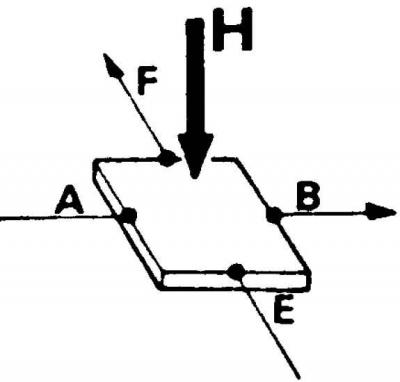
A and B are control electrodes, H is the direction of the magnetic field (perpendicular to the surface), E and F are the electrodes between which a potential difference arises (Hall voltage)
If the corresponding semiconductor, through which the current flows between the electrodes (A) and (B), is exposed to a magnetic field (H), then a potential difference will arise between the electrodes (E) and (F) of this semiconductor. This phenomenon is called the Hall effect.