Exhaust systems in the childhood of automobile manufacturing had the task of only reducing the noise of fuel combustion of the "explosive engine" and sending exhaust gases into the atmosphere - that was then. Starting from the eighties of the last century, the exhaust system began to perform other "work": catalysts in the exhaust system absorb almost 90% of toxic substances. The factory Mondeo is equipped with a multi-component exhaust system.
Ford covers the possibility of replacing the exhaust system with the appropriate service centers. To install the service units, the working unit is "split" along the appropriate flanges and the new part is inserted with a new gasket. During installation, the entire unit is suspended on new rubber holders.
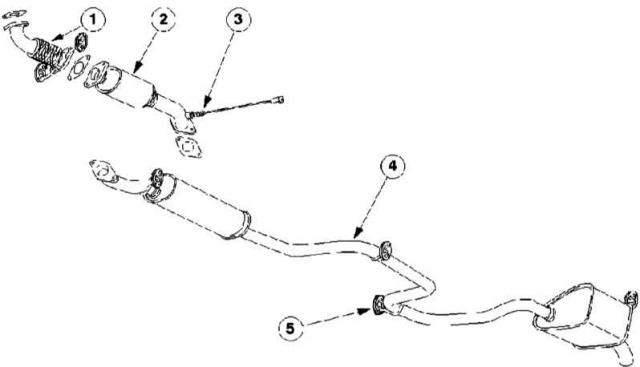
Complete installation of 1.8L/2.0L engine
 |
|
1 - Flexible tube,
|
4 - Muffler with end pipe,
|
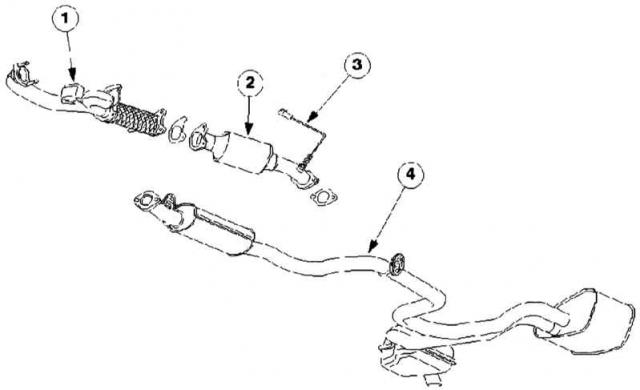
Complete installation of 2.5L V6 engine
 |
|
1 - Exhaust manifold with flexible intermediate pipe,
|
3 — Lambda sensor,
|
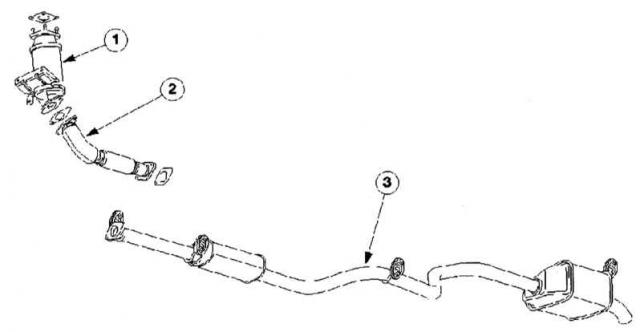
Complete installation of Mondeo DI
 |
|
1 - Oxidation catalyst,
|
3 - Muffler with end pipe. |
Lasts about 70,000 kilometers – Mondeo exhaust system
Naturally, the service life of the exhaust system depends greatly on the conditions in which your Mondeo is used. If you mainly drive around the city and mainly over short distances, then you can find significantly more "eaten" condensate, soot and aggressive acids in your mufflers. When driving over long distances, a constantly well-warmed exhaust system has a significantly increased service life. However, as a rule, the Mondeo exhaust system withstands all nasty operating conditions for about 70,000 kilometers.
- The front part of the exhaust system with the catalytic converter resists rust more successfully than other components. The reason: the exhaust gases have temperatures of 800 to 1000°C in this part, due to which water spray and condensate evaporate much faster.
- On their way through the intermediate reflection muffler and the end muffler to the end pipe, the exhaust gases are constantly cooled. They enter the atmosphere, depending on the nature of the work (petrol, diesel) with temperatures of approximately 150 - 300°C. At the same time, the end muffler collects the most condensate. A mixture of combustion residues and aggressive acids, thus, destroys the muffler from the inside out.
- As soon as the cold spray water "washes" the exhaust system under the car, strong temperature fluctuations occur. When driving long distances, they put more stress on the front parts of the installation. This, despite the flexible intermediate element, can lead to complete destruction of the tube or the appearance of fine cracks the size of a hair.
- Splashing and salt water cause rust to appear on the outside. In addition, stone impacts and other external influences, such as the installation touching the roadway, the exhaust system "survives" equally hard. In addition to all this, harmful vibration frequencies are added, which, for example, can lead to brittleness and cracks in the suspension rubber loops.
A matter of experience – this is how a professional "processes" an exhaust system
Oxidized metal cannot be welded reliably for a long time. Therefore, the success of repairing a rusted exhaust system is usually short-lived. Putty and bandage hold a little longer, but the corroded metal, as practice has shown, soon reappears near the repair sites. In exhaust systems with more than one muffler, it is not uncommon that after replacing the first muffler, after a few months, the second one has to be "fired". Therefore, in workshops, the entire system is usually replaced. However, before starting repairs, inspect the exhaust system and then decide whether to replace the entire installation or its individual components.
This article was borrowed from the website fordbook