Contents: Removal ↳ Installation ↳
Removal
Remove the fan motor.
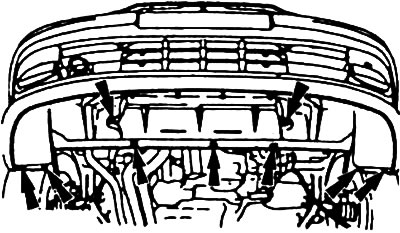
Raise the car onto jack stands. Unscrew and remove the lower radiator grille.
Drain the coolant through the drain screw at the bottom of the radiator, see p. 3.3.
Disconnect the upper and lower coolant hoses from the radiator. First, loosen and slide the fastening clamps.
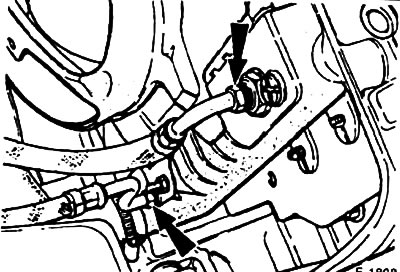
For vehicles with automatic transmissions only: Unscrew the ATF cooler oil lines from the radiator and plug the ends to prevent large losses of engine oil.
Caution! Collect the oil in a container provided. Clean the connection points so that dirt cannot get into the oil.
Raise the car onto jack stands.
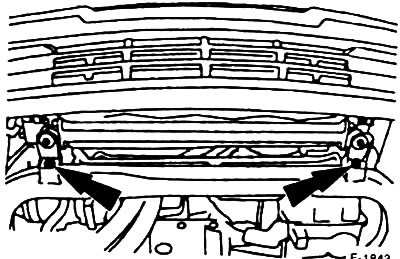
Disconnect the lower side of the radiator "arrow" and pull it out from the bottom of the car. In cars with air conditioning, you first need to remove the condenser from the front of the radiator and tie it with wire so that it does not interfere.
Caution! Never open the air conditioner coolant circuit.
Installation
Check the rubber seals at the top and bottom of the radiator for damage and replace them if necessary.
Install the radiator from below so that the locking tabs engage in the corresponding recesses.
If you have air conditioning, install the condenser in front of the radiator.
Tighten the radiator fasteners at the bottom to 25 Nm.
Install a splash guard under the radiator.
Lower the car onto its wheels.
Connect the upper and lower coolant hoses and secure them with clamps.
Screw in the radiator drain screw and tighten it slightly. Fill with coolant, see p. 3.3.
If necessary, connect the automatic transmission hoses. Finally, check the oil level, see p. 10.6.
Install the fan, see p. 3.7.
Connect the ground (-) wire. Set the clock and set the radio anti-theft code.
Warm up the engine, it should idle until the fan turns on. Check the cooling system for leaks.
Check the coolant level again and top up if necessary.