Raise the vehicle on a level surface, securely fix it and remove the wheels of the corresponding axle: in addition to this check, also check the condition of the brake shoe linings.
Brake Disc Dimensions
|
|
Front axle: |
Rear axle: |
|
Disc diameter mm |
300 |
280 |
|
Disc thickness (new) mm |
24 |
12 |
|
Wear limit mm |
22 |
10,2 |
|
Max. disc runout mm |
0,05 |
0,5 |


|
ORDER OF EXECUTION |
- Discs with a slightly bluish tint are completely normal.
- Pay attention to deep scratches on the discs. They indicate foreign objects trapped in the pads, rough road dirt, hardened or worn pads. If there are "milling marks" up to three millimeters deep, there is still no need to worry. However, in any case, free the pads and remove any foreign objects that have already been crushed.
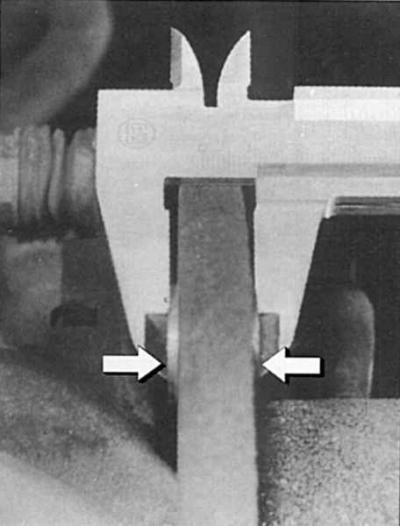
- The best way to measure the thickness of the disc is with a caliper and two euro coins. Place one coin on each side of the disc between the caliper and the disc. Naturally, the thickness of these two coins should be subtracted from the resulting value.
- Discs that have been stripped to the minimum possible thickness should be handed over to scrap metal. Scratched discs can, however, be ground. In this case, always replace and process discs in pairs.
Reading and subtraction: To get the correct value, you need to subtract the thickness of both coins after measuring. |
|
|