Contents: Operating principle ↳ Turning off the traction control… ↳ Driving with the traction control… ↳
See position 24 in Paragraph 2.
Operating principle
The traction control system prevents the drive wheels from slipping when there is poor traction. When one of them starts to slip due to insufficient traction, the traction control system, together with the ABS, reduces the engine torque and equalizes the rotation speed of the drive wheels. At this time, the driver may feel a slight push in the accelerator pedal. In addition, a warning light on the instrument panel begins to flash.
When the ignition is turned on, the traction control system and ABS warning lights come on for about 3 seconds, indicating that both systems are working properly.
If one of the control lamps does not light when the ignition is on or remains lit, then there is a malfunction in the system. In this case, you should immediately contact the Service Center.
Warning: Although both systems provide a high level of safety, you should not rely on them completely and expose yourself to unnecessary risks while driving.
Turning off the traction control system
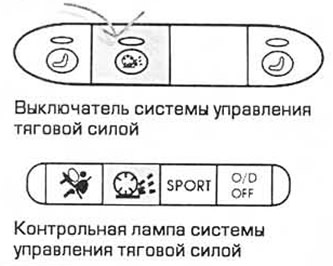
If the car wheels are equipped with anti-skid chains or the driver likes fast driving, it is recommended to switch off the traction control system. For this purpose, a corresponding switch is installed on the front panel. While the system is not working, the control lamp will be on.
To turn the system back on, press the switch again and restart the engine.
Driving with the traction control system on
On snowy and icy roads
The system optimizes fuel supply to the engine.
On sandy and soft ground
The system prevents wheels from quickly sinking into sand or mud.
On the slopes
Provides stable engine braking even on very steep slopes.