- personal passport or identity card and a certificate of residence for military personnel;
- driver's license;
- vehicle registration certificate or registration document;
- power of attorney (if any);
- medical certificate;
- receipts for payment of all required fees (payment for technical inspection and payment for the technical inspection coupon);
- civil liability insurance policy.
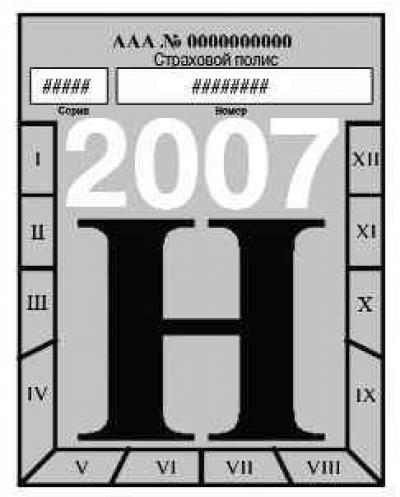
NOTE: When applying for a compulsory motor third party liability insurance policy at an insurance agency, a sticker of the established form is issued, which must be attached to the windshield in the same way as the coupon issued after passing the state technical inspection.
The vehicle must have a fire extinguisher with an unexpired expiration date, a new first aid kit of the established type (which must be confirmed by a special certificate received when purchasing the first aid kit) and an emergency stop sign.
According to the RF Government Resolution "On the procedure for conducting state technical inspection of vehicles registered with the State Road Safety Inspectorate of the Ministry of Internal Affairs of the Russian Federation" dated July 31, 1998 No.880, instrumental inspection of vehicles is being gradually introduced in the RF. So far, it has been introduced only in Moscow for passenger cars older than 5 years.
Instrumental inspection includes verification of numbers (to determine their authenticity and compliance with this particular vehicle). It differs from a regular technical inspection in that it includes a more rigorous bench inspection of the condition of the service and parking brake system, steering, CO and CH levels in the engine exhaust gases, as well as checking the condition of the exhaust system, wheels, windshield wipers, sound signals and external lighting devices. An external inspection of the vehicle is also carried out. If the technical inspection is not passed the first time, it is carried out again free of charge within 20 days.
In order to more accurately determine the actual technical condition of the car before instrumental inspection, it is best to undergo diagnostics at a special station. This will allow you to determine the condition and need for repair of a particular unit. Particular attention should be paid to the braking system (both working and parking) and the vehicle control system, as well as to adjusting the injection system, the state of the ignition system, check and adjust the environmental parameters of the car: CO and CH emissions. To adjust the latter, special equipment is needed, which is only available at service stations or special environmental control points. You should also pay attention to the tightness of all fuel lines and the fuel tank cap.
In addition, during the technical inspection, the brakes of all wheels are especially carefully checked for deceleration (specific braking force is not less than 64%) and unevenness of their operation (spread between wheels of one axle is not more than 9%). The control is carried out on running drums, therefore the brakes must be carefully adjusted before the technical inspection. The parking brake must hold the car on a slope of at least 23% without taking into account the unevenness of action on the wheels of the rear axle.
USEFUL TIP: Even if you have replaced the brake pads and shoes, do not rush to go for a technical inspection immediately, as the brakes need to be worked in (after 250-300 km of running).
If the braking force remains uneven, try to rub the brake disc a little with sandpaper to remove large burrs. Note that uneven braking is also affected by the difference in tire pressure, insufficient tire pressure (tires should also not be overinflated, as this also reduces the effectiveness of the brakes). GOST retains the ability to visually check the brake system by an inspector. During such a check, the car must brake to a complete stop without losing its straight-line trajectory.
The steering should not have excessive play (no more than 5° of deviation of the upper part of the steering wheel from the nominal position), for which you need to check the condition of the steering rod ends and the steering mechanism. You can independently determine the presence of excessive play. To do this, standing next to the car located on a horizontal platform, turn the steering wheel slightly from side to side, while resting the toe against the side of the front wheel. If the angle of the steering wheel is greater, and the front wheel has not yet begun to turn, then the play is excessive and the steering needs to be repaired.
You should check the functionality of the external lighting systems: headlights (low, high and parking lights, as well as hazard warning lights), turn signals, side repeaters, brake lights, rear parking lights and license plate lights, reversing lights. If at least one bulb is not lit, you will not pass the technical inspection. The beam of light from the headlights must be adjusted correctly (they should not blind oncoming drivers), it is better to do this on a special stand at the service station. The sound signal must also be in good working order.
The windshield wiper and washer must work, and the brushes ("wipers") must clean the area allocated to them by at least 90%. GOST also does not allow the presence of cracks on the windshield in the area of operation of the windshield wiper blades.
The car tires must not have wear exceeding the permissible limit (the tread groove depth must be at least 1.6 mm). The tread must not have one-sided wear, and the sidewalls must not have damage ("hernias"). It is not allowed to pass the technical inspection on a stand with brake drums with studded tires (also note that tires with a "winter" tread pattern reduce the braking efficiency on smooth drums). Those who are forced to undergo technical inspection in winter can be advised to "change" their car to universal or "summer" tires for this procedure.
The exterior of the car body must be neat (i.e. in addition to the fact that the car must be washed, including the engine, it must also not have noticeable damage to the paintwork on the body, doors and wheel disks). If necessary, eliminate damage and corrosion. If necessary, carry out repair painting of the body or individual parts. State registration plates must also be neat - not rusty or wrinkled. They can be touched up, but carefully, so that the number can be easily read.
The body must have mudguards as provided in the package, and serviceable door handles and locks; the darkening of the glass should not exceed the norm. A reduction in the light transmittance of tinted glass by no more than 25% is allowed, and when using a darkening film - no more than 30% (note that ordinary clear glass has a light transmittance of about 97%).
The seat belt buckles and seat adjustment mechanism in the vehicle must be in good working order.
Careful daily operation of the car and regular repairs and maintenance can significantly reduce the costs of preparing for a technical inspection, since all the main systems will be in better order and adjusted in advance.