IPS components
The Mondeo's IPS includes adaptive dual-section airbags for the driver and adjacent passenger, including a recognition system that analyses the level of the accident, the position of the driver and adjacent passenger seats and the occupancy of the adjacent passenger seat.
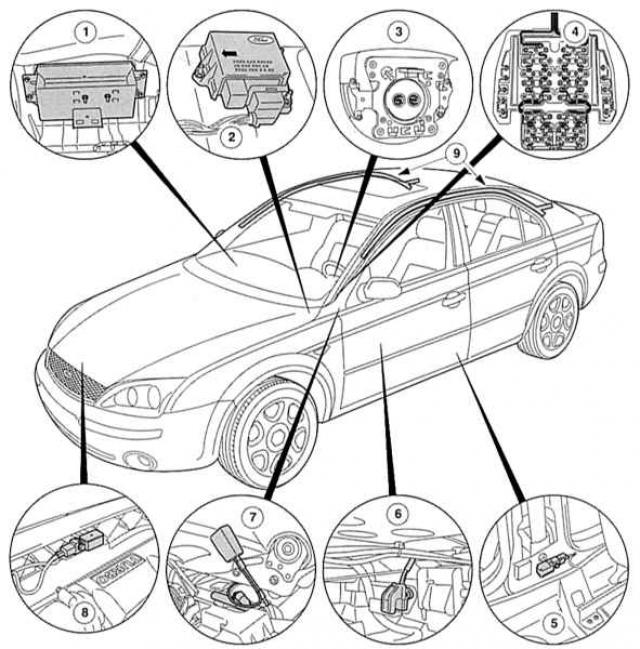 |
|
1 - Airbag for the adjacent passenger,
|
6 — Driver's seat position sensor,
|
Ford not only introduced new shapes and lines on the outside of the Mondeo, but also the interior of the car, in the language of shapes, acquired its own new frame design. Already in the early stages of development, the designers of the Mondeo inherited a precise spatial structural unit for their – at that time still digital – "baby", and during the creative phase, a large computer and the most modern software helped to implement their inspiration at every step: the 2001 Mondeo was created entirely in digital form. Thus, for the first time at Ford, the process of designing and developing a car was implemented using specialized software "Car Design". It represented a combination of digital tools for computer-aided design (CAD), computer-aided engineering (CAE), computer-aided manufacturing (CAM) and manufacturing information management (PIM), which united all components for joint "targeted work" on the Mondeo. The tool, called C3P, simultaneously combined the properties of a "communication genius" and a "time machine": C3P made it possible to reduce the usual design and development time to 13 months. Precious time during which Mondeo's developers were free to adjust "other design components" of their baby.
With the help of C3P, based on the primary screen information, it was possible to realistically and interconnectedly imagine the future basic proportions of the car, for example, the type of interior or the spatial position and placement of individual units of the "digital child".
The Mondeo developers also took advantage of the mainframe's 'dictatorship', aligning their own 'mental outbursts' with the overall concept of the digital 'linesman'.
The big computer did its homework very consistently and purposefully: in order to make the interior comfortable for five people and to create a "living space" in the boot, it reduced the space requirements for all mechanical components to a minimum, "expanded" the wheelbase by 50 millimetres compared to the Mondeo I and increased the overall length by 175 millimetres.
The Mondeo driver now enjoys this "digital dictate" at every kilometre: while driving, he is in a generously sized and tastefully "decorated" interior and, if necessary, uses the exemplary volume of the boot. The driver and his partner travel first class in a middle-class car, and the three rear seats provide long excursions on a well-defined rear bench without the feeling of pressure on the elbows and knees: legroom of 969 millimetres, knee room of 937 millimetres and width at the shoulder level of passengers of 1,393 millimetres are the optimal dimensions for the middle class. The highest class also applies to the safety system, Ford"s advertising texts even boasted the presence of IPS (Intelligent Protection System), thanks to which the driver and the passenger next to him are protected by active and passive means.
Protect the driver's feet - protective pedals
Before – after: pedal in normal condition (A) – after collision (B).
1 - Separating lever,
2 — Direction lever,
3 - Direction of movement during the braking process,
5 - Receiving the pushing rod of the GTZ,
6 — Master cylinder push rod,
7 — Brake pedal,
8 - Direction of movement at the time of collision,
9 - Broken brake master cylinder push rod (end of braking).
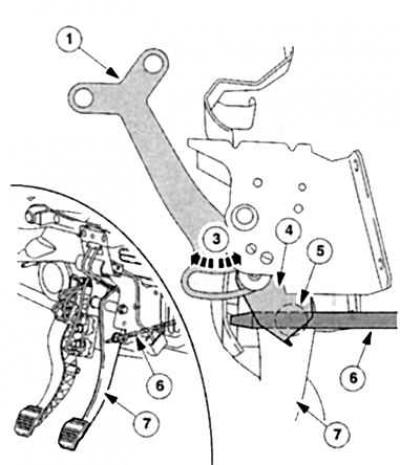 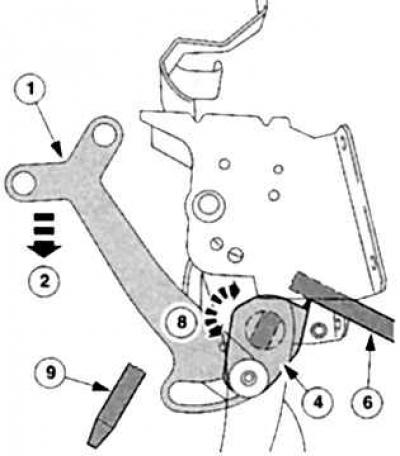 |
The two-stage front airbags, as well as the side, head and shoulder airbags, respond to information from the most modern Crash sensors in the Mondeo. Active head restraints (front), three-point seat belts on all seats, as well as seat belt pretensioners and a load-dependent belt force limiter (front) complete the "armament" of the Mondeo"s safety equipment. And to ensure that the driver"s feet also have the appropriate "chance of survival", possible fracture points of the Mondeo brake pedal have been "neutralized": in a severe frontal collision, it detaches "without resistance" and falls onto the underbody sheet.
In terms of "dimensions" everything is also well coordinated here. And for small children of "Isofix age", of course, there will be "their" seats in the Mondeo, and they can be fixed separately from their parents in the rear seats.
Functionality, tasteful controls and high-quality materials define the atmosphere of the Mondeo's interior: every detail is finely polished - visually and qualitatively. For example, the dashboard: its appearance with beautifully designed instruments and a smoothly integrated middle console is very impressive, and the attractive artificial material handles show that Ford has discovered, in addition to optics, also Haptik as a possible purchase argument. The interiors of the Ambiente and Trend versions, as well as models with leather interiors, are tastefully decorated in uniform tones - only the top models with the Ghia emblem have a horizontally divided color scheme.
The driver can reach all the main switches and controls directly in front of the steering wheel: the analog clock, the audio system (optionally with a steering wheel control panel), and the AC panel are located on the center console. In addition, the luggage compartment "shines" with its new clothes, it "swallows" bulky items with its flat loading floor and "chains" the medicine box and the emergency stop sign to the side walls. Without a doubt, all these new features in the second "edition" of the Mondeo affect its selling price.
We deliberately recommend only those maintenance and repair jobs that do not place excessive demands on knowledgeable hobbyists.
Why do we even dwell on the "interior architecture" in such detail here - it never "happened" before, but today it has become more and more, or is it not worth doing? And if you think about it?! An electric window lifter in the driver's door, for example, will rarely "live" the full life of the car. And a "false" lamp in the cabin or a "worn out" rearview mirror sometimes confront your "toolbox" more often, even if it could be your favorite. However, below we will still briefly and clearly tell you when and where professionals should become your first assistants.
The flaws in the work on your Mondeo, of course, are not hidden: after all, self-help is justified not only when faults appear and during repairs - a well-maintained car always puts you and your neighbor in a good mood. And later, if you have to resell your "horse", a systematically well-maintained interior creates not only a good impression on the buyer, but also adds a couple of hundred euros to its cost.
The original article is available on the website FordBook