Ford's maintenance plan requires that spark plugs be replaced every 60,000 kilometres. If your old plugs do not start your Mondeo satisfactorily or earlier than this, or if it runs jerkily after starting, the spark plugs have "gone on strike": for example, due to burnt-out electrodes. Or as a result of invisible cracks in the ceramic insulator. These cracks "willingly suck in" condensed fuel during cold starting. And since the igniting sparks generally follow the path of least resistance, they may no longer reach the electrodes. If you have any doubts about the old plugs, try your luck with a new set. The plugs should only be replaced when the engine is cold and using special spark plug wrenches or sockets.
|
TECHNICAL DICTIONARY |
What changes the "face of a candle"
Spark plugs are, to a certain extent, the main witnesses of the combustion process. Visually, the spark plug electrodes can tell the specialist whether the engine is working optimally. Therefore, always pay attention to the removed spark plugs and their appearance:
The color of the insulator's thermal cone is light gray, gray-yellow to reddish: well-prepared fuel-air mixture - the engine operates economically.
The color of the thermal cone of the insulator is whitish: the fuel-air mixture is too lean – check the CO content; perhaps the ignition timing is incorrect, the control unit is defective.
The thermal cone of the insulator, electrodes, and spark plug body are covered with a velvety, matte black soot: spark plugs do not reach their self-cleaning temperature (frequent short-distance driving), incorrect heat rating, rich fuel-air mixture, high CO content.
The thermal cone of the insulator, electrodes, spark plug body are covered with oily soot or oil carbon deposits: piston rings, valve guides or valve shaft gaskets are damaged. If possible, use motor oil or fuel with additives. Replace spark plugs, change oil and fuel brand, then check the condition of the spark plugs again. |
|


 60,000 km
|
ORDER OF EXECUTION |
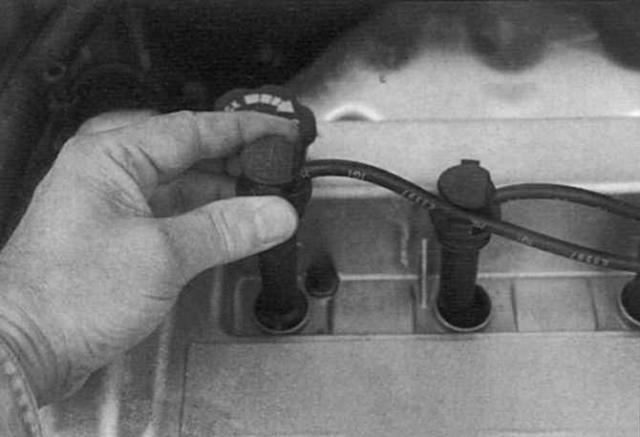
- First remove the engine cover and disconnect the spark plug connector from the spark plugs.
- Loosen the spark plugs by about three turns and blow out the spark plug holes thoroughly with compressed air. This will prevent contaminants from getting through the spark plugs into the cylinders.
Deep underground: the spark plug connector. |
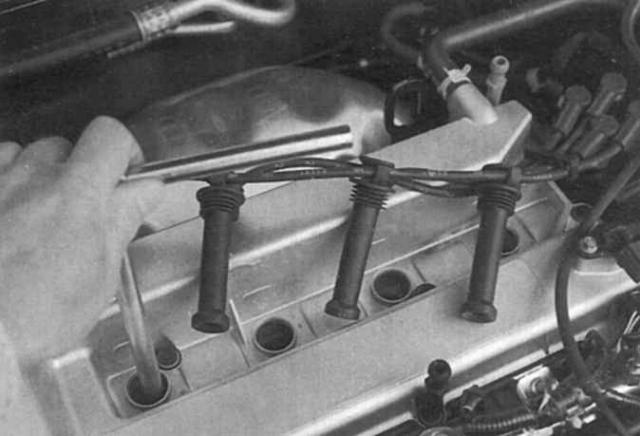
- Remove the spark plugs using a spark plug wrench and place them outside the engine compartment in cylinder order.
With a special spark plug assistant, no problem: removing spark plugs. |
- Before installation, lightly clean the threads of the new spark plugs with copper paste and screw the spark plugs firmly into the corresponding holes. Then tighten the spark plugs with a spark plug tool an additional 90° (a quarter of a turn). 90° corresponds to approximately the prescribed tightening torque of 25 Nm.
- If you are using used spark plugs, clean their threads thoroughly with a brass brush before installation, then lightly lubricate them, insert the spark plugs, screw them in firmly and then tighten them an additional 15°. This will be enough: in previously used spark plugs, the gasket is already pre-pressed before final installation.
|
|
|
HAZARD INSTRUCTIONS |
Work with the ignition system
The legislator classifies the electronic ignition system as a dangerous unit. Therefore, special precautions must be taken when performing all work on the ignition. Pacemakers, for example, may fail during such work. To be sure that you do not have any complications, it is better to transfer all work on electronic ignition systems to Ford workshops. Even when performing maintenance work, special care must be taken. - Never touch live parts of the primary and secondary electrical circuits when the ignition is on – danger to life.
- Always switch off the ignition system when performing any service work. This applies equally to replacing spark plugs, disconnecting and connecting electrical wires or connecting control instruments.
- With the ignition on, shaking the car is enough to cause a high voltage pulse. You are in danger under the engine hood, and individual parts of the ignition system may also fail.
- When carrying out electric welding work on your Mondeo, first disconnect both terminals of the battery.
|
|
|
PRACTICAL ADVICE |
The spark plugs are seated firmly
To release tightly seated spark plugs, never use "brute force": otherwise, the threads in the cylinder heads made of light metal can be destroyed. If such a problem occurs, as an exception, warm up the engine and try your luck again. Be careful - a hot engine can quickly burn your hands. Therefore, wait with installation until the engine has cooled down. Our recommendations also have a technical basis: if cold spark plugs were installed in a hot power unit, they sit as if welded. However, the spark plugs will be easier to remove the next time they are replaced if you lightly lubricate the threads with high-temperature-resistant copper grease before installation. Ignition module and cable - pay attention to them - Are the cable terminals and the multi-pin connector firmly connected to the ignition coil and control unit? The outgoing ignition cables are slightly raised due to air entering the socket contact jumpers and therefore ignition failure (misfires) is possible.
- Loose ignition cables cause leakage currents along the surface and uncontrolled spark flashovers.
- Check the coil housings for cracks or burn marks caused by overlapping sparks.
- Do the terminals make good contact with the spark plug plugs? They should not be oxidized.
- Check the high-voltage ignition cable, the insulation should not be damaged or broken. Immediately replace the cable with cleaning or extinguishing places. In a defective cable, the igniting spark may already jump off before the spark plug (the path with the least resistance!) - in this case, you can hear crackling and rattling in the engine compartment.
- Remove any salt or lime deposits from the spark plug wire.
|
|
The original version can be found on the website [FORDBOOK.RU]