


- Raise the rear of the car and remove the rear wheels;
- on vehicles with drum brakes, disconnect both brake drum safety clips and remove the brake drum, carefully pry off the protective cover with a screwdriver and unscrew the hub nut with the insert;
- in cars with disc brakes, unscrew the brake caliper and remove both safety clamps (if any) of the brake disc, carefully press the protective cover with a screwdriver and unscrew the hub nut with the insert;
Note: Tighten the wheel nuts carefully and make sure the vehicle is securely supported on supports.
- Using a two- or three-lever puller, disconnect the wheel hub flange from the axle protrusion, as shown when removing the front wheel hub.
Note: If the wheel hub bearing inner rotating race retaining ring falls out when removing the flange, replace the entire assembly.
When removing, insert the hub flange through the axle protrusion and hit with a rubber mallet. Temporarily tighten the hub nut.
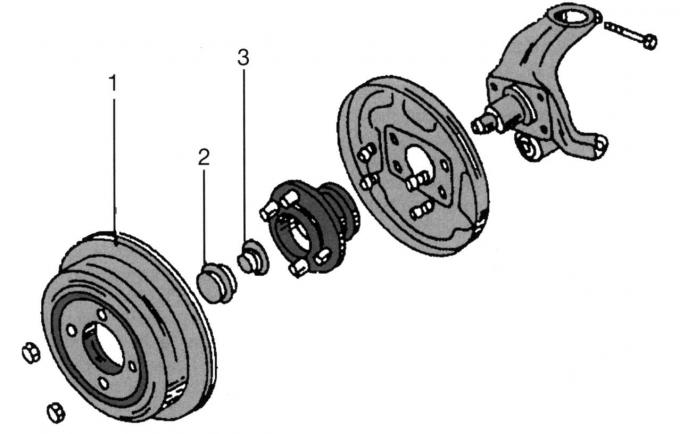
Fig. 228. Rear wheel hub parts (cars with drum brakes): 1 — brake drum; 2 - protective cap; 3 - wheel hub nut
Depending on the design of the rear brakes, the installation of the parts is carried out according to Fig. 228 or 229. When assembling, pay attention to the following:
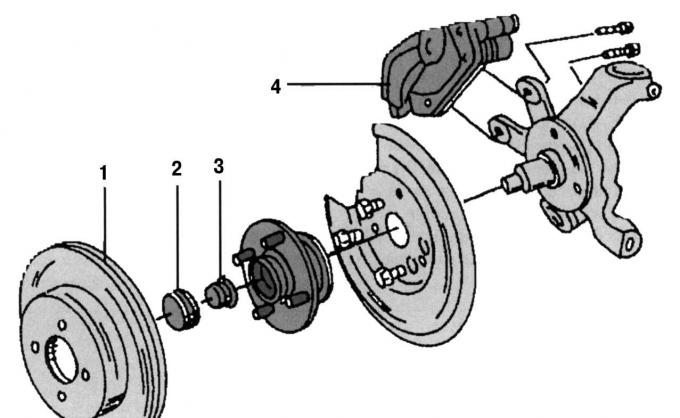
Fig. 229. Wheel hub parts (cars with disc brakes): 1 — brake disc; 2 - protective cap; 3 - wheel hub nut; 4 — brake mechanism support
- Always replace the drum or brake disc safety clips (if equipped);
- tighten the brake caliper bolts to a torque of 60 Nm;
- after the vehicle is lowered to the ground, tighten the wheel hub nut to 290 Nm;
- tighten the wheel nuts to a torque of 85 Nm.