Contents: General part ↳ Daily, when refueling, or before a… ↳ Monthly ↳ Routine maintenance - every 10,000… ↳ Standard service - every 20,000 km… ↳ Extended service - every 30,000 km… ↳ Every 60,000 km or once every 3 years ↳ Every 80,000 km or 4 years ↳ Every year, at the beginning of… ↳
General part
Below is the manufacturer's recommended maintenance schedule for the Ford Transit Diesel. All intervals listed in the schedule should be calculated from the vehicle's registration date. These intervals should be considered minimum, as they are recommended by the manufacturer for Ford vehicles, which, although driven daily, are operated only in "normal" mode. If your vehicle is frequently subjected to critical loads, we recommend performing these procedures more frequently. The more frequently your car is serviced, the more value you get from it and the higher the resale value of your car. Shorter service intervals are necessary if you are driving in dusty conditions, towing a trailer, idling, or operating at low speeds (that is, under heavy load) long enough, and also make frequent short-distance trips (less than 7 km) at temperatures close to freezing.
If your vehicle is under warranty, it must be serviced by a Ford dealer or the factory warranty will be voided. In most cases, initial maintenance procedures do not involve any costs for the owner. Please note that the first warranty service (carried out by the dealer 3 months (2500 km) after sale and definitely required for a new car) is not part of the regular maintenance and is therefore not included in the schedule below.
It should also be noted that for non-turbocharged models produced since 1992, the service intervals have been extended by the manufacturer so that temporary service procedures (every 10,000 km/6 months) integrated with standard maintenance procedures (every 20,000 km/12 months) and are consolidated into a single annual maintenance schedule, which should be performed every 16,000 km/12 months. Accordingly, owners of diesel engines of recent years can, if desired, adjust the maintenance schedule below.
Daily, when refueling, or before a long trip
- Check the engine oil level and top up if necessary (Section 3).
- Check the brake fluid level and top up if necessary (Section 3).
- If the fluid level drops shortly after adding fluid, have the system checked for leaks or damage at the first opportunity (Sections 11 and 28).
- Check the windshield/rear window washer fluid level and top up if necessary (Section 3).
- Check the tire pressure, including the spare tire (Section 4).
- Inspect the tire treads for wear or damage (Section 4).
- Check the operation of all exterior and interior lights, as well as the horn, windshield wipers and rear window washers (Sections 6 and 7).
- Replace all burned out light bulbs (Chapter 12) and clean the lenses of all external lighting devices.
Monthly
Perform all daily checks, then perform the following procedures:
- Check the coolant level and top up if necessary (Section 3).
- Check the electrolyte level in the battery (if provided for by the battery design) (Section 3).
- Check the power steering fluid level (if it is installed) and top up if necessary (Section 5).
- Inspect all tanks, hoses and pipes for leaks (Section 11).
- Check the operation of the air conditioner (if it is installed) (Section 19).
- Check the operation of the handbrake (Section 26).
- Check and adjust, if necessary, the height of the windshield/rear window and headlight washer jet (Section 6).
- Check the condition of your windshield wiper blades, replacing them with new ones if they are worn out - remember that manufacturers recommend replacing the blades with new ones annually, regardless of their condition (Section 6).
Routine maintenance - every 10,000 km or 6 months, whichever comes first
Repeat monthly checks, then do the following:
- Check the electrical system (Section 7).
- Check the battery (Section 8).
- Check your seat belts (Section 9).
- Check the drive belts (Section 10).
- Check the condition of the hoses and the presence of leaks in the engine compartment (Section 11).
- Change the engine oil and oil filter (Section 12).
- Clean the engine oil filler cap (Section 13).
- Drain the fuel filter (Section 14).
- Check steering, suspension and wheels (Section 15).
- Check the brake system (Section 16).
Caution: If the vehicle is frequently used for short distance travel (less than 16 km) or in a busy urban cycle, more frequent oil and oil filter changes should be performed. If necessary, contact your local Ford dealer for advice.
Standard service - every 20,000 km or 12 months
Add the following to the procedures described above:
- Check the condition of all electrical wiring in the engine compartment (Section 17).
- Check and adjust valve clearance if necessary (Section 18).
- Check the condition of all air conditioning system components (if it is installed) (Section 19).
- Check the doors and hood, lubricate the hinges and locks (Section 20).
- Lubricate steering kingpins and bushings (solid axle models) (Section 21).
- Check the oil level in the manual transmission (Section 22).
- Lubricate the clutch cable (Section 23).
- Lubricate the accelerator drive sliding joint and the driveshaft splines (Section 24).
- Lubricate the automatic transmission linkage (Section 25).
- Lubricate the rod and check the handbrake adjustment (Section 26).
- Inspect the driveshaft and its center bearing for wear (Section 27).
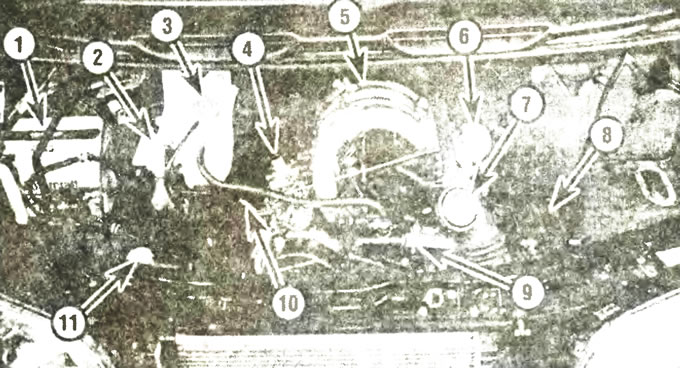
General view of the engine bay on 1992 non-turbo models: 1. Battery.; 2. Brake fluid reservoir.; 3. Expansion tank of the cooling system.; 4. High pressure fuel pump.; 5. Intake manifold (split).; 6. EGP system valve.; 7. Oil filler neck.; 8. Air filter.; 9. Thermostat housing.; 10. Dipstick for measuring the engine oil level.; 11. Windshield washer reservoir.
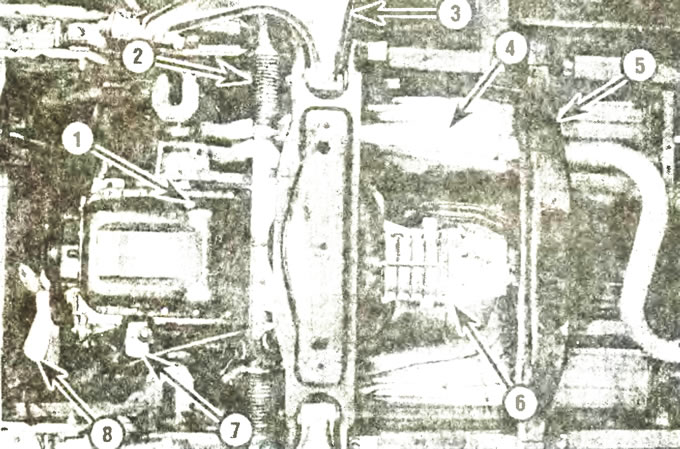
Underside view of the front of a 1992 Ford Transit Diesel short wheelbase minibus: 1. Engine drain plug.; 2. Rubber protective "accordion" of the steering gear.; 3. Lower suspension arm.; 4. Exhaust pipe.; 5. Transmission cross member.; 6. Gearbox.; 7. Oil filter.; 8. Fan.
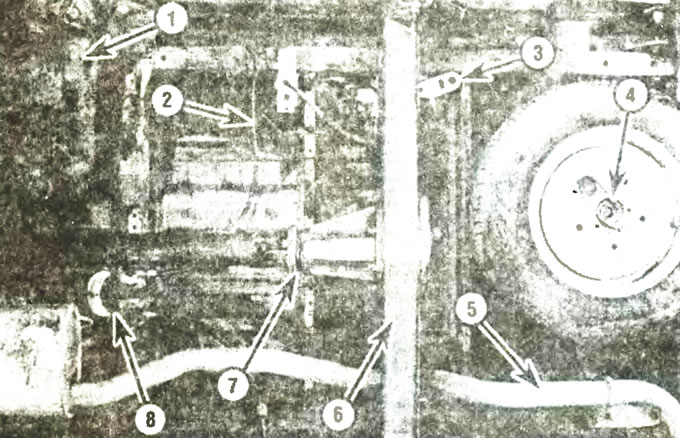
Underside view of the rear of a 1992 Ford Transit Diesel short wheelbase minibus: 1. Fuel tank.; 2. Handbrake cable.; 3. Rear wheel brake pressure control valve.; 4. Spare tire holder.; 5. Exhaust pipe.; 6. Rear axle.; 7. Cardan shaft and gear flange.; 8. Handbrake tension compensator.
- Inspect all fuel and brake system lines (Section 28).
- Check the exhaust system (Section 29).
- Check the oil level in the rear axle differential (Section 30).
- Adjust the load distribution valve (Section 31).
- Check the tightness of all wheel nuts (Section 32).
- Conduct a roadside inspection (Section 33).
- Check the transmission fluid level (Section 34).
- Check and adjust the engine speed and idle speed stabilization (Section 35).
Extended service - every 30,000 km or 3 years
Follow all the steps listed above, plus the following:
- Replace the air filter element with a new one (Section 36). Remember that replacement should be done more often if the vehicle is operated in a dusty or highly polluted atmosphere.
- Replace the fuel filter with a new one (Section 37).
- Check it out (adjust) front wheel bearings.
Every 60,000 km or once every 3 years
Follow all the steps listed above, plus the following:
- Drain and replace the coolant.
- Drain and replace the brake fluid.
- Check the installation of the front wheels.
Every 80,000 km or 4 years
Replace the camshaft timing belt with a new one.
Every year, at the beginning of winter
Clean the fuel tank of the glow plug of the pre-heating system (if any).