- When loosening stud nuts, always clean the exposed threads with a wire brush to remove any dirt or rust. This will prevent the nut from threading onto the dirty threads. Then spray the joint with rust remover spray;
- if you need to remove a screw screwed into a welded nut (mainly on the body), if possible, treat the threads on the back with a rust remover spray. The bolt heads of such connections often come off, and sometimes the welded nut comes off too;
- sometimes it is very difficult to unscrew screws with slotted or cross-heads. Cross-head screwdrivers often slip out of the slot and damage it. In such cases, you can insert the screwdriver into the slot using a hollow rod and give it a short blow with a hammer. In most cases, the bolt head separates from the joint and the screw can be easily unscrewed;

Fig. 9. Graduated disc (A) and Torx screws (B)
- in modern automobile manufacturing, screws with special heads are increasingly used, which look like heads with cross slots, but are not. Screws with such heads, called "Torx" heads, are unscrewed with special inserts, which can be purchased in a set. Fig. 9 shows such a screw. A slipping ratchet clutch, an extended handle, etc. can then be installed in the usual way on the "Torx" insert cup.;
- Allen screws (hexagon head) or "Polygon" head screws (multiple engagement, mostly 12 angles) can also be difficult to loosen. First, clean the hex hole well (e.g. with a small screwdriver) to properly seat the Allen key or polygon key. If possible, also use a socket. Before loosening the screws, you can give the socket a short blow with a hammer to loosen the resistance of the screw. However, sometimes an angled Allen key is required, but its angled position can make loosening difficult. In this case, proceed as follows: insert the key into the screw and place a small ring spanner on the long end of the Allen key. Now hold the Allen key firmly and loosen the screw by applying pressure to the ring spanner. This prevents the internal rotation of the angle key in tightly seated screws;
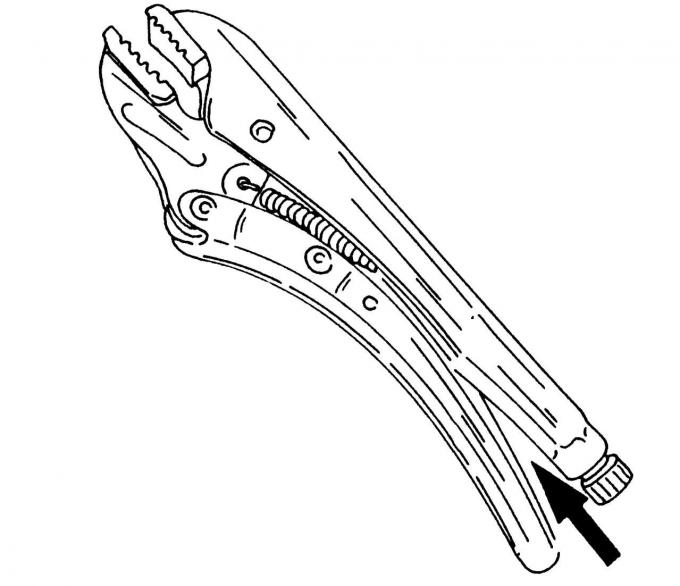
Fig. 15. Clamp
- in easily accessible places, small heads of Allen screws can be grasped with a clamp (Fig. 15) and thus the screw can be unscrewed, especially if the Allen screw already has rounded edges.
Avoid injuring your fingers when squeezing the clamp;
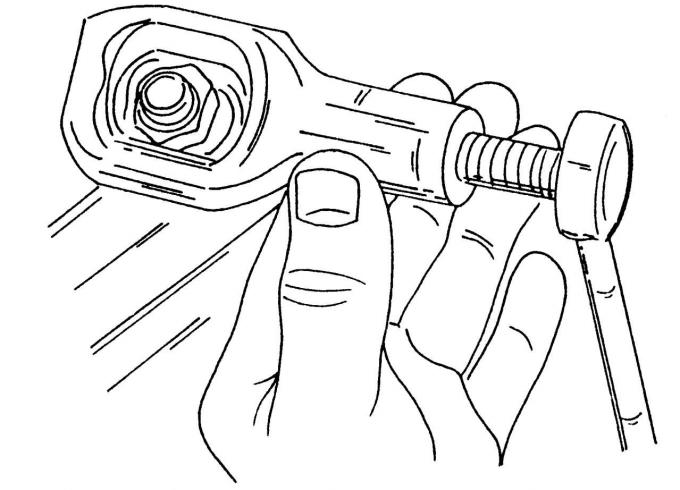
Fig. 16. Using a nut splitter
- sometimes there may be difficulties when unscrewing nuts or screws whose edges have become rounded during use, with a wrench of the wrong size (sometimes happens on used cars). You can try to unscrew the nut or screw with the clamp mentioned above. Depending on the position of the nut, it can also be cut with a chisel or sawed along the thread. If you have a spacious work area, you can use a nut splitter. The tool works as shown in Fig. 16, i.e. the screw is tightened until the nut breaks. The advantage is that when using such a tool, the screw thread is not damaged;
- the text often mentions self-locking nuts. They should always be replaced with new ones;
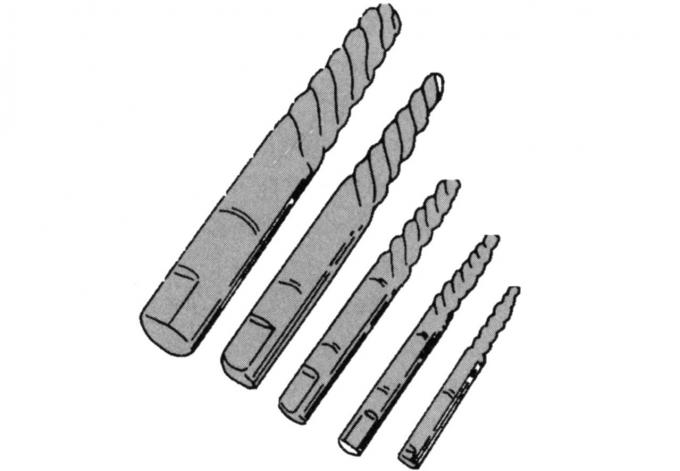
Fig. 17. Left-hand thread pullers
- sometimes it happens that the head of the screw breaks off. To remove the remaining part with the thread from the hole, drill a hole in the middle of the screw and use the so-called puller with a left-hand thread (Fig. 17). It can be purchased at auto parts stores. The puller is screwed into the drilled hole like a screw. When tightening, the tool cuts into the remainder of the screw and allows it to be pulled out. Another solution is to drill out the screw thread to approximately the diameter (somewhat less) and then cut the thread with a tap;
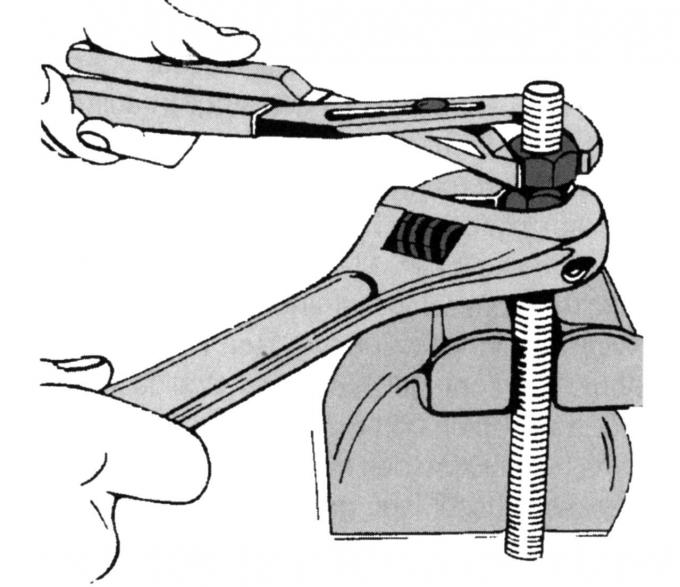
Fig. 18. Installing and removing studs
- the spacer bolts are unscrewed using two nuts locked against each other. When unscrewing, place the key on the inner nut, and when screwing in, on the outer nut. Fig. 18 shows how to unscrew and screw in the bolts;
- Sometimes when tightening screws, the threads cut in aluminum parts are damaged. They can be restored with Heli-Coil thread inserts.
Tightening torques
This manual specifies the tightening torques for screws and nuts of the main critical connections. To maintain the required tightening torques, it is necessary to use socket inserts of the appropriate size and a torque wrench, sometimes with an extended handle.
Often it is impossible to reach the screw or nut to install the torque wrench, or the tightening torque is too low to record its value on the torque wrench. Here you just need to estimate the tightening torque. In mechanics' language, this means "tighten well", and a sense of proportion plays an important role, especially with a thread diameter of 6 or 7 mm.