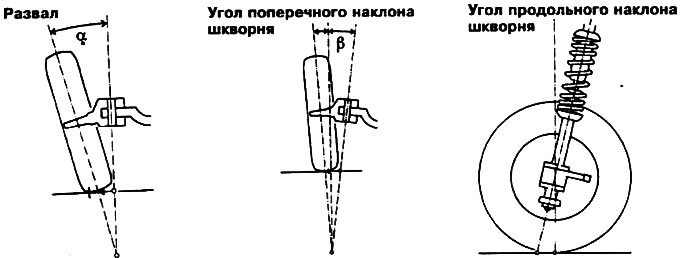
Track/camber/kingpin caster/kingpin caster
Track is the distance between the wheels of one axle. Toe-in is the difference in the distances between the steered wheels, measured at the height of the center of the wheel in front and behind, when the distance between the wheels in front is slightly less than in the back. Negative toe-in is when the distance measured in front of the wheels is slightly greater than in the back.
Convergence:
- Control value: from 0.5 to - 3.5 mm
- Setting value: - 2±3 mm
Correct camber and kingpin angles prevent the transmission of road shock to the steering and provide the lowest rolling resistance when cornering.
Camber is the angle of deviation of the wheel plane from the vertical. Thus, the wheels are installed at an angle, with negative camber, for example, the distance between the wheels at the bottom is greater than at the top. The transverse inclination angle of the kingpin is the angle between the axis of rotation of the steering knuckle and the vertical, when viewed along the axis of the car. The longitudinal inclination angle of the kingpin is the angle between the axis of rotation of the steering knuckle and the vertical, when viewed from the side of the car. The longitudinal inclination angle of the kingpin mainly determines the stabilization of rectilinear movement. Too small an angle of longitudinal inclination of the kingpin leads to the car pulling away when driving on a bad road and in a crosswind, and also returns the wheels to the middle position with insufficient force after a turn.
Conditions for checking wheel alignment angles
The steering is adjusted correctly.
There is no unacceptable clearance in the steering rod joints and ball joints, the wheels are not damaged.
The tires are inflated to the specified pressure.
The vehicle is not loaded: the spare wheel and jack are in their designated places, otherwise unload the vehicle.
Rock the car vigorously before checking.