


Caution: Do not shake the oil before pouring, as this will cause air bubbles to form.
Removing air
Fill the receiver with new, clean and bubble-free hydraulic fluid up to the "MAX" mark on the receiver.
Caution: Pour oil slowly to avoid air bubbles.
Start the engine and turn the wheels from one extreme position to the other three times.
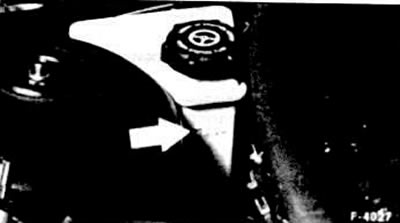
Monitor the oil level in the receiver. Do not allow the level to drop below the "MIN" mark, add oil if necessary.
Check the hydraulic system for leaks at the same time. Pipe connections, rack seals and valve bodies must be tight.
Stop the engine and check the oil level again, top up if necessary.
Note! A slight noise from the power steering after bleeding the air while the engine is running is considered normal. This noise will subsequently disappear while the vehicle is moving.
If the power steering is making a lot of noise, remove the air using an auxiliary vacuum pump.
At the service station, instead of the plug, an adapter is installed on the receiver to connect the vacuum pump. A suitable adapter can be made from another receiver cap.
Connect the vacuum pump.
Start the engine and slowly turn the steering wheel all the way to the right.
Stop the engine and use a vacuum pump to create a vacuum of about 0.15 bar until the air is completely removed from the system.
Caution! Maintain the vacuum constant for at least five minutes, equalizing it with a vacuum pump.
Finally, release the vacuum. Turn the steering wheel all the way to the left and repeat the bleeding process.
Remove the vacuum pump, check the oil level, top up if necessary. Screw in the receiver plug.
Start the engine and turn the steering wheel from lock to lock. If the power steering noise increases, repeat the bleeding process.
If the noise level is still high, leave the vehicle overnight and repeat the bleeding process the next day.