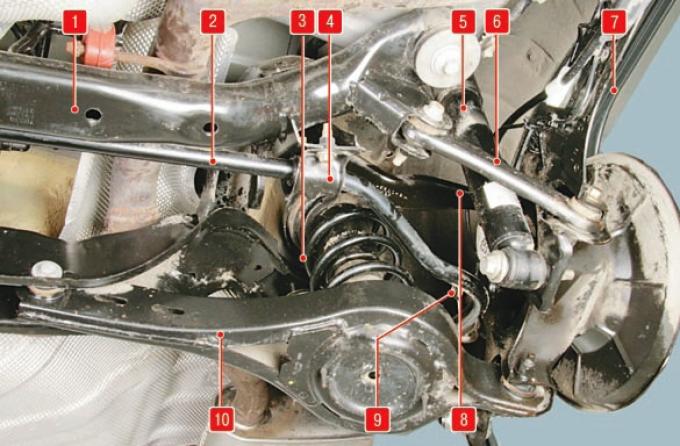
Fig. 7.2. Location of rear suspension elements on the vehicle: 1 – rear suspension crossmember; 2 - transverse stability stabilizer bar; 3 – rear suspension spring; 4 – bracket for fastening the stabilizer bar to the rear suspension crossmember; 5 – rear suspension shock absorber; 6 – Front lower arm of the rear suspension; 7 – Rear suspension trailing arm; 8 – Upper arm of the rear suspension; 9 - transverse stability stabilizer bar; 10 – rear lower arm of the rear suspension
All checks and work should be carried out from underneath the vehicle, installed on a lift or inspection pit (with the rear wheels raised).
Find out if there are any cracks or traces of contact with road obstacles or the body on the suspension parts, deformation of the levers, stabilizer bar, rear body parts in the places where the suspension units and parts are attached.
Check the condition of the rubber-metal hinges, rubber cushions, and the condition (settlement) of the suspension springs.
Rubber-metal hinges and rubber cushions are subject to replacement in case of ruptures and one-sided bulging of the rubber, as well as in case of cutting of their end surfaces.
The location of the rear suspension elements on the vehicle is shown in Fig. 7.2.
The following are not allowed on rubber-metal hinges: – signs of aging, cracks; - one-sided bulging of the rubber mass.
Replace defective parts.
Check for mechanical damage (deformations, cracks, etc.) to suspension components.
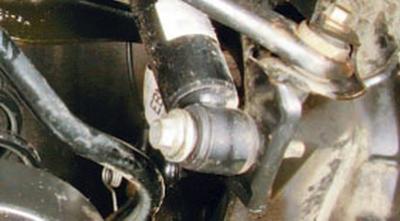
1. Inspect the rubber bushings of the lower mount…
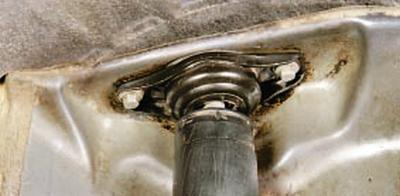
2….and the upper shock absorber mounting hinge 5 (see Fig. 7.2) and the shock absorbers. No liquid leaks or fogging are allowed on the shock absorbers.
3. Check the rubber-metal hinges (silent blocks) of the rear suspension trailing arm to the car body.
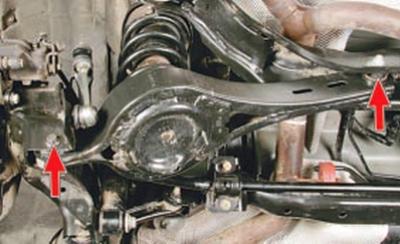
4. Using a mounting blade, check the silent blocks of the rear lower arms for play.
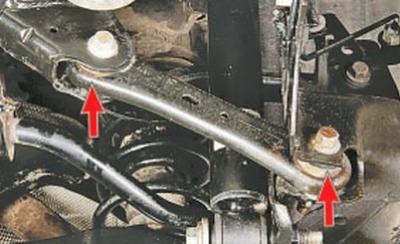
5. Using a mounting blade, check the silent blocks of the front lower arms of the rear suspension for play.
6. Similarly, check the silent blocks of the upper arms of the rear suspension.
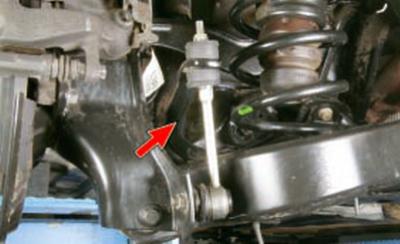
chch7. By shaking the anti-roll bar up and down, check the anti-roll bar struts and the anti-roll bar rubber pads for play.
8. Check springs 3 (see Fig. 7.2) and compression buffers.
USEFUL TIP: Pay attention to the exhaust system. Extraneous knocking sounds from it are often mistaken for knocking in the rear suspension. The use of non-standard parts or a break in the muffler suspension elements can cause a strong knock, especially when revving. To check, stop the engine, carefully inspect the exhaust system, check the reliability of the fastening and suspension of the muffler. Taking the end of the exhaust pipe, swing the muffler up and down and from side to side - there should be no knocking.
The article was taken in its entirety from the specified website: FORDBOOK