The front wheels propel your Mondeo, steer it, absorb most of the lateral forces and do most of the work of reducing speed when braking. As a result, the front tyres wear out faster than the rear tyres. So check the condition of your tyres regularly – ideally with the car jacked up.


|
ORDER OF EXECUTION |
- Rotate each wheel fully and carefully remove any stone particles or other foreign objects from the tire tread slots using a small screwdriver. If a piece of glass or a nail has "settled" somewhere on the tire surface, the frame may already be damaged in that area. In this case, a specialist should inspect it – even if the air has not yet escaped.
- Pay attention to irregularities such as cuts, nicks, cracks and missing parts of the tread pattern. Damaged rubber allows moisture to easily penetrate into the tire. However, this cannot be seen from the outside with the naked eye. For greater safety, you can ask a specialist to "x-ray" the tires. However, this also applies to cases of severe tire wear.
- The tread pattern of summer tires must be at least 2 mm deep across the entire working surface of the tire. You can"t go wrong here: the remaining tread depth can be seen in several places at once. Wherever you find the letters "twi" (tread wear indicator) on the sidewall of the tire, there are tread pattern grooves across the profile crossbars – they have an exact height of 1.6 mm. If these crossbars already make up "one" relative to the contact surface, then replace such tires immediately. And not only because this is prescribed by law, but also because the dynamic properties deteriorate significantly with a decrease in tread depth – and especially on wet roads. It is better to replace summer tires with new pneumatic tires already at a residual depth of 2.5 mm. Winter tires lose their "abilities" already at a value of about 4.5 mm.
- Check that all tires are worn evenly around the circumference.
- Carefully inspect the sidewalls of the tire: the presence of dents is an unmistakable indication of damage to the tire frame.
|
|
|
TECHNICAL DICTIONARY |
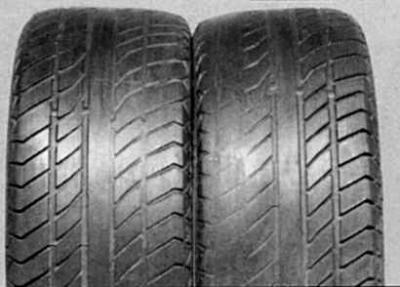
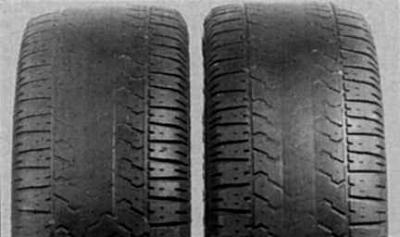
What a tire wear pattern can tell you
One-sided wear: consequences of incorrect bridge geometry. |
Center tread wear: caused by frequent driving at high speeds and with high tire pressure. |
Outer Edge Wear (Front Tyres): fast cornering. Check wheel alignment. Turn tires on rims in the direction of rotation or replace with rear tires.
Outer edges are more worn than the middle: Air pressure is too low.
Oblique pattern: Indicates that the wheels are not installed correctly. This most often occurs when the tires are worn on one side.
Strong wear in the middle of the tire compared to the outer edges occurs due to frequent driving at maximum speed. The tires "inflate" due to centrifugal force, which leads to greater wear in the middle than at the edges. This is especially noticeable on the rear wheels.
Uniform wear across the entire bearing surface: most likely, there is a defect in the shock absorber (the tires "dance" on the road surface).
Wear on both sidewalls of the tires (distributed around the perimeter): unmistakable indication of imbalance. Wheel balancing is required.
Presence of areas with severe wear: Brake plate. Appears during braking with wheel locking only in cars without ABS.
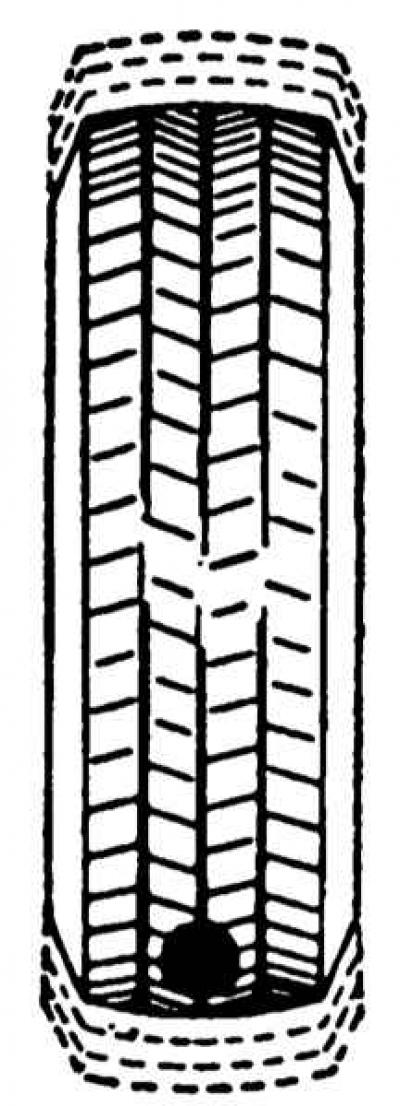
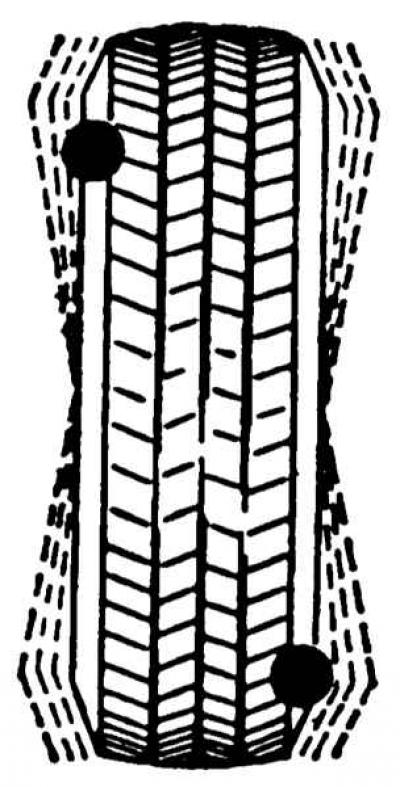
Wheel imbalance causes vibrations in the steering wheel or shaking movements of the front of the car. The reason: uneven mass ratios on the wheels. Unbalanced tires wear out faster. Therefore, immediately look for a workshop and have your Mondeo's wheels balanced.
|
Static imbalance A: is already observed when the wheel can swing freely with the car raised high: the center of gravity has completely "moved" downwards. A wheel with static imbalance bounces when driving, the shock absorber wears out faster.
|
Dynamic imbalance B: appears at high speeds. The "excess weight" is not located in the center plane of the wheel, but is slightly shifted to the right or outward or inward. When driving fast, the wheel shakes and trembles. |
|
|
|
PRACTICAL ADVICE |
How to store tires correctly
After remounting summer or winter tires, you should properly organize the storage of old tires. A dry, ventilated and dark room is best for this. Keep substances such as gasoline, oil, grease and chemicals away from tires - over time, they corrode rubber. - First, mark the direction of rotation and the location of the tire with an oil pencil from the car first aid kit (FR - front right, FL - front left, RRR - rear right, RLL - rear left).
- Remove the tires, clean them with water and a good dose of dishwashing detergent. Dry the well-cleaned tires and do not forget to remove foreign objects from the tread grooves.
- Place the tires and rims horizontally, preferably on a wooden pallet.
- Simply place the tires without rims next to each other. Rotate the tires from time to time.
|
|