


Removal
1. Separate the engine from the transmission (paragraph 7).
Cable operated clutch
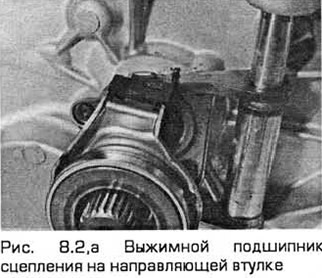
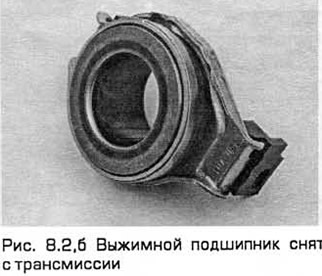
2. Remove the bearing from the guide sleeve by turning the release lever (see Fig. 8.2, a, b).
Hydraulic clutch
3. The release bearing and the slave cylinder are assembled into one unit.
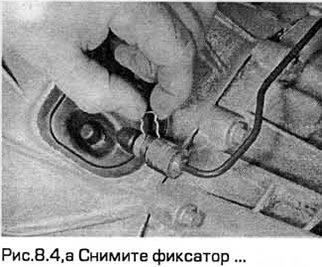
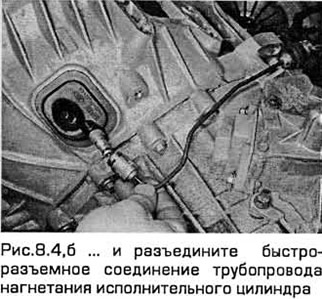
4. Remove the retainer and disconnect the quick-release connection of the actuator cylinder discharge line (see Fig. 8.4, a, b). Plug the resulting holes.
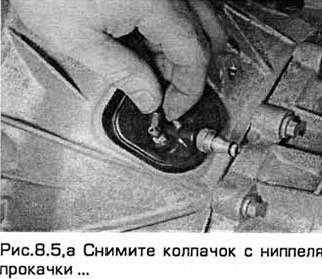
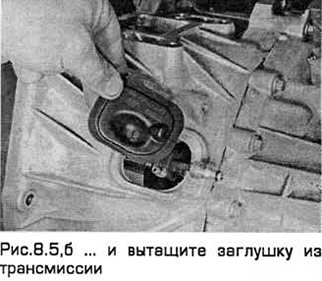
5. Remove the cap from the bleed nipple and pull out the plug from the top of the transmission (see Fig. 8.5, a, b).
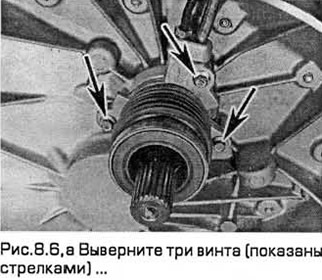
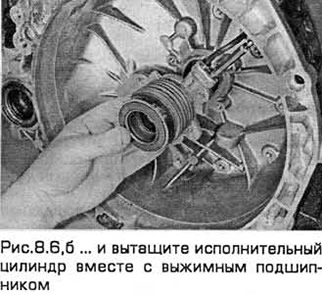
6. Unscrew the three screws and pull out the slave cylinder together with the release bearing (see Fig. 8.6, a, b).
Inspection
7. Check the smoothness of the bearing rotation and if it does not move smoothly, replace the bearing. Do not attempt to disassemble, clean or lubricate it.
8. As stated above, it is recommended to replace the bearing regardless of its condition.
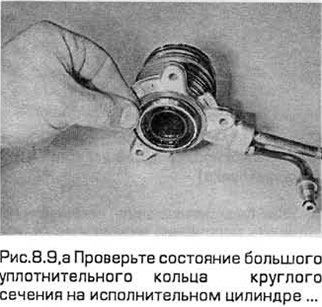
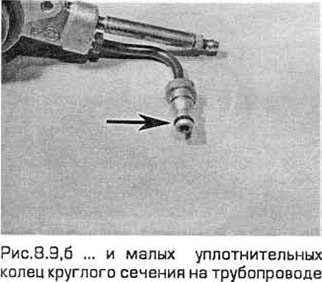
9. On models with hydraulic clutch drive, check the condition of all O-rings (see Fig. 8.9,a,b). It is recommended to install new rings in advance, since they are not easy to reach in case of malfunction.
Installation
10. Installation - in the reverse order of removal.
- a) On cable operated models, ensure that the bearing is correctly seated on the release lever fork. When installing the bearing on the guide sleeve, it is useful to slightly raise the release lever. When installing the bearing, the fork should contact the plastic shoulders of the bearing.
- b) On hydraulic models, tighten the bolts to the specified torque. Connect the pipe and remove air from the hydraulic system.