USEFUL TIP: If the clutch fails, we recommend replacing all of its components at the same time (driven and leading discs, as well as the clutch release bearing), since replacing the clutch is labor-intensive, and the service life of undamaged clutch components has already been reduced, and if they are reinstalled, the clutch may need to be replaced again after a relatively short mileage.
You will need: a 10 mm wrench (a socket head is more convenient), a mounting blade, and a mandrel for centering the driven disk.
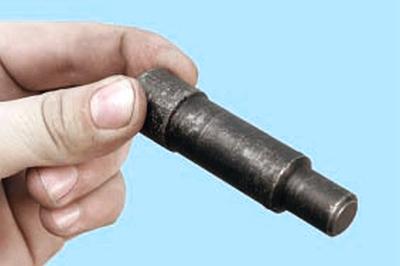
You can use a commercially available mandrel for front-wheel drive vehicles vAZ cars.
1. Remove the gearbox (see Removing and installing the gearbox).
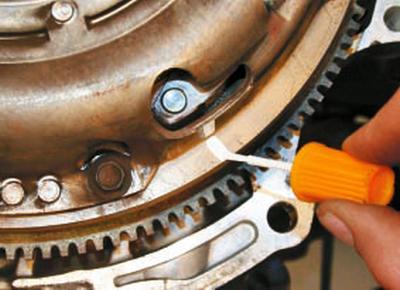
2. If you are going to install the old pressure plate, mark in any way (e.g. with paint) the relative positions of the pressure plate housing and the flywheel in order to install the pressure plate in the same position (to maintain balance).
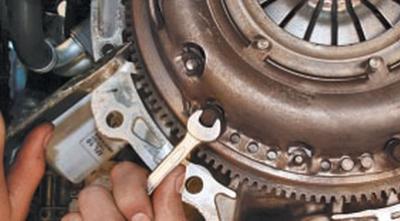
3. While holding the flywheel with a tire iron (or a large screwdriver) to prevent it from turning, remove the six bolts that secure the clutch pressure plate housing to the flywheel. Loosen the bolts evenly: one turn each, moving from bolt to bolt by diameter.
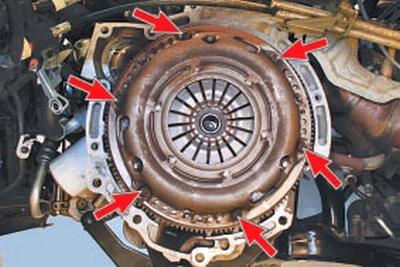
NOTE: This is the location of the clutch housing bolts that secure the engine flywheel to the clutch housing.
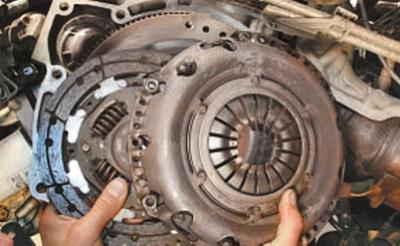
4. Remove the pressure and driven clutch discs from the flywheel, holding the driven disc.
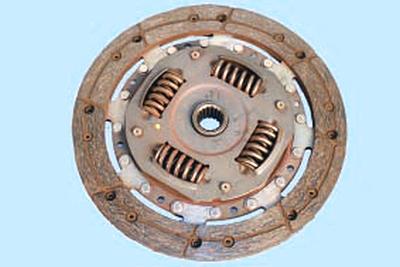
5. Inspect the clutch driven disc.
Cracks on the driven disk parts are not allowed.
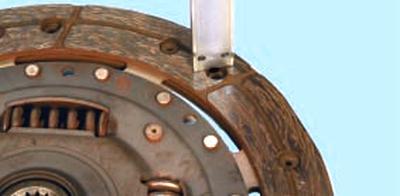
6. Check the degree of wear of the friction linings. If the rivet heads are recessed less than 0.2 mm, the surface of the friction linings is oily or the rivet joints are loose, the driven disk must be replaced. Compress the friction linings with your hands. If the total thickness of the disk in the compressed state is less than 5.5 mm for gasoline engines and less than 5.0 mm for diesel engines, also replace the disk.
NOTE: If the driven disk linings are oily, check the condition of the transmission input shaft seal. It may need to be replaced.
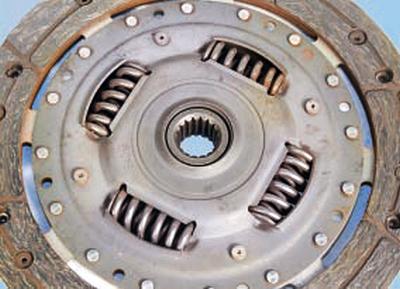
7. Check the reliability of fixation of the damper springs in the sockets of the driven disk hub by trying to move them in the sockets of the hub by hand. If the springs move easily in the sockets or are broken, replace the disk.
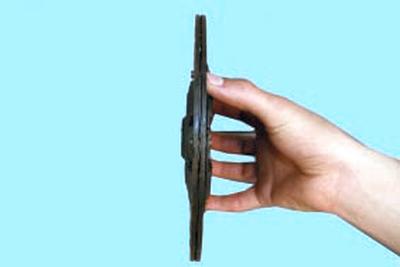
8. Check the runout of the driven disk if its warping is detected during visual inspection. If the runout is more than 0.5 mm, replace the disk.
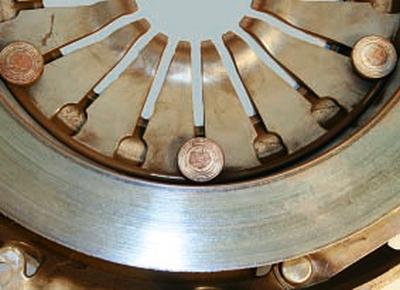
9. Inspect the working friction surfaces of the flywheel and pressure plate, paying attention to the absence of deep scratches, nicks, burrs, obvious signs of wear and overheating.
Replace defective components.
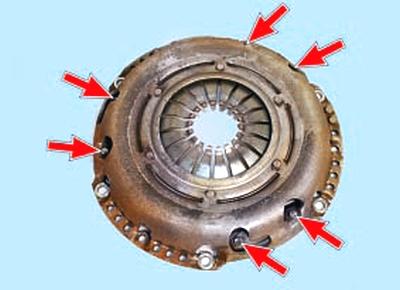
10. If the riveted connections of the casing parts and the pressure plate become loose, replace the pressure plate assembly.
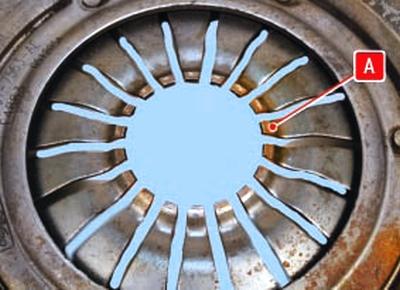
11. Assess the condition of the diaphragm spring of the pressure plate by visual inspection. The presence of cracks on the diaphragm spring is not allowed. The contact points of the spring petals with the clutch release bearing must be in the same plane and have no obvious signs of wear (wear should not exceed 0.8 mm).
Otherwise, replace the pressure plate assembly.
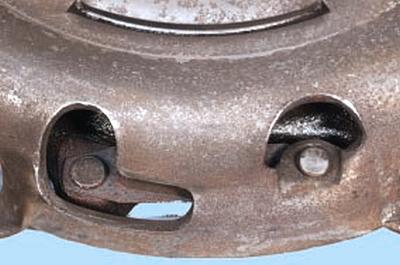
12. Inspect the connecting links of the housing and the disc. If the links are deformed or broken, replace the pressure plate assembly.
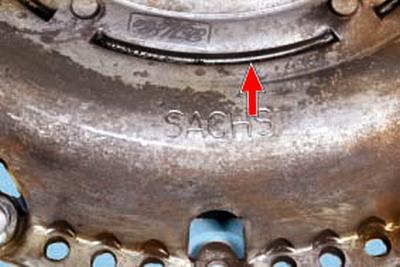
13. By visual inspection, assess the condition of the support rings of the pressure spring with the outer…
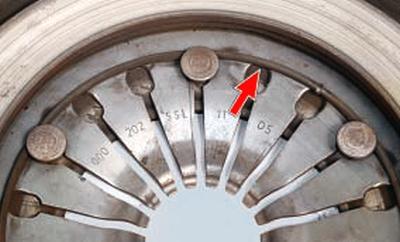
14….and the inner side of the spring. The rings should not have cracks or signs of wear.
Otherwise, replace the pressure plate assembly.
15. Before installing the clutch, check the ease of movement of the driven disk along the splines of the input shaft of the gearbox.
If necessary, eliminate the causes of jamming or replace defective parts.
16. Apply high-melting grease to the splines of the driven disk hub.
17. When installing the clutch, first install the driven disk using a mandrel…
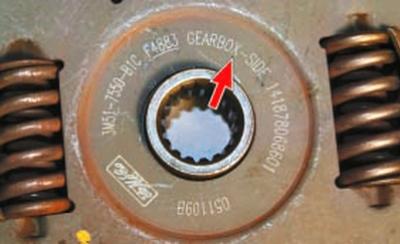
NOTE: Install the driven disc so that the inscription "GEARBOX-SIDE" is directed towards the gearbox (the protruding part of the disc hub should be directed towards the diaphragm spring of the clutch housing).
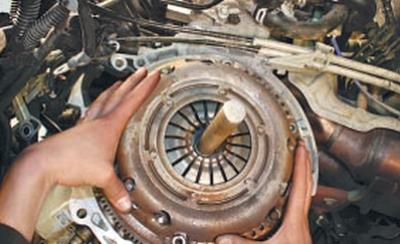
18….then place the pressure plate casing on the three centering pins and screw in the casing mounting bolts to the flywheel.
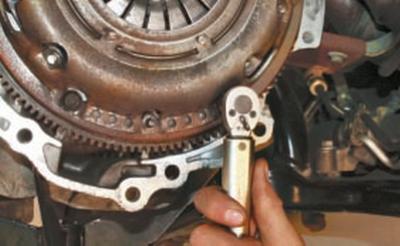
19. Screw in the bolts evenly, one turn each, moving from bolt to bolt in turn by diameter. The tightening torque of the bolts is specified in Appendix 1.
20. Remove the mandrel and install the gearbox.
21. Check the operation of the clutch (see Checking the Clutch Release Pedal Travel).
For details, please visit the website fordbook.ru