Contents: Set of tools for maintenance and… ↳ Set of tools for medium and major… ↳ Special tools and devices ↳ Buying tools ↳ Storage and maintenance of tools ↳ Workplace ↳
Selecting good tools is the key to good maintenance and successful repair of your car. For car owners who do not have such tools, purchasing them will cause significant expenses. However, provided that the tools purchased meet safety requirements and are of good quality, they will serve for many years and save a lot of money.
To help the car owner decide what tools he or she needs to perform the various jobs described in this guide, we have compiled three tool lists under the following headings: "Maintenance & Repair," "Medium & Major Repair," and "Specialty." Owners who have no experience with repairs should begin by purchasing a set of tools for Maintenance & Repair and limit themselves to a simple work area around the car. Then, as experience increases, they can move on to more complex tasks. This will require the purchase of additional tools as needed. In this way, a "Maintenance & Repair" set can be expanded to a "Medium & Major Repair" set over a significant period of time, without incurring a large one-time expense. Experienced mechanics may have a set of tools suitable for most repairs, plus additional tools from the "Specialty" category, if they are confident that the expense of purchasing them will be justified by the frequent use of the tools.
Set of tools for maintenance and minor repairs
This list represents the minimum set of tools needed for maintenance and minor repairs. We recommend purchasing combination wrenches (a box wrench on one side and an open-end wrench on the other). Although these wrenches are more expensive, they combine the properties of both types of wrenches.
Set of wrenches:
- Metric - from 8 to 19 mm inclusive
- Adjustable wrench - 35mm jaws (approx.).
- Spark plug wrench (with rubber insert)
- Brake adjuster key (depending on version)
- Spark plug gap adjustment device
- Set of feeler gauges
- Key for unscrewing the brake system bleed nipples
Screwdrivers:
- With flat end - 100mm long x 6mm diameter
- With cross end - 100mm long x 6mm diameter
Tools:
- Pliers
- Hacksaw
- Tire inflation pump
- Tire pressure gauge
- Butter can
- Oil filter removal tool
- Sandpaper (fine)
- Wire brush (small)
- Funnel (medium)
Set of tools for medium and major repairs
These tools and accessories are essential for any major car repair and complement the tool kit for maintenance and minor repairs.
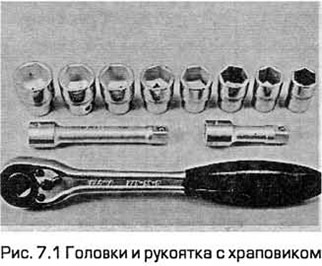
The list includes a set of socket wrenches with replaceable heads. Although expensive, it is very convenient for repair work when unscrewing nuts and bolts with different heads. For such wrenches, we recommend a square head ratchet, as it can be used with most torque heads.
The tools in this list sometimes require supplementation with tools from the Special List:
- A set of socket heads (or open-end wrenches) with the same parameters as in the previous list
- Reversible ratchet handle (for use with socket heads) (see Fig. 7.1)
- Extension at least 250 mm long (for use with socket heads)
- Cardan joint ratchet (for use with socket heads)
- Torque wrench (for use with socket heads)
- Self-locking clamps
- Round head hammer
- A hammer with a soft head (plastic, aluminum or rubber)
- Flat-head screwdrivers - long power, short (wide), narrow (for electrical work)
- Phillips head screwdrivers - long power, short (wide)
- Pliers with long jaws
- Side cutters (for electrical work)
- Snap ring pliers - external and internal
- Chisel - 25 mm
- Scriber
- Scraper
- Kern
- Beard
- Hacksaw
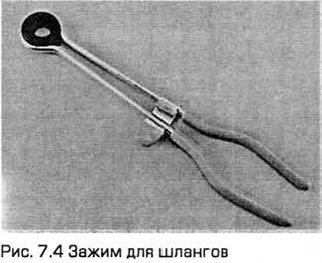
- Brake hose clamp (see Fig. 7.4)
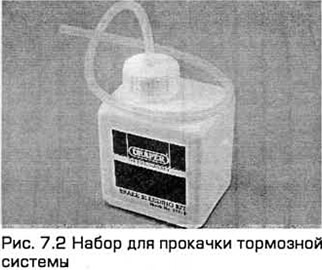
- Brake bleeding kit (see Fig. 7.2)
- Set of drills
- Steel ruler
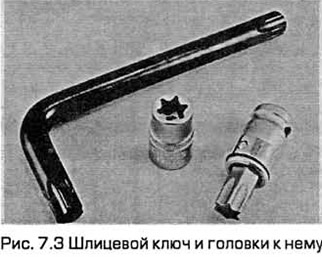
- Allen keys (including slotted head keys) (see Fig. 7.3)
- Set of files
- Wire brush
- Car stands
- Jack (hydraulic or mobile)
- Portable lamp with extension cord
Special tools and devices
The tools and accessories listed here are not used often and are expensive. However, they should be used according to the manufacturer's instructions. If you rarely do complex mechanical work, these tools will not pay off. In this case, you may want to team up with friends (or join a car club) to buy or rent these tools.
The following list contains only tools and accessories that are commercially available, not those manufactured by the vehicle manufacturer specifically for the dealer network. References to special tools may be found throughout this manual. Usually, an alternative method of doing the job is given - without the special tools. However, sometimes there is no alternative. If this is the case at the depot, and the appropriate tools cannot be purchased or rented, then the work must be entrusted to the dealers.
- Valve Spring Compressor
- Valve grinding tool
- Piston track conductor
- Tool for removing / installing piston tracks
- Honing head for boring cylinder mirror
- Ball joint puller
- Suspension spring compressor (if any)
- Bearing and hub pullers with two/three jaws
- Impact screwdriver
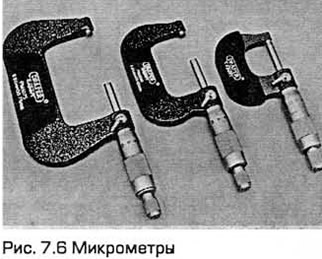
- Micrometer and/or caliper (see Fig. 7.6)
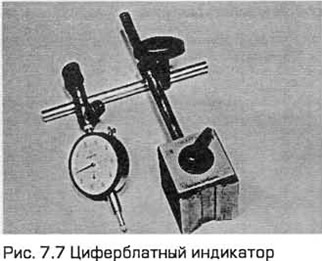
- Dial indicator (see Fig. 7.7)
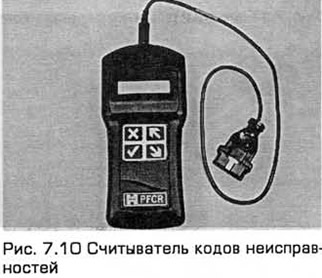
- Universal Electrical Tester
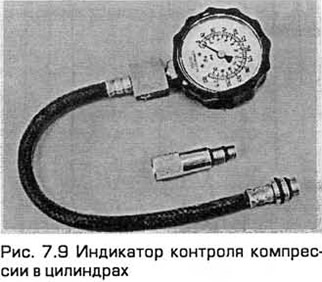
- Cylinder compression indicator (see Fig. 7.9)
- Clutch slave disc centering tool
- Drum brake shoe removal tool
- Device for pressing out/pressing in bushings and bearings
- Stud Extractor
- Set of taps and dies for cutting threads
- Lifting device
- Mobile jack
Buying tools
Supermarkets and big box stores often offer excellent, high quality tools and accessories at low prices.
Remember: you don't have to buy the most expensive tool, but you also don't want to buy the cheapest one. Beware of "bargains" offered at car boot sales and similar places. Of course, you can buy good tools at reasonable prices, but always try to buy products that meet safety requirements. When in doubt, consult with the owner or manager of the store.
Storage and maintenance of tools
Once you have purchased the necessary set of tools, keep them clean and in good working order. After use, always clean the tools from dirt, oil and metal particles with a dry cloth. Never leave tools on the workbench if you are not currently using them. Simple tools such as screwdrivers and pliers should be stored on the walls of the garage, wrenches and socket heads - in a metal box. Any measuring devices, indicators, etc. should be stored in places where they will be protected from damage and rust.
Exercise basic caution when working with tools and equipment. From time to time, hammer heads get nicked and screwdriver blades become dull. Give your tools a little attention, sand them or file them down, and they'll be back to their original condition.
Workplace
If the scope of the planned work is greater than that of normal maintenance, it is necessary to provide a comfortable work place. Such work, for example, assembling and disassembling the engine, etc., should be carried out under the roof in the garage. Wherever possible, disassembly of parts should be carried out on a clean, flat workbench or table of suitable height.
Any workbench should be equipped with a vice with an opening of up to 100 mm. Such a vice is suitable for most work places. As mentioned above, a clean, dry place should be allocated for storing tools. In addition, a place is required to store all kinds of lubricants, liquids, paint for touching up, etc.
One of the most common tools in the garage is a power drill with a chuck for drill bits up to at least 1/4" in diameter, which can be used for a variety of jobs.
Last but not least, always keep some old newspapers and clean rags in your work area and keep it clean.