Contents: Examination ↳ Tension ↳ Adjusting the tension of the sliding… ↳ Flat drive belt ↳ Replacing the belt ↳
The auxiliary drive belt is located on the front of the engine and drives the alternator, water pump, power steering pump and air conditioning compressor from the engine crankshaft pulley.
Examination
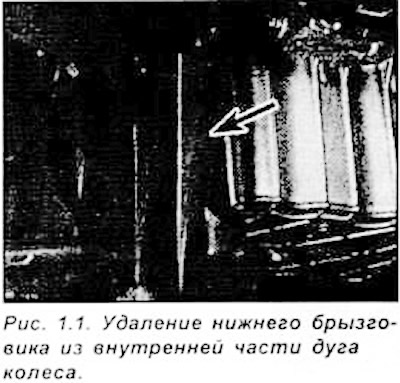
For improved access, raise the front right side of the vehicle, remove the wheel, then remove the lower splash guard from the inside of the wheel arch (See Fig. 1.1).
Turn the engine over with a wrench on the crankshaft pulley and inspect the entire length of the accessory drive belt for cracks, delamination, and torn or worn ribs.
Tension
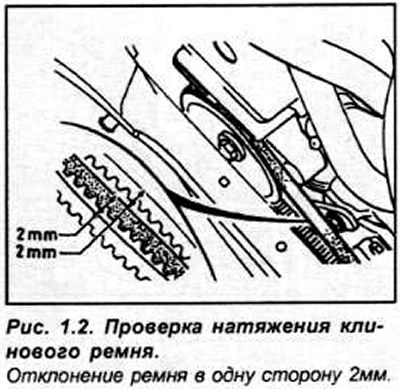
Tension adjustment is only necessary on V-belts. Flat drive belts are equipped with an automatic tensioning mechanism. To adjust the belt tension, a special measuring tool must be used, however, the tension can be roughly checked by pressing a finger on the middle of the long branch of the belt, while the belt deflection should be about 2 mm in one direction.
Adjusting the tension of the sliding V-belt drive
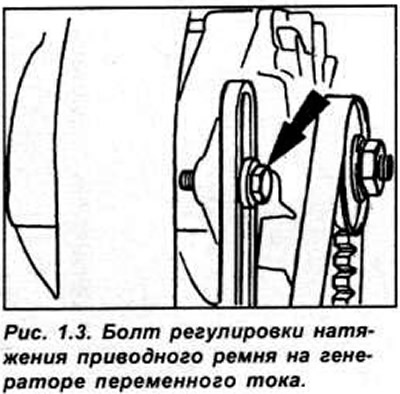
To adjust the tension of the auxiliary drive belt, loosen the generator mounting bolts and the adjusting bolt, then rotate the alternator away from the engine until the required tension is obtained and tighten the bolts (see Fig. 1.2, 1.3).
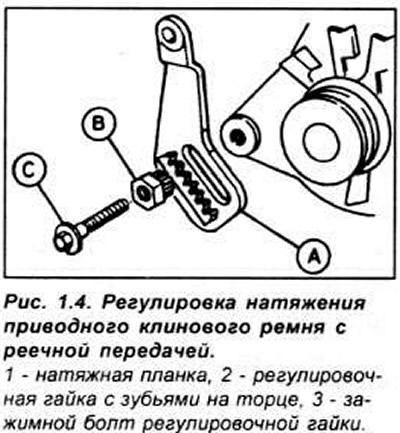
Adjusting the tension of the rack and pinion drive V-belt.
To adjust, loosen the alternator mounting bolts and tension bar mounting bolt. Loosen the central clamping bolt of the toothed nut and turn the nut until the required belt tension is obtained and retighten the clamping bolt and mounting bolts (see Fig. 1.4).
Run the engine for 5 minutes and check the belt tension.
Flat drive belt
The flat drive belt has an automatic tensioning mechanism, and no adjustment is required during operation. If the belt tension is clearly insufficient, the tensioning mechanism must be replaced. Remove the drive belt, then unscrew the bolt and remove the tensioning mechanism.
Replacing the belt
To replace the belt, jack up the front right side of the vehicle, remove the wheel, then remove the lower splash guard from the inside of the wheel arch.
The location of the drive belt around the pulleys depends on the type of drive belt and whether you have power steering or air conditioning.
If the belt is to be reinstalled, mark the direction of rotation of the belt so that the belt can be reinstalled in that position. To replace a V-belt, completely release the belt tension and remove the belt from the pulleys. To replace a flat belt, insert a spanner into the hexagon in the center of the automatic tensioner pulley. Rotate the tensioner pulley clockwise to release the belt tension, then remove the belt (see Fig. 1.5).
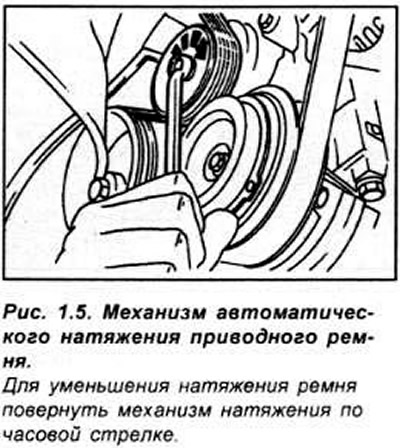
Check all pulleys to ensure that their working surfaces are clean and free of oil. Check the operation of the automatic tensioning mechanism. When turning the pulley clockwise, the force of the compressed spring should be felt, and the return of the pulley should be smooth.
Install the drive belt on the upper pulleys, turn the tensioner pulley clockwise and install the drive belt on the crankshaft pulley and release the tensioner.
Turn the crankshaft two revolutions using the crankshaft pulley and check the position of the belt on the pulleys and its tension.