Contents: Removal ↳ Installation ↳
Removal
The manual gearbox is removed from the bottom of the engine compartment after disconnecting it from the engine. Due to the fact that the gearbox has a significant weight, it is necessary to use a jack or other lifting mechanism to lower it. Also, when removing the gearbox, it is necessary to support the engine, for which you can use a second jack.
Remove the negative terminal from the battery. Remove the air filter and engine air supply system components. Disconnect the clutch cable from the clutch release lever.
Remove the lock nut and the speedometer cable from the transmission. Also, if equipped, disconnect the vehicle speed sensor connector.
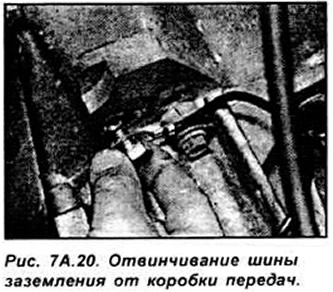
Remove the bolt and remove the ground bus from the gearbox.
Remove the transmission breather hose from the hole in the side member. To ensure proper adjustment of the gearshift mechanism, when installing the transmission, engage second gear on a four-speed transmission or fourth gear on a five-speed transmission.
Unscrew the three upper bolts securing the gearbox to the engine (see Fig. 7A.20).
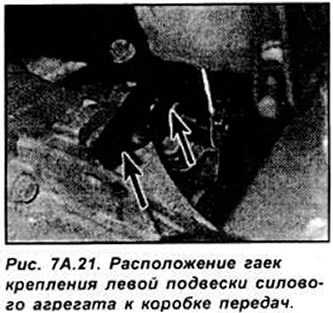
Unscrew the two nuts securing the left powertrain mount to the gearbox (see Fig. 7A.21).
Raise the front of the vehicle and support it on stands.
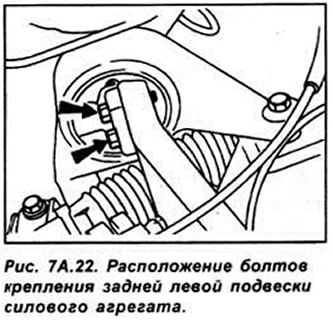
On HCS engines, unscrew and remove the spark plug for cylinder 4. to avoid damaging it when lifting the engine with a winch. Place a jack under the engine and raise it so that the weight of the engine is supported by the jack. Unscrew the two bolts and remove the rear left suspension of the power unit (see Fig. 7A.22).
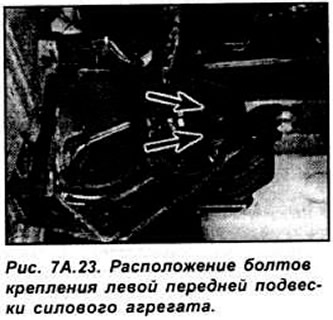
Similarly, unscrew the two bolts securing the front left suspension of the power unit (see Fig. 7A.23). Disconnect the connector from the reversing light switch. Disconnect the wires, then unscrew the bolts and remove the starter.
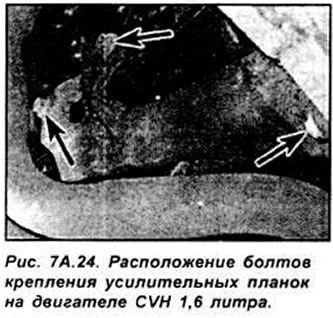
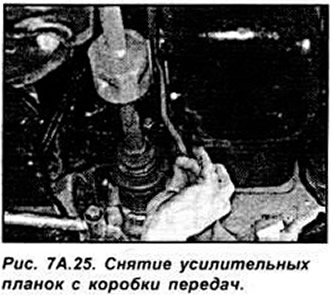
On a 16L CVH engine, remove the seven bolts securing the reinforcement bars and remove the reinforcement bars on each side. Remove the bolt and remove the intermediate plate (see Fig. 7A.24, 7A.25).
On 1.3 and 1.4 liter engines, unscrew the bolts and remove the intermediate plate.
Before disconnecting the gear shift rod, mark the position of the gear shift rod and gear shift shaft. Unscrew the gearbox stabilizer mounting bolt, disconnect it from the gearbox and, using wire, tie it to the gear shift rod.
Remove both wishbones by first unscrewing the mounting bolt on the bracket and then the nut on the ball joint. Unscrew and remove the left steering rod ball joint from the steering knuckle. Remove the drive shaft from the gearbox. To do this, insert a crowbar or large screwdriver between the constant velocity joint and the gearbox housing and, while an assistant pulls the car wheel outward with force, knock the drive shaft out of engagement in the differential axle gear with a strong, sharp blow to the end of the crowbar. Tie the drive shaft removed from the gearbox to the steering rods with soft wire. Remove the second drive shaft in the same way. Instead of the removed drive shafts, insert plastic or wooden plugs to secure the differential axle gears.
Lower the engine with the gearbox a little, then unscrew the mounting nut and remove the suspension from the gearbox. Unscrew the bolts that secure the gearbox to the engine. Check again that all gearbox connections are separated.
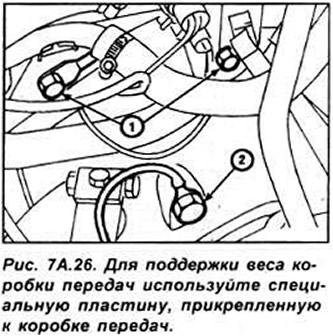
Check that the engine is securely supported. The engine can be supported either by a winch or by a jack from underneath the vehicle (see Fig. 7A.26).
Raise the gearbox slightly with your hand, move it away from the engine until the splines of the clutch driven disk hub disengage from the input shaft, then lower it and remove the gearbox from under the car.
Installation
Installation is carried out in the reverse order of removal, taking into account the following points:
- check that all mating surfaces are clean;
- lubricate the splined portion of the gearbox input shaft and the release bearing guide sleeve with a thin, even layer of special grease, since when the clutch is operating, excess grease will be thrown onto the clutch working surfaces;
- on 1.3 and 1.4 litre engines, check that the connector plate is correctly seated on the guide pins on the engine;
- when installing drive shafts into the gearbox, use new drive shaft retaining rings;
- install the gearbox support bracket onto the 3 studs and tighten with nuts;
- lower the vehicle. Raise the engine with a lifting device until the threaded holes on the transmission support are aligned. Insert the 2 bolts and tighten them to the specified torque;
- install and secure the wishbones and left steering tie rod joint;
- connect and adjust the gearshift mechanism. Tighten all bolts and nuts to the specified torque;
- if necessary, top up the transmission oil level in the gearbox to the normal level.