Identification marks and markings for correct piston and connecting rod position
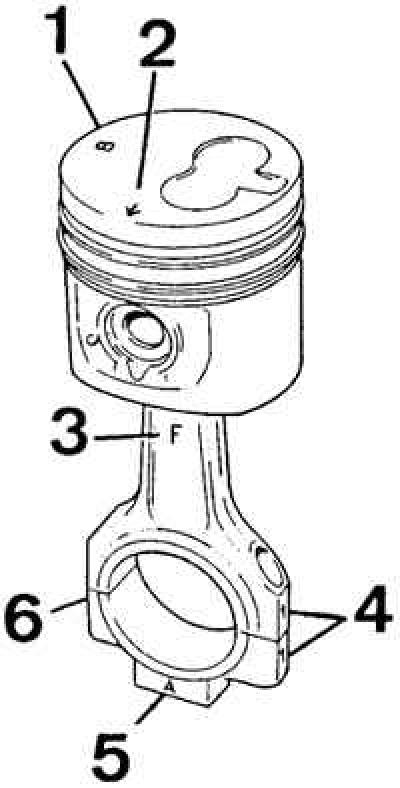
1 – piston diameter designation; 2 – designation of the direction of installation in the cylinder (the arrow should point towards the valve timing drive); 3 – designation of the direction of installation of the connecting rod relative to the piston (the letter "F" should be directed in the same direction as the arrow on the bottom of the piston); 4 – cylinder number designation; 5 – connecting rod length designation; 6 – designation of connecting rod mass
High pressure fuel pump drive
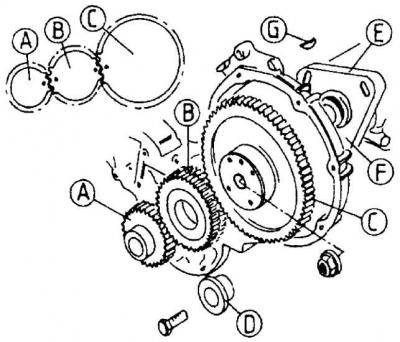
A – crankshaft gear; B – intermediate gear; C – fuel pump gear; D – bearing sleeve; E – fuel pump flange; F – seal; G – segment key
1. Install the crankshaft thrust half rings into the sockets in the middle main bearing, directing the oil grooves of the half rings outward of the main bearing.
2. Insert the main bearing shells.
3. Lubricate the main and connecting rod journals of the shaft and the main bearing shells with oil.
4. Install the crankshaft on the main bearing shells in the engine cylinder block.
5. Install the main bearing caps (with arrows on the caps pointing towards the timing drive) together with the liners.
6. Lubricate the threads of the new main bearing cap bolts with oil.
7. Tighten the main bearing cap bolts to the specified torque.
Caution! Use only new bolts to secure the main and connecting rod caps.
8. If the piston rings were removed, install them on the pistons with the inscription "TOP" towards the bottom of the piston.
9. Place the ring locks at an angle of 120°.
10. Lubricate the smooth surface of the cylinders, the side surface of the pistons and the piston rings with oil.
11. Install the half bearings into the connecting rod bases.
12. Install the piston-connecting rod assemblies in the cylinders, paying attention to the installation marks:
- the connecting rod and cover are marked with the number of the cylinder in which they are installed (cylinder No.1 on the timing drive side);
- the arrow on the bottom of the piston and the letter "F" on the side surface of the connecting rod journal must be directed towards the drive of the system;
- the connecting rods are divided into four selection groups, differing in the distance between the axes of the head and base holes; this allows to limit to a minimum the difference in the piston protrusion above the upper plane of the cylinder block (and thus the difference in the compression ratio in individual cylinders);
- the selection group of the distance between the centers of the connecting rods is designated by the letters "A", "B", "C" and "D" stamped on the caps of the connecting rods (the letter "A" refers to the shortest connecting rods);
- the cranks are divided into two selection groups depending on their weight: "light" and "heavy"; all connecting rods in an engine must belong to the same mass group.
13. Insert the half bearing shells into the connecting rod caps.
14. Lubricate the connecting rod bearings and shaft journals with oil.
15. Install the connecting rod caps, paying attention to their markings.
16. Insert new connecting rod cap bolts and lubricate their threads with oil.
17. Tighten the connecting rod cap bolts to the specified torque.
18. Install the front cover with the oil pump. Lubricate the pump with oil and turn it. Before installing the cover, insert the sealing ring into it.
19. Install the crankshaft rear cover together with a new gasket reaching the bottom plane of the engine cylinder block.
20. Tighten the rear cover mounting bolts.
21. Using tool 21.148 and the mounting bolt, install the crankshaft pulley, the front plate of the cylinder block together with a new gasket.
22. Lubricate the front journal of the crankshaft and the O-ring of the pulley with oil.
23. Install the oil pump receiver with a new seal.
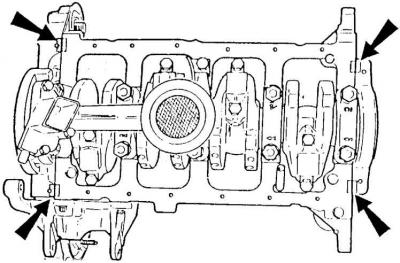
24. Lubricate the areas indicated by the arrows with a thin layer of sealing paste and install the oil pan together with the new gasket.
25. First insert the four oil pan mounting bolts into the corners of the oil pan, tighten them by hand, then insert and tighten the remaining oil pan mounting bolts by hand.
26. Tighten the bolts, except for the bolts in the corners of the pan, to the specified torque.
27. Tighten the bolts at the corners of the oil pan to the specified torque.
28. Screw on the oil filter.
29. Install the high pressure fuel pump with a new seal on the gear housing and tighten the bolts and nuts.
30. Install the gear on the crankshaft, making sure that the keyway with the key in the journal is exactly opposite the keyway in the gear
31. Lubricate the bearing seat in the intermediate gear with oil, install the gear with the bearing sleeve without the washer. The narrow part of the gear should be directed backwards.
32. When assembling the high pressure fuel pump drive, the marks on the gears must match.
33. Install the high pressure fuel pump gear.
34. Install the pump drive cover, having first inserted the radial sealing rings.
35. Install the coolant pump with a new seal.
36. Install the crankshaft belt pulley.
37. Install the cylinder head.
38. Install the vacuum pump with a new O-ring. To do this, turn the engine until the camshaft eccentric has its shortest stroke. Then install the lower bolt, vacuum pump and upper bolt in sequence. Tighten both bolts evenly and install the oil return hose.
39. Screw on the thermostat housing with a new seal. The color mark should be facing up.
40. Install glow plugs and busbar.
41. Install a heat shield.
42. Screw the fuel filter to the cylinder head and connect the fuel lines to the pump.
43. Install a new fuel filter.
44. Set the high pressure fuel pump to the start of fuel delivery.
45. Install the generator.
46. Install the flywheel onto the crankshaft.
47. Install the clutch on the flywheel, having first centered the clutch disc relative to the flywheel using a mandrel.
48. Install the starter.
49. Install the exhaust manifold.