


Main dosing system
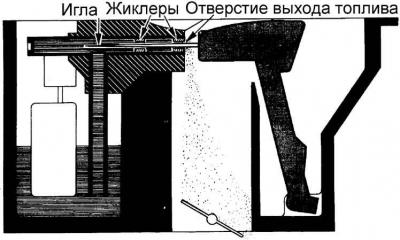
Needle valve with float
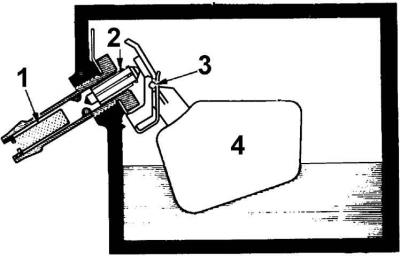
1 – filter; 2 – valve; 3 – float axis; 4 – float
Fuel enters the carburetor through a needle valve, which is controlled by a float. When the fuel level in the float chamber is low, the float drops and opens the needle valve, which causes the float chamber to fill with fuel, the float rises and closes the needle valve, stopping the fuel supply.
The fuel level in the carburetor is not regulated, since small fluctuations in the fuel level do not affect the operation of the carburetor. The opening of the float chamber communicates with the main jet body and the carburetor suction channel, thereby eliminating the possibility of gasoline vapors entering the atmosphere.
The composition of the working mixture is regulated by a pneumatic valve, which opens and closes depending on the engine operating mode. This valve is driven by a diaphragm, which, in turn, opens and closes depending on the vacuum in the diffuser between the pneumatic valve and the throttle valve.
When idling, the engine consumes little air and therefore the valve closes, causing the air velocity near the main jet outlet to increase. However, when the throttle valve opens, the vacuum in the diffuser increases and the diaphragm held by the spring opens the pneumatic valve.
As the throttle valve opens further, the valve continues to open and the control vacuum force and spring tension are balanced throughout the entire speed range. Fuel is drawn from the float chamber through the transfer tube and then through two jets and a conical needle valve into the engine.
At low revs, the needle enters the main jet and restricts the flow of fuel. During acceleration and at high revs, the needle is pulled out of the main jet by the pneumatic valve to which it is attached. Since the needle has a conical shape, the amount of its movement regulates the amount of fuel passing through the main jet.
The full article is on the online resource: www.FordBook.ru