Contents: Removal and installation ↳ Checking the shock absorber ↳ Signs of a faulty shock absorber ↳
Upper rack mounting elements
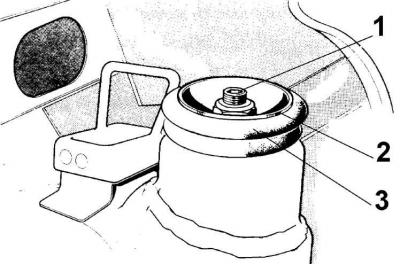
1 – shock absorber rod; 2 – conical washer; 3 – elastic sleeve
Lower shock absorber mount
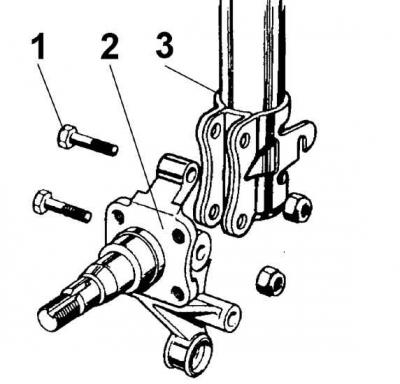
1 – bolt; 2 – hub base; 3 – shock absorber strut
Removal and installation
1. Loosen the wheel bolts, raise and secure the rear of the car on stands and remove the wheel.
2. Place a jack under the transverse arm and lift the arm slightly.
3. Open the rear door of the car, remove the shelf and the protective cap from the upper nut of the rack.
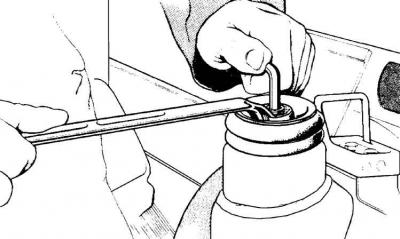
4. Use a bent open-end wrench to unscrew the shock absorber rod mounting nut, while using a second Allen key to prevent the rod from turning.
5. Remove the conical washer and elastic bushing upwards.
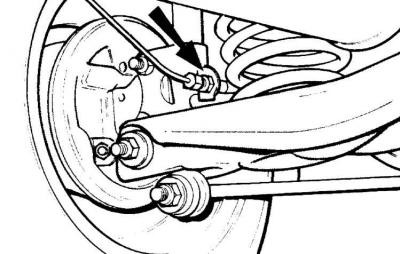
6. From underneath the vehicle, disconnect the brake hose from the shock absorber strut (the arrow indicates the location where the brake hose is attached to the shock absorber strut).
7. Unscrew the lower shock absorber support fastening and remove the shock absorber strut downwards together with the cup and elastic bushing.
8. Check the condition of the shock absorber.
9. Installation is carried out in the reverse order of removal.
Checking the shock absorber
1. A precise check of the shock absorber parameters is performed on a test bench. The condition of the shock absorber can be determined approximately by manually compressing or stretching the shock absorber removed from the car. In a serviceable shock absorber, the rod should move evenly, with the same force from stop to stop.
2. If there are significant leaks of shock absorber fluid, the shock absorber must be replaced.
Signs of a faulty shock absorber
A shock absorber that has failed is determined by the following signs:
- strong, prolonged vibrations or rocking of the car body when driving over uneven roads;
- wheels bounce and the car body vibrates even on a smooth road;
- deterioration of stability and skidding of the vehicle on turns.