Removal
Remove the brake drum. Spread the brake shoes at the top to release the wheel brake cylinder and the automatic adjuster will lock them in this position.
Clamp the brake hose with a suitable clamp. Make sure that the hose is not damaged by the clamp. Loosen the union nut of the brake hose on the back of the wheel cylinder (see Fig. 9.34).
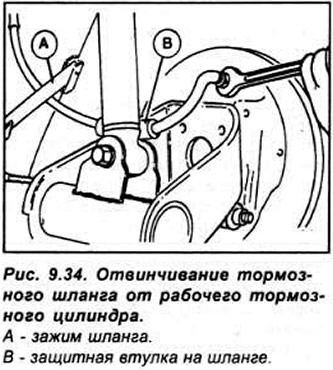
Unscrew the 2 bolts securing the brake cylinder to the shield.
Remove the wheel brake cylinder and completely unscrew it from the brake hose. Close the hose with a plug to prevent loss of brake fluid and dirt from entering.
Disassembly
If the wheel brake cylinder is not to be replaced, it can be disassembled in the installed state. The brake shoes must first be removed. The brake cylinder must be replaced if the piston in the cylinder has difficulty moving or if there are grooves and corrosion. In one of these cases, the wheels either do not brake or are constantly braked.
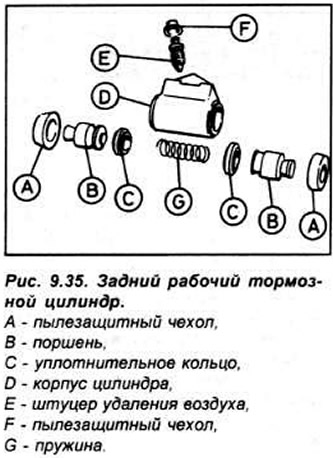
Clean the outside of the brake cylinder. Remove the dust boots from each end of the cylinder.
Remove both pistons with sealing rings from the brake cylinder.
Remove the spring from the brake cylinder and wash the parts in clean brake fluid. Check the condition of the pistons and brake cylinder for wear, corrosion and other defects.
Install the sealing rings on the piston so that the sealing lips face the direction of brake fluid pressure.
Insert the left piston into the wheel cylinder.
Insert the spring on the right, unscrew the bleed nipple and insert the second piston.
Install the dust caps.
Installation
Wipe the brake shield and remove the plug from the brake hose. Screw the brake cylinder onto the brake hose and install the cylinder on the brake shield. Secure the cylinder with bolts. Install the brake shoes and brake drum.
Remove the clamp from the brake hose. Remove air from the brake system. In this case, as a rule, it is enough to bleed only the cylinder where it was replaced. Press the brake pedal hard several times to adjust the rear brakes.