Fuses
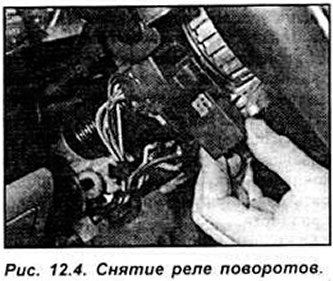
The main fuses, relays and timers are located in the central electrical box, located under the instrument panel on the driver's side. Additional fuses are located in the box in front of the battery (see Fig. 12.1). The fuses can be inspected and, if necessary, replaced by opening the box cover. The location of the fuses and relays is shown on the box cover. Each fuse is labeled with the amount of current it can pass through.
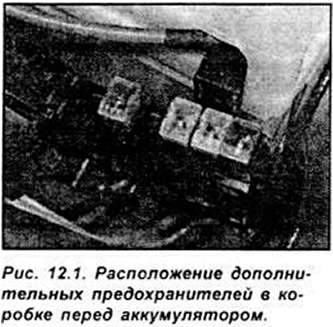
To blow a fuse, use the tweezers located on the cover to remove the fuse from the socket. Remove the fuse from the tweezers. The wire inside the fuse is easily visible and will be severed if the fuse is blown (see Fig. 12.2).
Always replace a fuse with another fuse of the same rating. Never replace a fuse more than once without determining the cause of its blown fuse. The fuse rating is indicated on the box cover.
Relay
A relay is an electronically controlled switch that is typically used as follows:
- a relay can switch high voltage current remotely from the circuit in which that current flows, allowing the use of thinner wires and switch contacts;
- a relay can have more than one control input, unlike a mechanical switch;
- the relay can perform the function of a timer, for example, set the interval of operation of the windshield wipers.
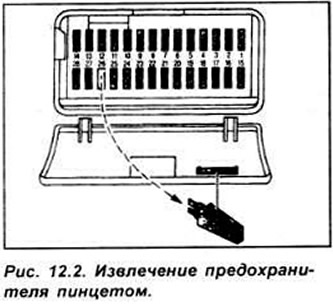
The relays are located on the back of the fuse box. The various relays can be removed by carefully pulling them out of their sockets (see Fig. 12.3).
If a relay-controlled system fails and the relay is probably the cause of the failure, listen to the relay when the system is on. If the relay is functioning properly, you should hear a click when it is turned on. If the relay is functioning properly, the cause of the failure is in the components or connecting wires. If the relay does not function, it means that it is not receiving the main power supply or control pulse, or the relay is faulty.