Operation of the automatic transmission STX
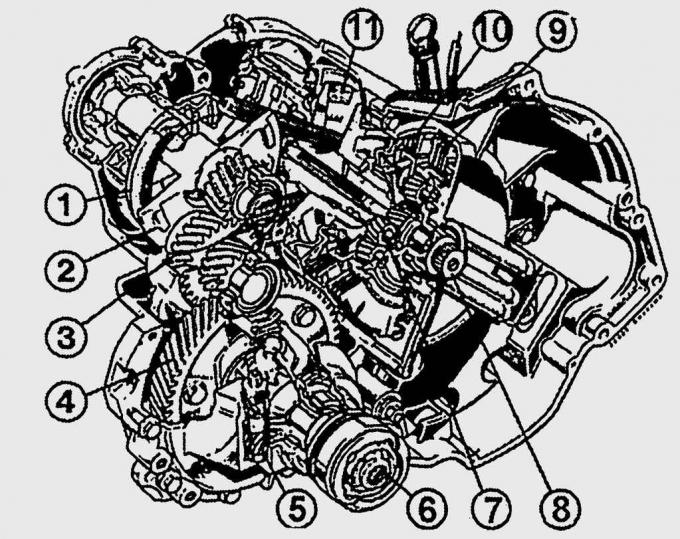
Fig. 12.9. Continuously variable automatic transmission STX: 1 – steel multi-link belt; 2 – a pair of secondary conical discs; 3 – downshift; 4 – compensating gear; 5 – speedometer drive; 6 – main gear; 7 – planetary gear; 8 – drive shaft; 9 – reverse gear clutch; 10 – forward gear clutch; 11 – a pair of primary conical discs
The distinguishing feature of the CTX automatic transmission is its steel multi-link belt: it transmits the force from the engine between two axially adjustable conical disks not by traction, but by sliding (Fig. 12.9). The steel multi-link belt consists of hundreds of high-strength steel links with an extremely wear-resistant surface. The transmission connects the input (primary) shaft of the transmission to the output (secondary) shaft of the transmission, while it moves in conical disks arranged in pairs, one in front of the other (conical disks of the steel chain). Depending on the driving situation, the disks are hydraulically pressed against each other and moved apart. In accordance with pressure differences, the steel belt moves lower into the pair of conical disks of the primary shaft, for example, at the start of the car's movement. Because of this, its radius on the primary shaft becomes smaller, if the belt moves "up" on a pair of conical disks - its radius becomes larger.
How the STX Automatic Transmission Changes Gear Ratios
1. The small radius of the belt on the primary conical discs and the large radius of the belt on the secondary conical discs ultimately result in the maximum gear ratio required for smooth starting of the vehicle.
2. The large belt radius on the primary conical discs and the small belt radius on the secondary conical discs result in a minimum gear ratio that provides optimum engine speed for highway driving.
3. An infinite number of gear ratios are possible within the range of these gear ratios. The hydraulic control unit of the STX gearbox automatically selects the gear ratio at which the engine always operates with the best efficiency.
4. The transmission of torque when starting off is transmitted by a hydraulic multi-plate clutch. As in all existing automatic transmissions, it creates a tendency to creep/slow running. As soon as the engine crankshaft increases the rotation speed, the clutch disengages and further drive is carried out without jerks in the conical disk system.
5. For forward and reverse movement, a single-stage planetary gear is located between the engine flywheel and the conical disc system. Depending on the position of the gear selector lever, it determines the direction of movement.
6. When moving forward, the "forward clutch" is connected to the force closure of the planetary gear and the primary shaft. Thus, without mechanical losses, the planetary gear rotates as a single unit.
7. When reversing, the "reverse clutch" is engaged with a force lock, it securely fixes the wheel with the internal teeth of the planetary gear, while the planetary gears rotate the sun wheel located on the shaft of the primary conical disks in the direction of rotation of the reverse gear.

PRACTICAL TIPS
Features of operation of the automatic transmission STX Fiesta
Never start the engine with the gearbox without working fluid after repairs - the steel multi-link belt and conical disks will move dry, which will lead to their intensive wear. If the battery of the Fiesta with the automatic transmission CTX is discharged, it is impossible to start the engine by towing the car: when the engine is not running, the hydraulic clutch does not connect the crankshaft of the engine to the gearbox. The engine can only be started from the battery of another car. Therefore, there should always be a set of wires in the trunk.
When towing, first set the selector lever to the "N" position
If you need to tow a Fiesta with an automatic transmission CTX, be sure to set the selector lever to the "N" position, the maximum towing speed should not exceed 50 km / h. Cars with an automatic transmission cannot be towed for a distance of more than 80-100 km, since the drive lubrication is insufficient. In doubtful cases, it is necessary to transport the car on a platform.
[The original source of this article can be found at FordBook.ru]