Contents: Gearboxes of types G and N ↳ MT75 gearbox ↳
The vehicles described in this manual are equipped with either a 4-/5-speed manual or a 4-speed automatic transmission. This section describes manual gearboxes. Automatic transmission service procedures are provided in part B.
There are three types of manual transmission, namely G, N and M175 (see figure 1.2,a,b). An overdrive gear can be installed on the G-type gearbox. On all models, the gearbox is mounted to the rear of the engine. The cardan shaft transmits torque to the rear axle. All types of gearboxes have constant meshing gears.
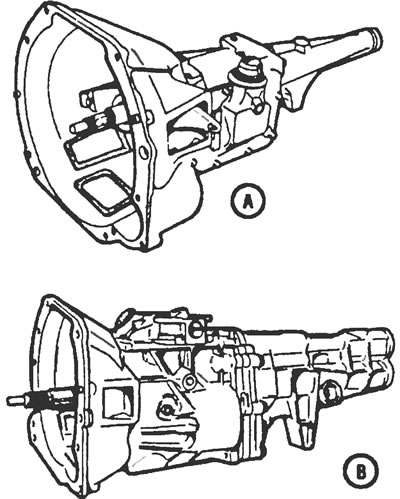
Figure 1.2,a. Type G and type N gearboxes: A Type G, B Type N.
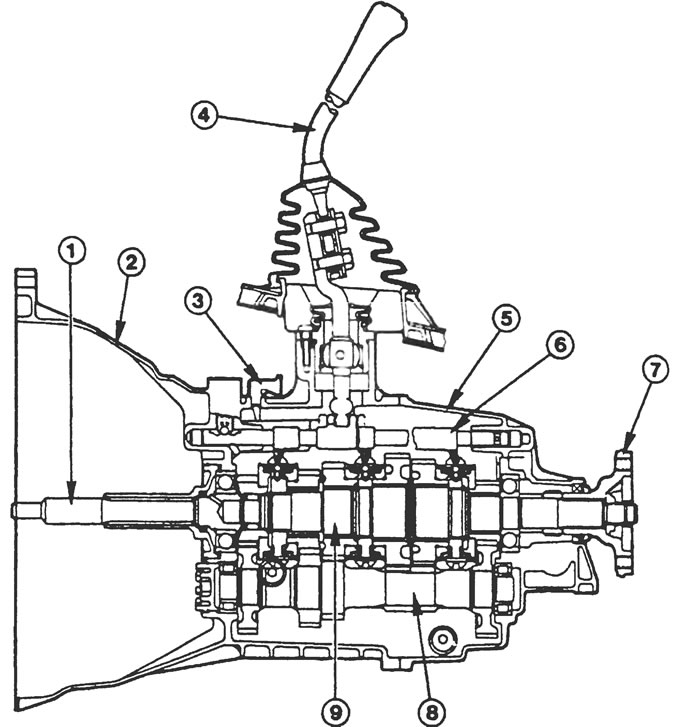
Figure 1.2,b. MT75 gearbox: 1. Drive shaft, 2. Clutch housing, 3. Breather, 4. Gear shift lever, 5. Rear housing, 6. Gear shift rods, 7. Drive shaft flange, 8. Intermediate shaft gear block, 9. Driven shaft.
Gearboxes of types G and N
In these types of gearboxes, all forward gears are synchronized. All forward gears have helical toothed gears, while the reverse gear has straight toothed gears.
The clutch housing, gearshift housing (on type G) and extension are bolted to the main gearbox housing.
The primary shaft and secondary shaft are engaged and rotate on ball bearings. The secondary shaft sleeve rotates in needle bearings, just like the intermediate shaft gears.
The synchronizers are equipped with conical locking rings and locking pins and operate on the principle of engagement with the conical surfaces of the gears. When the gear is engaged, the synchronizer sleeve presses the locking ring against the conical surface of the gear with three spring-loaded locking pins. The pressure of the locking ring causes the gear to rotate at the speed of the synchronizer, and at this moment the further movement of the sleeve engages the sleeve, the locking ring and the gear teeth into a single block.
Reverse gear is engaged by moving the intermediate reverse gear pinion into engagement with the intermediate shaft pinion and the 1st and 2nd gear synchronizer teeth.
The G-type gearbox uses a three-rod gear selector mechanism. The rods are located in the crankcase and move in accordance with the movement of the gear shift lever. The gear shift forks are mounted directly on the rods and drive the gears.
The N-type gearbox uses a single-rod gear selector mechanism.
MT75 gearbox
The MT75 gearbox was first introduced at the end of 1988. Its designation MT75 comes from the words "Manual Transmission" (translated from English as "mechanical gearbox") and the distance between the shaft axes (75 mm).
The gearbox is a constant mesh type and has five forward gears and one reverse gear. The primary and secondary shafts are engaged and rotate on ball bearings mounted in the front and rear gearbox housings. The secondary shaft sleeve, intermediate shaft gears and secondary shaft gears rotate in needle bearings. Synchronizers have conical locking rings and locking pins and operate on the principle of engagement with the conical surfaces of gears (as with other types).
The gear shift lever is mounted on the top of the gearbox and interacts directly with the gear shift forks.
The gearbox housing consists of two halves: the front, which includes the clutch housing, and the rear, which contains the main components and gear shift gears.
(The original can be found on this resource: «FordBook.ru»)