Two different axle types are used on diesel Transit vehicles: the "H" and "G" axles. The "H" axle uses a single version (Type 34), while the "G" axles have three different versions (type 51, 51A and 53). Differences in the timing of routine and major repairs for these axle versions depend primarily on the design of the rear hub assembly. The external appearance of the bridges of type "H" and "G" is shown in the figure 7.2.
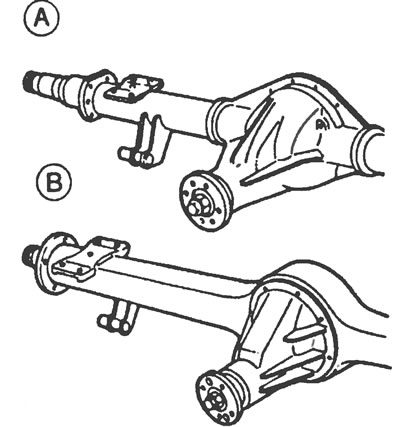
Figure 7.2. External appearance of the rear axles: A - Bridge type "G"; B - Bridge type "H".
The G-type axles are equipped with a fully unloaded Salisbury type differential, mounted directly into the drive axle housing; it can be accessed through the rear inspection cover (see Figure 7.3).
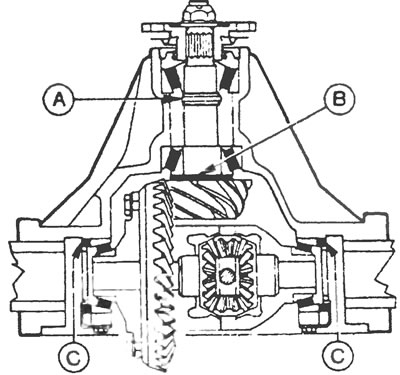
Figure 7.3. Type "G" bridge in section: A - Bushing, B - Pinion Adjusting Shim, C - Bearing Adjusting Nuts
On the "H" type axles (Timken) there is a differential, unloaded by 3/4 and attached with bolts to its own housing, which, in turn, is attached to the front side of the axle housing (see figure 7.4).
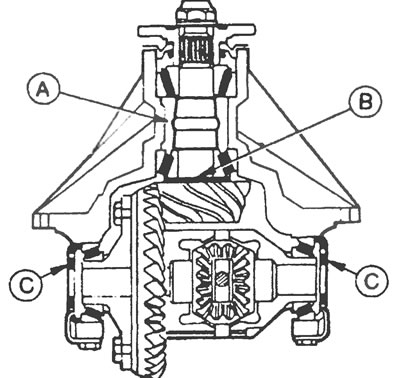
Figure 7.4. Type "H" bridge in section: A - Bushing, B - Pinion adjustment shim, C - Bearing adjustment nuts.
On all bridges, a deformable bushing is used as a bearing spacer sleeve. Special care must be taken when replacing the gear seal to avoid overtightening the flange retaining nut and damaging the bushing, which could interfere with the installation of the drive and driven gears.
The differential rotates in tapered roller bearings, the adjustment of which depends on the type of axle. On the "H" type bridge, adjustment is performed using adjusting nuts on the differential housing. On the G-type bridge, adjustment is made using adjusting nuts on the bridge housing.
The design of the wheel hub depends significantly on the type of axle and the model of the car. On the "H" type axle, the wheel hub is supported by a double ball bearing (see Figure 7.7,a). On the G-type axles, models 51A and 53, the wheel hub is mounted on two tapered roller bearings, the clearance of which is set by an adjusting nut secured by a locking tongue and locknuts (see Figure 7.7,b). On bridge type "G" mod. 51 (which replaced the Type 51A unit in 1992.) ball bearings are used and the arrangement of this bridge is similar to the "H" type bridge.
On all axle types, the outer hub bearings are lubricated with rear axle oil.
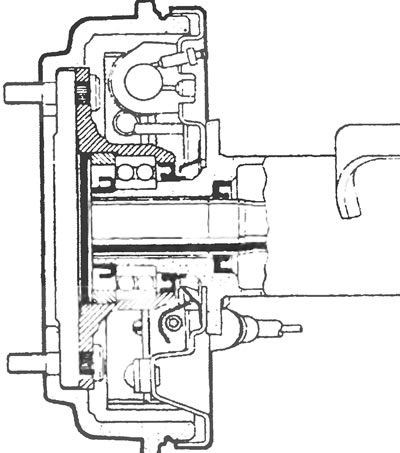
Figure 7.7,a. Hub with bearing on the "H" bridge assembled.
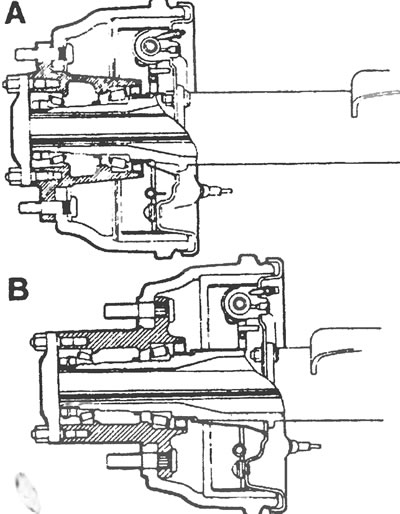
Figure 7.7b. Hub with bearing on bridge "G": A - Bridge mod. 51A, B - Bridge mod. 53.
(This article is a copy from the website: «fordbook.ru»)