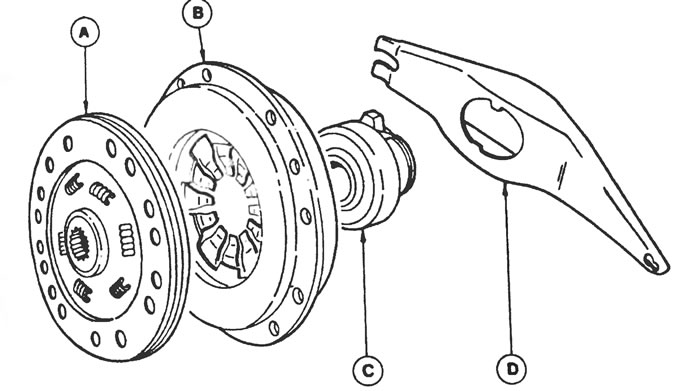
Figure 1.1. Clutch components: A - Clutch slave disc, B - Housing assembly, C - Thrust bearing, D - Release fork.
The clutch disc slides freely on the transmission input shaft and occupies a position between the flywheel and the pressure plate. The disc has friction material linings and a damper, which ensures smooth drive engagement, dampens torsional vibrations and protects against impact loads.
The clutch release mechanism consists of a release fork and a thrust bearing, which is in constant contact with the petals of the diaphragm spring. Pressing the clutch pedal activates the release fork, which, by pressing on the clutch release bearing, overcomes the force of the diaphragm spring, thus moving the center of the spring inward. As the center of the spring moves inward, its outer parts move outward, thus moving the pressure plate and removing it from contact with the driven disk.
When the pedal is released, the elastic force of the diaphragm restores contact between the pressure plate and the friction linings of the clutch disc. Now the driven disk is securely pressed against the flywheel, transmitting all the torque from the engine to the transmission.
Wear of the friction linings is automatically compensated for by a self-tightening mechanism on the clutch pedal. The mechanism consists of a toothed segment, a pawl and a return spring. The toothed segment is free to rotate on the clutch pedal axis, held on one side by the clutch cable and on the other by the return spring. When the pedal is pressed, the pawl comes into contact with the teeth of the segment, thereby locking it and allowing the pedal to pull the cable and control the clutch. When the pedal is released, the return spring rotates the segment relative to the pawl by the amount of wear on the friction linings.
(The original can be found on this resource: www.fordbook.ru)