Basic information
1. Intercooling has been installed on some turbocharged engines since 1997. Before entering the engine, compressed air is cooled in a so-called "air" radiator—this entire process is performed by intercooling.
2. When air coming from the atmosphere is compressed, it is heated, which causes it to expand. If you cool the air, you can increase the volume of air and increase engine power.
3. Compressed air coming from the turbine goes directly into the intake manifold, but in this case it is pre-cooled. The intermediate cooling radiator is installed in the front part of the engine compartment and is blown by the air flow when driving. Heated air from the turbocharger passes from the bottom up through the intermediate cooling radiator and is cooled by the air flow that passes through the radiator during movement. When the air reaches the top of the radiator, it becomes cool and enters the intake manifold.
Removal
4. Loosen the hose clamps and disconnect the air hoses from the intercooler radiator (see Figure 28.4). If the upper hose needs to be removed completely, first disconnect the connector from the air temperature sensor.
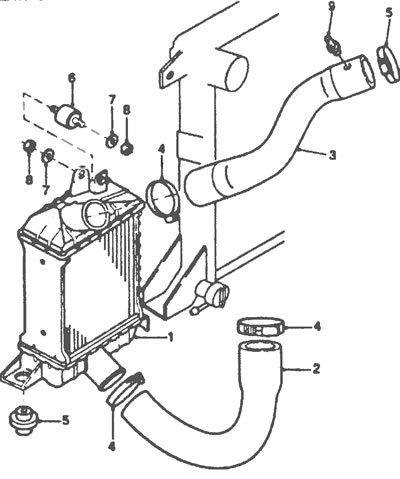
Figure 28.4. Intercooler radiator and its elements: 1. Radiator, 2. Air hose from turbocharger, 3. Air hose to intake manifold, 4. Hose mounting clamp, 5. Lower support, 6. Upper support, 7. Washer, 8. Nut, 9. Air temperature sensor.
5. Supporting the top of the radiator, unscrew the nuts that secure it to the front beam. Remove the washers.
6. Remove the intermediate cooling radiator from its supports and take it out of the engine compartment.
Installation
Installation is carried out in the reverse order of removal, but the following must be taken into account:
- a) Clean the radiator fins, but be careful with your fingers, as the fins are sharp;
- b) Tighten the clamps on the air hoses securely to prevent air leakage.
(For more information, please visit the website: FordBook)