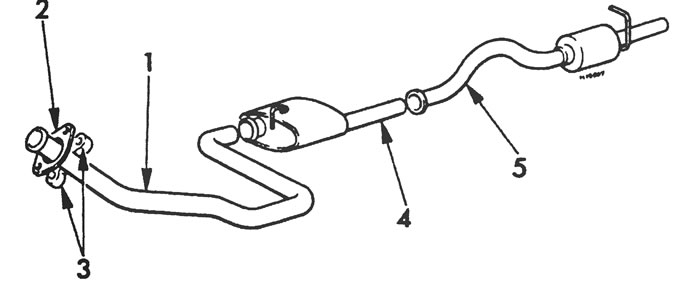
Figure 23.1. Typical exhaust system components: 1. Intake pipe, 2. Flange, 3. Flange nuts, 4. Intermediate muffler, 5. Rear muffler and pipe.
2. Each part of the original system can be removed independently; however, to remove the central sections, it is recommended to remove the entire system to avoid deformation of individual sections.
3. Remove the entire system or part of the system, after jacking up the front or rear of the vehicle (as required) or the entire vehicle if the system needs to be removed completely and place it on supports.
4. Unscrew the nuts from the manifold flange, then lower the muffler outlet pipe and remove the gasket.
5. Disconnect the mounting rubber bushings and completely remove the system from the vehicle.
6. Installation is carried out in the reverse order of removal. Be sure to clean the mating surfaces of the flange and install a new gasket. Tighten the flange nuts to the specified torque.
7. The exhaust system sections are secured with U-shaped clamps or flange connections (see Figure 23.7). To separate the sections, unscrew the flange or U-bolt lock nuts and separate the joint. In the case of U-shaped clamps, the sections to be fastened are additionally connected by bushings, and to separate them from each other, either soak them in sealing oil and then grab and pull them out individually, or insert a screwdriver into the joint and spread the sections apart, or cut the joint with a hacksaw.
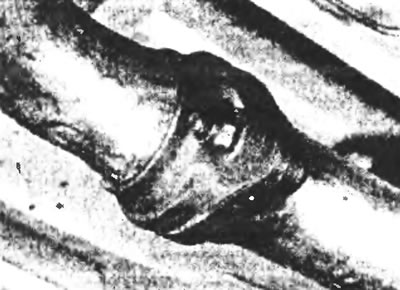
Figure 23.7. Flange connection of the exhaust system.
8. Some models are initially equipped with long sections that can be replaced as two or more separate individual sections during repair. In this case, it is necessary to purchase a new section, then cut off part of the original long section to accommodate the replacement. Connect the new section to the old one using a bushing and clamp with a U-clamp. Reduce the length of the original section if necessary using a hacksaw.
9. When joining sections, use a suitable jointing compound. For U-clamps, delay fully tightening the connections (articulations, joints), until the system is fully installed so that any adjustment of the front or rear sections can be made.
10. Where a catalytic converter is installed, the mounting rubber bushings are made of a different material, adapted to the high temperatures of the catalytic converter. Make sure the fasteners you use are correct for the system type.