The three main body types are Bus (minibus), Van (van) and Chassis Cab (pickup truck with a cargo platform). Double rear doors or a tailgate are provided, and some models have a side sliding door (or doors). The body has aerodynamic contours that save fuel and reduce noise when driving.
During the assembly of the car, the body is carefully prepared for painting, treated with zinc phosphate and polyester primer, after which it is thoroughly dried in an oven, and then coated with enamel in two layers. To prevent corrosion, paraffin is injected into the internal closed cavities.
The front seats are equipped with inertia-reel seat belts, which in recent cars are equipped with an automatic tensioning mechanism (see figure 1.4). In a severe frontal collision, the spring-loaded mass sensor releases the coil spring, which pulls the seat belt buckle down and locks the seat belt. Once triggered, the tensioning mechanism fails and must be replaced.
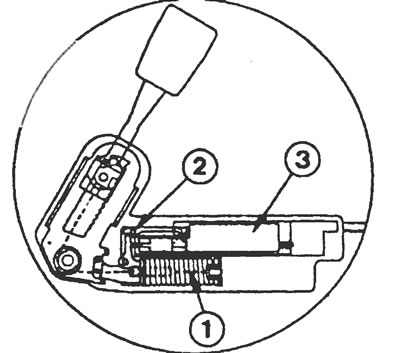
Figure 1.4. Automatic seat belt tensioner mechanism: 1. Coil spring; 2. Lever system; 3. Inertial mass sensor
Due to the large number of different specialized Ford Transit models, this chapter provides information only on the most common and frequently encountered models. Specialized models are not considered here.