Install the water pump with a new gasket.
Connect the flexible hoses of the cooling system. The white line on the hose should match the lug on the coolant pump nipple.
Screw the spacers into the pump body using Loctite 242.
Install the timing belt tensioner, compress it fully, and then wedge it firmly.
Check if the piston of the first cylinder is set to TDC.
Loosen the camshaft belt pulley.
Install the camshaft and fuel injection pump dowel pins.
Install the intermediate wheel.
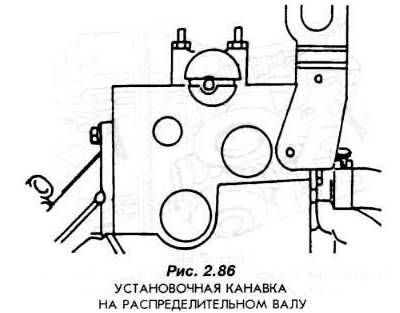
Install the timing belt so that the tensioner rod is taut and the groove on the end of the camshaft is in the correct position (Fig. 2.86).
Loosen the locking bolt, which will cause the tensioner to rest against the timing belt.
Secure the tensioner with the mounting bolt.
Secure the camshaft belt pulley.
Remove the dowel pins.
Adjust the timing belt tension as described below. Turn the crankshaft two times in the direction of rotation while the engine is running. Turn the crankshaft again until the injection pump shaft has turned 15°.
Loosen the bolts securing the belt pulley to the camshaft.
Loosen the tensioner and eliminate the gap (slack) in the timing belt.
Tighten the tensioner to a torque of 50 Nm.
Screw the dowel pin into the engine housing and set the piston of the first cylinder to TDC.
Check the relative position of the camshaft and the injection pump shaft using the dowel pins.
If the shafts are installed correctly, secure the camshaft drive belt pulley with bolts.
Secure the top belt cover.
Install a suction noise muffler.
Raise the car.
Secure the lower belt cover.
Install and tension the alternator drive V-belt. The belt tensioner rod should deflect 4 mm under thumb pressure.
Install the generator casing.
Lower the car onto its wheels.
Fill the cooling system with liquid, pouring it gradually through the expansion tank. The liquid level should reach the "MAX" sign located on the wall of the expansion tank.
Connect the battery to the vehicle's electrical system.
Unscrew the bleed screw on the upper flexible hose connected to the radiator.
Start the engine and warm it up to normal temperature.
The upper hose of the cooling system, on which the bleed nipple is located, should be hot.
Screw in the bleeder screw and, if necessary, after the engine has cooled down, bring the coolant level in the expansion tank to normal.