The vacuum booster, located between the master cylinder and the engine compartment bulkhead, reduces the pedal pressure force required to operate the brake. If this unit is damaged for any reason, the brakes will still work, but the effort required to press the pedal will increase. The vacuum pump is mounted on the rear of the alternator and, powered by the alternator, creates the vacuum needed to operate the booster.
The rear brake hydraulic circuit includes, depending on the model, either brake pressure control valves or a load distribution valve (LAV). These valves regulate the braking force at each rear wheel to reduce the risk of rear wheel lockup during braking.
Models produced before 1992 have non-ventilated front brake discs, while later models have ventilated ones. Cars with non-ventilated front discs and independent front suspension have two-piston floating brake calipers, while models with dependent front suspension have either two- or four-piston rigidly mounted brake calipers with pistons mounted opposite each other (see figure 1.4, a, b). Later models with ventilated front brake discs have a modernized twin-piston floating caliper.
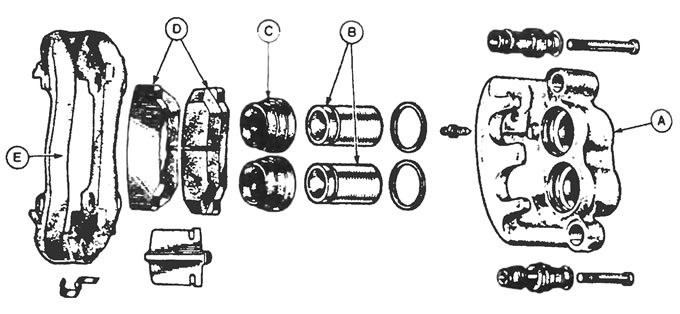
Figure 1.4,a. Detailed view of the old type of floating caliper with two pistons: A - Caliper, B - Pistons, C - Dust caps, D - Brake pads, E - Pad guides.
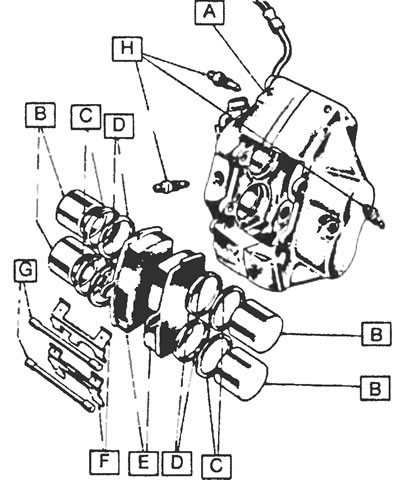
Figure 1.4,b. Detailed view of the caliper with four pistons installed opposite each other: A - Caliper, B - Pistons, C - Seals, D - Seal retainers, E - Brake pads, F - Noise retainers, G - Pins, H - Bleed nipples.
The rear drum brakes incorporate brake shoes that are actuated by dual-piston wheel cylinders. The rear brakes have an adjustment mechanism that automatically compensates for wear on the rear brake pad friction linings each time the foot brake pedal is pressed.
The parking brake only applies to the rear brakes. Some models are equipped with an anti-lock braking system (ABS), many of whose components are similar to those found in a conventional braking system. You will find more detailed information about the ABS system at the end of this Chapter.
Content was created using data from this website (Fordbook.ru)